


Older listeners · ages 9–12 · comfortable from 8 with a grown-up · Retold from the Panchatantra
A heads-up: a king sentences the story’s kind man to death by mistake, and a snake bites a queen to save him — both are put right by the end, but they happen.
Reading aloud? A note for you
Slow down at the well itself — four voices, one after another, is a lot to hold, so give each animal its own beat before moving to the next. Your listener may well ask why the Brahman pulls the man out after being told twice not to; that’s the story’s real question, and it’s fine to let it sit unanswered rather than explain it for them. The death sentence and the snakebite are both stated plainly and both resolved within a page or two — if your child startles at “put to death at dawn,” you can reassure them in the moment that this story turns around fast. In the old telling, the tiger says outright that he killed the prince himself and boasts of it as a favour; here we only say the prince had died in the forest, without saying whose doing it was.
Leo and Mira were mid-argument over a card game’s rules. “You can too skip a turn,” Leo insisted. “You made that up,” Mira shot back, unconvinced. Neither showed any sign of backing down before Nani called them over. Bupam, uninvited, headbutted Nani’s hand until she gave in and scratched behind his ears.
“You’re quiet tonight,” Nani said to Dev, who had sat a little apart from the argument.
“I’m listening already,” he said, and that made Leo laugh so hard he forgot what he’d been arguing about.
“This is the story a jackal named Damanaka told a lion named Pingalaka, in the middle of turning the lion’s heart against a friend of his — an old, sly use for a story. But the story itself is honest. It’s about a man who was warned, more than once, by creatures wiser than he knew, and about what it costs to wave a true warning away.”
“Listen.” And she began.
In a certain town there lived a Brahman who had nothing to his name but a wife, some children, and an empty cooking-pot. His wife scolded him for it every single day — go, she said, go somewhere, anywhere, and find some way to feed these children, and don’t you dare come back until you have. So one morning, more weary of her voice than he was afraid of the open road, he left the town behind him and walked on into a great forest.
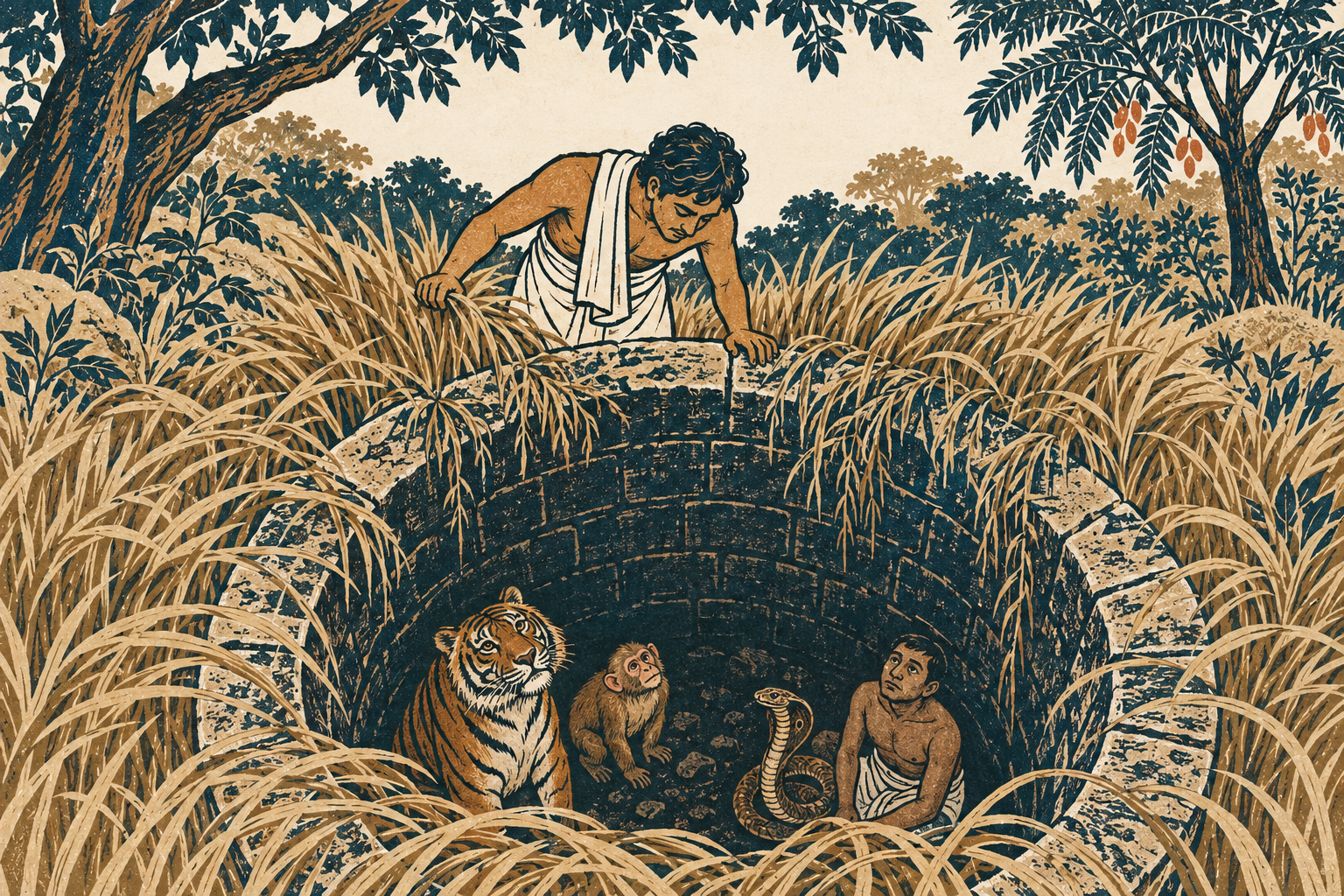
He walked a long way in there, footsore and hungry, looking for nothing more than a place to drink, and at last, well past noon, he spotted a well ahead of him among the trees. Its mouth was so choked with tall grass that he very nearly walked straight past it. He stopped, pushed the grass aside, and looked down over the edge.
Down at the bottom, looking back up at him, were four trapped creatures: a striped tiger, a small quick monkey, a coiled snake, and, apart from the other three, a person.
The tiger spoke first. There is great merit, he said, in saving a life — pull me out, and I will live again among my own kind, my mate, my cubs, my kin. The Brahman said plainly that he was afraid; the very name of a tiger put a shiver through him. But the tiger swore, three times over, that no harm would come to him for it, and weighing the risk against the good, the Brahman decided a kindness was still worth doing, dangerous or not. So, working carefully, he got the tiger up and out onto the grass.
Then the monkey made the same request, and the Brahman freed him too, just as carefully.
Then the snake asked. The Brahman said he feared a snake’s name even more than a tiger’s. But the snake said that snakes do not choose whom they bite — they are only ever obeying — and he too swore that the Brahman had nothing to fear from him. So, last of the three animals, the snake came up out of the well as well.
All three, once they were free and standing on the grass, turned serious. Don’t pull out the man, they told him. Whatever else you do today, leave him where he is. He is trouble dressed as a person, and you should not trust him.
Then, before they went their ways, the tiger told the Brahman where his den could be found, on the far side of a certain hill, and asked him to visit, so that the debt of his rescue could be properly repaid. The monkey said the same, and told him where his home was, near a waterfall. The snake only said: if you are ever in danger, think of me.
And they went.
But the man at the bottom kept calling up, again and again, until eventually the Brahman’s better nature — or perhaps his worse judgment — got the upper hand. He is a person, just as I am, the Brahman thought, and he could not bring himself to leave him down there. So, against everything the three animals had told him, he brought the man up out of the well too.
The man said he was a goldsmith, and gave the name of the town where he could be found, and told the Brahman that if he ever had gold that needed shaping into ornaments, he should bring it there.
The Brahman went on his way, but found nothing in the forest worth bringing home. On his walk back he remembered the monkey’s invitation, and turned aside to visit him, and was given fruit so sweet it put strength back into his legs. From there, at his own asking, the monkey walked him on to the tiger’s den and made the introduction.
The tiger knew him at once, and to repay the kindness done him, gave the Brahman a set of gold ornaments — fine work, a necklace among them — that had belonged to a prince who had died in that same forest, alone, far from home.
The Brahman, thinking of nothing but that gold ought to be sold for a fair price, remembered the goldsmith, and carried the ornaments to him.
The goldsmith welcomed him in, gave him water and a seat and food, and asked what he could do for him. The Brahman showed him the gold and asked him to sell it.
But the moment the goldsmith looked closely, he knew that work — his own hands had shaped it, for the prince himself. He asked the Brahman to wait, and went out, and did not come back with a price. He went instead to the king, and laid the gold before him, and said that a Brahman in his house had brought it.
The king, seeing his own son’s ornaments in a stranger’s hands, needed no more proof. He gave the order that the Brahman be seized, and that he be put to death at dawn.
The Brahman, in his fetters, thought at last of the snake — and the snake came, exactly as promised, and asked how he could help.
I will sink my fangs into the queen, the snake said. No remedy will touch that poison — only your hand, laid on her, will draw it out. Once you have made her well, you will be set free.
And so it happened just that way: the queen was bitten, and nobody in the whole palace could reach her, not the healers, not the wise men who were sent for in a hurry, not any medicine that anyone tried. In the end, desperate, the king’s people called out that whoever could save her would have whatever they asked for. And the Brahman, still bound, said that he was the one who could.
They freed him on the spot and brought him to her, and by the touch of his hand alone, the poison left her, and she lived.
The king, overjoyed and ashamed in the same breath, asked the Brahman to tell him the plain truth of where the gold had come from. And the Brahman told him everything, start to finish — the well, the four voices calling up out of it, the tiger’s den, the goldsmith’s silence, all of it — and left nothing out.
Hearing the whole of it, the king had the goldsmith arrested on the spot, and gave the Brahman land, a household, and a place at his own right hand as counsellor, for the rest of his long and comfortable days.
And that, Damanaka told Pingalaka, was the whole of it: three wild creatures, a tiger and a monkey and a snake, had each warned that kind man plainly, in his own hearing, and he had not listened to a single one of them — and it had very nearly cost him everything he had, and everyone he loved.
Here, under our tree, nobody spoke for a moment. Then Leo said, “But it turned out fine.”
“It did,” said Nani. “This time.”
Mira had gone back to her cards, sorting them by suit without really looking at them.
Dev, who hadn’t spoken since the story ended, only nodded once and let it go at that.
For the grown-up (not read aloud): the heart of it — the animals warned him plainly, more than once, and he didn’t listen, and it nearly cost him everything.
Where it comes from: retold from the Panchatantra (the man pulled from the well who forgot the ones who saved him, Book 1), freely reshaped.
More stories for ages 9–12
The Light That Wasn’t Fire · The Owl Who Cried at Dawn · Buried Between Friends · The Parrot Who Edged Away · The Trail of Fish · The Servant’s Two Mutterings
 Banyan Story Studio