


Older listeners · ages 9–12 · comfortable from 8 with a grown-up · Retold from the Panchatantra
Reading aloud? A note for you
This is a story about how quickly a good name can be taken away, and how strangely it gets given back. There’s no danger in it, and nothing to brace for — it’s really a story about listening carefully to what people say, and about how one unfair moment can be put right by a second, ridiculous one. Slow down at the two mutterings: it matters that the first one is believed and the second one isn’t, and your listener may want to stop and puzzle out why. A child may ask why the king believed the first lie at all — that’s worth sitting with rather than rushing past. We’ve kept the old telling’s plot exactly, but softened the details: the original has an unkind joke and an accusation that don’t belong in a children’s story, so here the two mutterings are simply “a lie” and “something silly,” with no particulars given, and the merchant is turned away rather than struck.
A vegetable-seller’s cart was still creaking somewhere down the lane, his call rising and falling, and half the words reached the banyan garbled beyond telling — enough that Leo had spent the walk over insisting the man was shouting something about a lost goat, and Mira insisting just as firmly that he wasn’t. They were still arguing about it, mildly, when they sat. Dev, who had been trailing behind the whole way, took a side only once he’d sat down — and even then it was just to listen to the last of the cart’s wheels fade rather than to either of them.
“Tonight,” Nani said, “is a story that Damanaka the jackal tells, in the big tale — he tells it to win the bull’s trust, right after he’s led him to the lion. He tells it to make a point: that even the smallest, humblest servant of a house is owed some honour. And what he means by that, underneath, is himself.” She let that sit a moment, half a smile at the corner of her mouth. “It’s a story about a merchant who forgot that rule for one careless moment — and about how much trouble a forgotten servant can make, once he decides to.”
“Listen.”
There was once a city called Vardhamana, home to a merchant named Dantila, who managed the city’s business and the king’s business both — which is a harder job than it sounds, since the two are forever pulling in different directions, and a man who pleases one side is generally accused by the other. Dantila managed it so well that for a long time everyone, high and low, was satisfied with him.
When his daughter was married, Dantila held a wedding for the whole city, and invited the king’s household besides, and gave gifts and honour to everyone who came. Among the king’s household that day was a servant whose task it was to sweep the king’s rooms — a man named Gorambha. At the wedding, in front of the king’s own chaplain, Gorambha sat down in a seat that was not his to sit in. Dantila, seeing it, sent him away.
It was a small thing to Dantila, and he forgot it by morning. Gorambha did not. The shame of being sent off in front of everyone stayed with him, and though he told himself there was nothing he could do about it — he was, after all, only a servant, and Dantila was a man the whole city depended on — the hurt of it kept him up at night all the same.
Then, one morning, while Gorambha swept near the king’s bed, with the king drowsy but not quite asleep, Gorambha muttered — as if to himself, as if he thought no one could hear — a lie about Dantila. Something wicked. Something that was not true at all.
The king came awake at once. “What’s that? What did you say?”
Gorambha startled, and bowed, and said he’d been half asleep at his sweeping and could not say what he might have mumbled — he hadn’t slept well, he didn’t know what foolishness had come out of him.
But the king could not put it out of his mind. A servant who sweeps a room hears and sees a great deal that no one thinks to hide from him. What if it were true? The king turned the lie over and over until it had worn a groove in his thinking, and by the end of it his trust in Dantila had worn away with it. He said nothing to Dantila directly. He simply stopped calling for him, stopped inviting him to court, and let his favour cool without ever saying why.
Dantila felt the change at once — a door that used to open for him no longer did — and could not think what he had done. He turned over every meeting, every piece of advice he’d given, and found nothing in any of it that could explain the king’s coldness. It troubled him badly, because he had never, as far as he knew, brought harm to the king, or to anyone in his household, by word or deed.
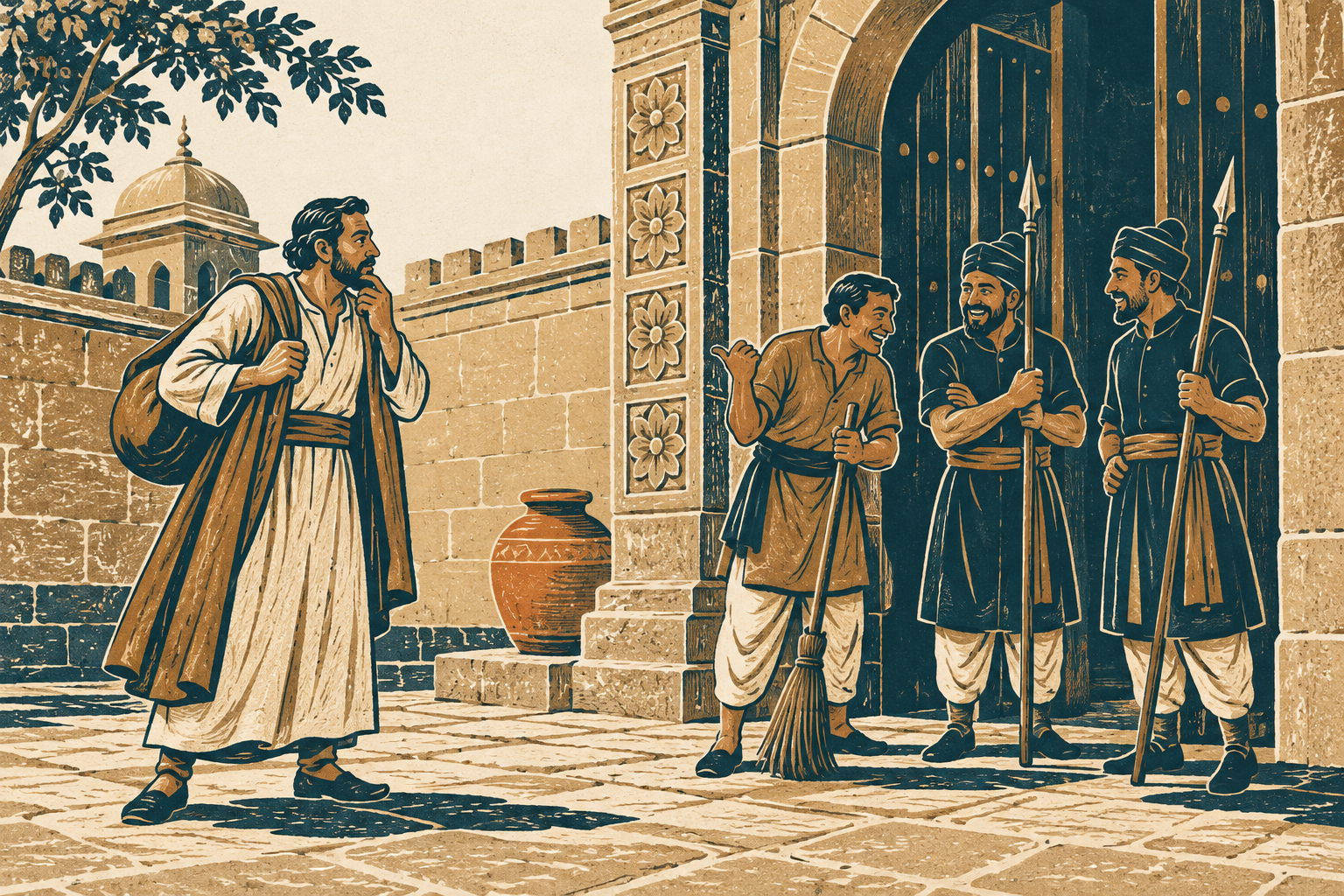
Then one day, refused at the palace gate once again, he heard Gorambha laughing to the doorkeepers close by. “Careful how you treat this one,” Gorambha was saying, nodding at Dantila. “He used to be somebody, before the king soured on him. Turn him away and see if it matters now.”
And hearing that, Dantila understood everything at once. It was Gorambha. Of course it was Gorambha — the very servant he’d sent from the wedding, all those months ago, without a second thought.
Dantila went home troubled and ashamed of himself, because whatever Gorambha had done, Dantila could see now that he himself had started it, by treating a small servant as if he mattered nothing at all. That evening he sent for Gorambha, gave him gifts of good cloth, and said plainly: “I didn’t have you sent away by the king’s order. It was my own doing, because I saw you sitting somewhere you shouldn’t have, in front of the chaplain, and I was ashamed on your behalf as much as my own. I’m sorry for the harm it’s brought you.”
Gorambha took the gifts gladly — more gladly, in fact, than the gifts alone were worth, because what he wanted most was simply to be treated as if he counted for something — and went off satisfied, telling Dantila he’d see the good of it returned to him soon.
And the very next morning, sweeping again near the king’s bed, with the king still caught between waking and sleep, Gorambha muttered something else. Something about the king himself, this time — something so plainly silly, so obviously untrue, that nobody hearing it could possibly believe it for a moment.
The king sat straight up. “What is this nonsense? What are you saying about me now?”
Gorambha gave the very same answer as before — that he’d slept poorly, that he’d been half asleep at his sweeping, that he couldn’t account for whatever had come out of him — and the king, turning the words over, realised how completely impossible they were. Nothing of the kind had ever happened, not once, not in all his years. And if this servant could mutter something so far from the truth about the king himself, in that same half-waking way — then surely the first thing he’d muttered, the thing about Dantila, had been no truer. It had simply been the mumbling of a man not fully awake, taken far too seriously by a king who ought to have known better.
So the king called for Dantila that same day, gave him gifts to make up for the months of coldness, and brought him fully back into his favour. He had learned, as even a great merchant can, what it costs a proud man to slight the humblest servant of a house — for it was very nearly his own place he had lost by it.
Here, under our tree, Bupam had found a fallen fig and was working on it with great seriousness.
Leo shook his head slowly. “So Gorambha — he got Dantila in trouble on purpose. And then he got him out of it on purpose too?”
“He did,” Nani said. “Once he’d been treated fairly.”
Dev was quiet for a moment, turning it over. “It’s strange that the same person could do both.”
“It is,” said Nani.
Somewhere down the lane, the cart-seller’s call had long since faded into nothing, and nobody said anything more.
For the grown-up (not read aloud): the heart of it — treat even the humblest person in your household carelessly, and you may find you’ve made a much larger problem for yourself than you meant to.
Where it comes from: retold from the Panchatantra (the merchant and the servant’s two mutterings, Book 1).
More stories for older listeners
The Jackal’s Two Lies · The Treasure He Would Not Set Down · The Crab Who Looked Down · Three Warnings · The Light That Wasn’t Fire · The Owl Who Cried at Dawn
 Banyan Story Studio