


Older listeners · ages 9–12 · comfortable from 8 with a grown-up · Retold from the Panchatantra
A heads-up: an archer, startled by a night cry, is told to shoot at the sound — and it is the swan, asleep and silent nearby, who lies in the arrow’s path when the story stops. Nothing is shown, and nothing is resolved; a child who needs stories to tie up may find that hard.
Reading aloud? A note for you
This is a short, sober tale, and it earns its weight by staying plain — read it a little slower than a lively one, especially in the last few lines. Your listener may ask what happened to the swan; you can say honestly that the story doesn’t tell us, and that not knowing is part of why it’s remembered. In the old telling, the arrow finds its mark and the swan is named as killed; here the story stops just before that, at the archer taking aim, so nothing is shown or said beyond that moment. If your listener wants to talk about why the owl’s flattery mattered, that’s a good place to linger.
A call came out of the dark trees behind them, low and strange, unlike anything that usually sounded once the sun went down — and all three went still, Leo halfway into sitting down. Above them, Bupam flattened against the bark for a moment before deciding it was nothing. The call didn’t come again, and Leo finished dropping onto the root, a beat late. “What was that?” he asked, not quite steady.
“Something with wings, and nowhere else it wanted to be,” Nani said. “The forest talks to itself at night. Not always to us.”
Mira had already gone back to her notebook, pencil tapping the cover. “I’m keeping a list of who trusts who in these stories,” she said, “and whether they should. So far nobody trusts anybody quite enough — or a great deal too much.”
Dev, settling at Nani’s side, was still looking toward the trees where the call had come from.
“Then tonight’s is for your list,” said Nani. “Sanjivaka told this one to Damanaka, grieving, because he’d seen a false friend bring ruin on somebody who did nothing wrong. It turns on three things: a friend who flatters instead of caring, a harsh voice at the wrong moment, and a thing done in haste that can’t be called back.”
“Listen.” And she began.
Deep in a forest lay a wide, calm lake, ringed with reeds and always busy with wings, and on that lake lived a king among swans — a bird with white, easy feathers and an easier temper, who loved good days and good company and had, as far as he knew, no reason in the world to be careful.
One evening an owl came to him out of the dusk — an owl with smooth words and a smoother manner, all bows and praise, who said he had travelled far and wide across many lands looking for the finest company anywhere to be found, and that his long search had ended here, at last, at this very lake, in the swan.
The swan, who had never in his life had a stranger arrive with quite so much admiration in his voice, was flattered, and pleased, and welcomed him warmly, the way you welcome someone who has said exactly what you wanted to hear. “Stay as long as you like,” the swan said, “and share this lake and this good living with me, as a friend should.” So the two of them fell into each other’s company, day after day, gliding the same waters and trading the same easy talk, and for a while it truly did look like a fine friendship — the kind that seems, from the outside, as though it had always been there.
But before long the owl said he had to be getting back to his own home — a grove some distance off, thick and shadowed with lotus — and before he left he pressed the swan hard for a promise. “If you value me at all,” he said, laying it on the swan the way he laid everything on, “you will not fail to come and visit me there.” And with that, off he went into the dark, leaving the swan alone again with the lake he already knew by heart.
Seasons turned. The swan, who had spent his whole life circling that one stretch of water and had never once seen another corner of the wide world, found himself thinking more and more of his friend’s invitation, and of everything a new place might hold that this old one no longer could. New water, he told himself. New company. New things to eat, and new sights he had never once had reason to imagine. So, in the end, he set out to find the owl and collect on that promise.
It took him a long, tiring search through the lotus grove before he found his friend at all, and when he finally did, the sight gave him pause — for his fine, flattering friend was crouched low in a rough, dark hollow in the riverbank, blinking helplessly and half-blind, for it turns out owls, whatever else they are, cannot bear the plain light of day.
Still, glad simply to have found him after so much searching, the swan called out warmly from outside the hollow. But the owl only answered, in a voice gone flat and irritable now that there was no one else to impress, that he never came out by day, not for anyone — that if the swan wanted him, he would have to wait until the sun had properly gone down.
So the swan settled outside to wait out the whole long, hot afternoon, and when night finally fell and the owl emerged, the two of them talked and caught up as old friends do, trading news of the seasons between them. But the swan, worn thin from his journey and from waiting all that time in the heat, was more tired than he realized, and before long, without quite meaning to, he settled down right there, close by the mouth of the owl’s hollow, and fell fast asleep.
Now, that same night, a large band of traders had made their camp at that very lake, resting their animals before the road ahead. Well before dawn, their leader rose to get the company moving again, and gave the old signal to break camp — one long, clear note blown on a horn, carrying out over the still water.
The sound cut through the dark and startled the owl badly, waking him out of a doze he hadn’t meant to fall into. He let out one harsh, ugly cry — sharper and uglier than he perhaps intended — and scrambled back down into the safety of his hollow, hiding at once from the noise and from the first grey hint of coming light.
To the trading company’s leader, jolted awake by that sudden, raw cry out of the darkness, it sounded like nothing so much as a bad omen — the very kind old travellers warn one another about before they set out on a long and uncertain road. Unsettled, and unwilling to travel under a cry like that, he turned to a bowman in his company, a man well known among them for being able to shoot true by sound alone, with no need to lay eyes on his mark at all, and told him plainly to loose an arrow at the place the cry had come from.
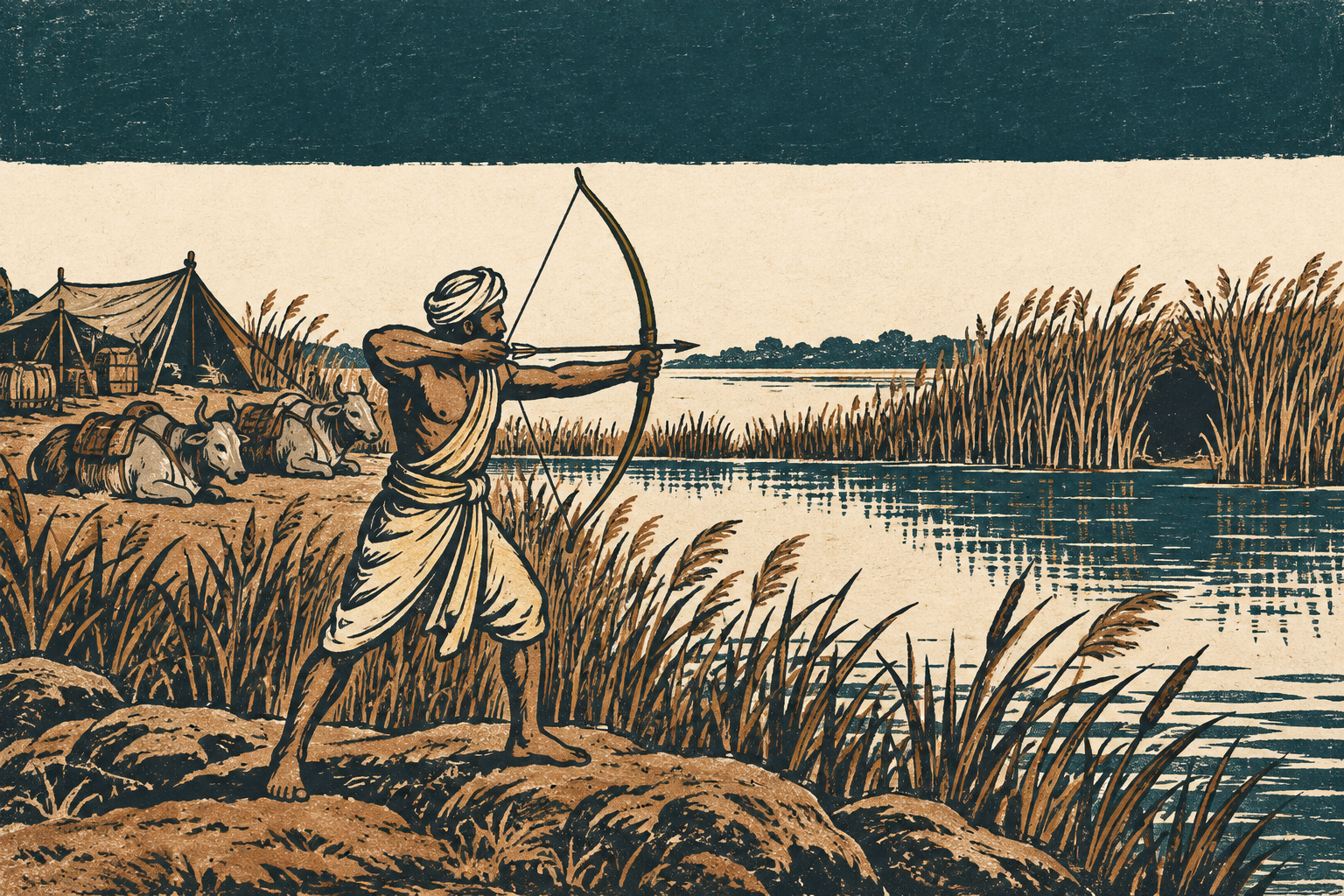
The bowman said nothing, only raised his bow, drew the string back until it touched his ear, and aimed, in the last dark before morning, at the sound alone. And there, close by the mouth of the owl’s hollow, hidden from the bowman’s eyes just as surely as the owl himself was, lay the swan, still fast asleep.
Here, under our tree, for a moment nobody moved.
“It doesn’t say what happened next,” Leo said finally, half a question, half not.
“It doesn’t,” Nani agreed.
Mira closed her notebook without writing anything more.
Dev, who hadn’t said a word all evening, spoke at last, very low. “I don’t think I’d have gone looking for him. Not after that hollow.”
Nani only nodded, and reached over to straighten his sleeve where it had bunched at his wrist, an ordinary thing to do, while the dark trees stayed exactly as quiet as before.
For the grown-up (not read aloud): the heart of it — a false friend, a harsh voice, and a thing done at the wrong moment can each bring ruin down on someone who never did anything wrong.
Where it comes from: retold from the Panchatantra (the swan who went to visit an owl, Book 1), freely reshaped. In the old telling, the story goes one step further and says plainly that the arrow strikes him down; here it stops at the archer’s aim, before that is told.
More stories for ages 9–12
Buried Between Friends · The Parrot Who Edged Away · The Trail of Fish · The Servant’s Two Mutterings · The Jackal’s Two Lies · The Treasure He Would Not Set Down
 Banyan Story Studio