


Older listeners · ages 9–12 · comfortable from 8 with a grown-up · Retold from the Panchatantra
A heads-up: a bystander gets badly burned when a hiding place is set on fire, and the story ends with the court punishing the one who lied.
Reading aloud? A note for you
This is a courtroom story more than an adventure one, so the tension is in the talking, not in chases or fights — slow down for the two speeches the sons give the judges, since that’s where the plan and the trick both live. Your listener may ask why the dishonest son’s own father would agree to hide in a tree for him; there’s no tidy answer in the tale itself, only that a father can be talked into a bad thing by a son he loves, and it costs him. The burning is real but brief and not dwelt on — the story cares more about who ends up honoured than about the injury itself, and your telling can match that. If your listener wants to know exactly what happened to the father afterward, the honest answer is that the story doesn’t say, and that’s all right to say out loud.
The three of them had spent the last hour of daylight playing hide-and-seek in the garden, and Dev arrived last, still brushing dried mud off his elbows from where he’d wedged himself behind the water tank and stayed there far longer than the game required. Leo dropped down beside him, still triumphant about finding him. Mira settled last, straightening her skirt, already asking whether tonight’s story was a long one.
“Long enough,” said Nani. “This is the story Karataka told Damanaka, two jackals who don’t trust each other very much, when Damanaka was busy hatching a scheme of his own. Karataka told it to warn him — that a trick built too cleverly has a way of coming down on the very house that built it.”
Mira frowned, turning that over. Dev, still faintly smelling of tank water, said nothing at all, just listened.
“Listen.” And she began.
In a certain city there lived two young men, sons of merchants, who had grown up as friends. Their families were neither rich nor poor, and when the two of them were old enough, they agreed to travel together to a distant land, the way merchants’ sons often did, to see what fortune they could make of themselves before they came home and settled.
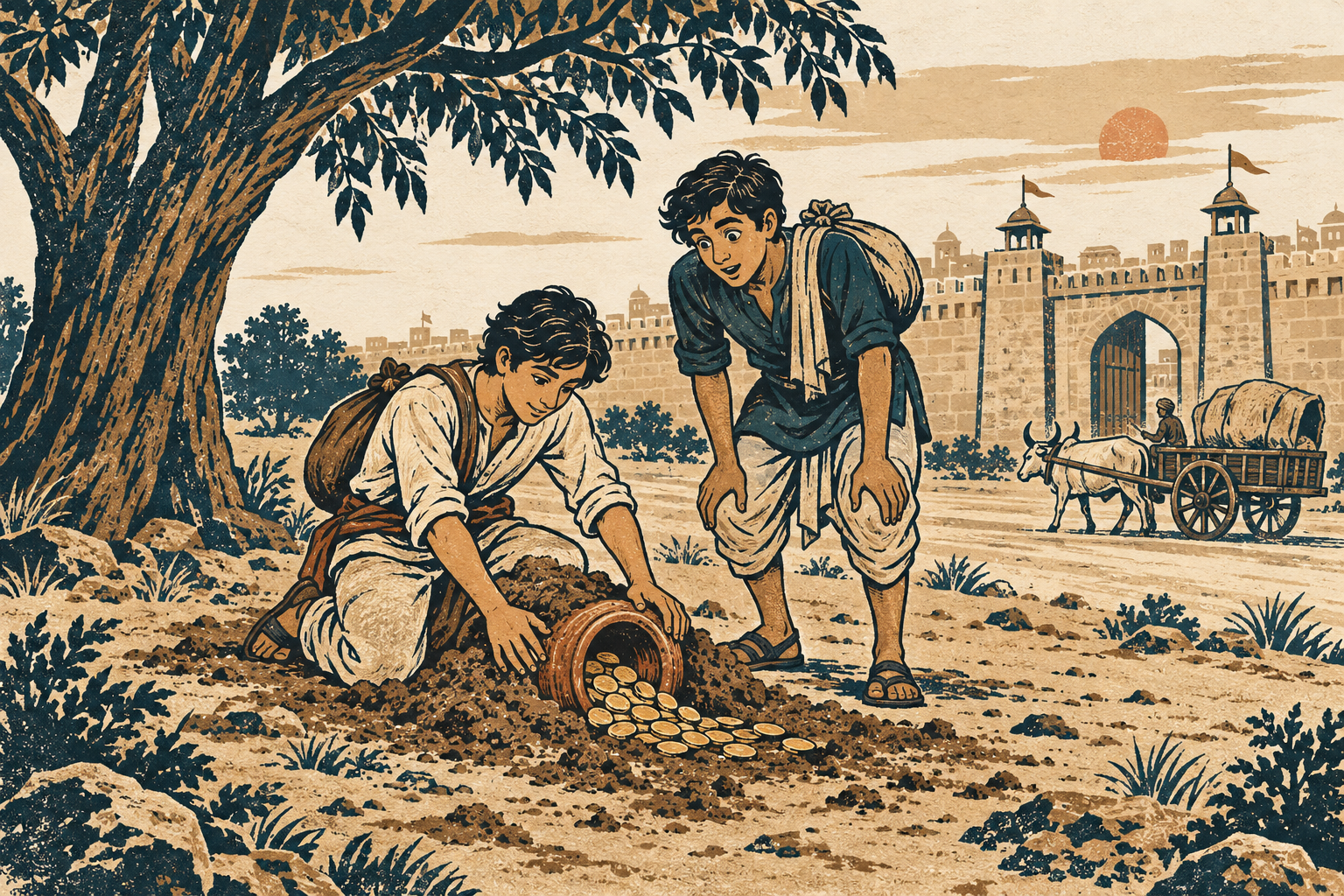
The journey was long, and the work they found there was ordinary — buying and selling, watching prices, waiting for luck. It was on an ordinary walk, across a stretch of open ground outside the town where they were staying, that one of them — his name was Dharmabuddhi — noticed a patch of earth that looked disturbed, as though someone had dug there once and smoothed it over again. Something about it caught his eye enough that he stopped, and dug, and found a buried pot holding a thousand gold coins, left there long before by some traveler none of them would ever know or meet. He didn’t think twice about keeping the good luck to himself. He carried the pot straight to his friend, and the two of them agreed: between what they already had and this besides, they had made the fortune they’d come for. It was time to go home.
As their own city came into view, Dharmabuddhi said, “Half of this is rightly yours. Take it now, so we can walk in with our fortunes made, the two of us together.”
But his friend — his name was Papabuddhi, though nobody called him dishonest yet — had already begun thinking a different kind of thought. “Let’s not divide it all at once,” he said. “While we hold it together, our friendship is proof against every kind of trouble. Let’s each take a hundred now, for our immediate needs, and bury the rest here outside the city until we want it.”
Dharmabuddhi, who judged his friend’s heart by his own, saw nothing strange in this and agreed. They buried the remaining coins together, marked the place in their minds, and each carried a hundred home.
It didn’t take Papabuddhi long to spend his share. When it ran out, he came back to his friend and proposed they divide another hundred each from the buried treasure — and that, too, was gone within the year. A third time he came, and by now a different thought had taken hold of him: if he kept splitting what remained, there would be little enough left for either of them. Better, he decided, to go alone, dig up what was left, and keep the whole of it.
So he went alone, and carried away every coin, smoothing the earth back over the empty hole so no one would know.
A month later he went to his friend and suggested, as if it were his own idea, that the two of them go split what was left between them, as before. They walked out to the spot together and dug — and found nothing. Papabuddhi snatched up the empty pot and cracked it hard against his own skull, then began shouting that his friend had robbed him, and that he would see him brought before the magistrates for it.
“I’ve taken nothing,” said Dharmabuddhi. “You know that isn’t in my nature.” But there was no undoing an accusation once it was made loudly enough, and the two of them carried their quarrel before the city’s judges.
The judges, hearing two men accuse each other with no evidence on either side, were ready to settle it by ordeal, the old way of testing a hard case. But Papabuddhi objected. “An ordeal is a last resort,” he said. “Better evidence exists — a witness. A forest spirit keeps watch near where the money was buried. Let her tell you which of us is telling the truth.” The judges, intrigued at the idea of a witness who could not be bribed or mistaken, agreed to hear the wood-spirit’s testimony the next morning, and sent both young men home on their word to return.
That night Papabuddhi went to his own father and told him the plan. There was a hollow in the old tree that stood by the burial spot; if his father hid inside it before dawn, he could speak from the hollow in the morning as if he were the voice of the wood itself, and swear that Dharmabuddhi was the thief.
His father was troubled by the scheme from the first word of it, and said so plainly. “We would both be lost if this goes wrong,” he told his son, “and a plan like this can go wrong in more ways than the ones you’ve thought of.” He offered his son an old story to make the point — about a heron whose cleverness brought a mongoose right into his own nest — the kind of warning that says: think first about what a plan might cost you, not only about what you want it to win. But Papabuddhi had made up his mind long before he ever asked his father’s opinion, and no story was going to unmake it now. Against his own better judgment, the father let himself be talked into it. That night the son hid him in the hollow of the tree, in the dark, and told him exactly what he was to say when morning came.
In the morning, washed and dressed as though he had nothing to hide, Papabuddhi led Dharmabuddhi and the judges back to the tree. He called out loudly for the spirit of the wood to speak the truth, to say plainly which of the two of them was the thief.
And a voice answered from inside the hollow tree: “It was Dharmabuddhi. He is the thief.”
The judges, astonished to hear a tree itself accuse a man, began to weigh what punishment such a theft deserved.
But Dharmabuddhi had grown up in that country too, and knew something about trees with hollows in them. Without a word of argument, he gathered dry wood and brush from around the tree, piled it against the hollow, and set it alight.
As the flames caught and the old wood began to smoke, a cry came from inside the hollow, and Papabuddhi’s own father stumbled out of the burning tree, badly burned, gasping before he could be asked anything at all: “It was my son. My son put me here. He is the thief.”
The judges heard him, and understood everything at once — the buried money, the false witness, the voice that had never belonged to any forest spirit at all, only to a father his son had put in harm’s way to win a lie. They saw to it that Papabuddhi was punished for what he had done, to his friend and to his own father both, and that Dharmabuddhi had all that was rightly his returned to him, and was honoured besides, in front of the very court that had almost ruled against him.
A trick built to be too clever has a way of turning on the one who built it — that was the whole of what happened to Papabuddhi, who thought a hollow tree could say anything he wanted it to.
Here, under our tree, nobody spoke for a moment.
“His own father,” said Leo finally, shaking his head slowly, like the thought didn’t fit anywhere easy.
Mira was quieter, turning the shape of it over. “The tree didn’t even have to lie for very long,” she said. “Just once. And it was already too much.”
Then Dev — who had said nothing at all through the whole telling — spoke into the dark, low enough that they had to lean in to catch it: “I think the father knew, before he ever climbed in.”
Nani said nothing more, and let the quiet sit there under the leaves with them.
For the grown-up (not read aloud): the heart of it — a trick too clever by half ruins the trickster and everyone he pulls in with him.
Where it comes from: retold from the Panchatantra (buried money and the false witness, Book 1).
More stories for ages 9–12
The Parrot Who Edged Away · The Trail of Fish · The Servant’s Two Mutterings · The Jackal’s Two Lies · The Treasure He Would Not Set Down · The Crab Who Looked Down
 Banyan Story Studio