


Older listeners · ages 9–12 · comfortable from 8 with a grown-up · Retold from the Panchatantra
A heads-up: a beloved creature dies in this story, gently and without violence, and the sadness of it is real — the gods themselves cannot undo it.
Reading aloud? A note for you
This is a short, quiet story about fate, told inside the studio’s frame by a bride explaining to worried relatives why a promise cannot be undone. A parrot dies simply by looking at Death — there is no violence, no chase, no cause to soften, but the sadness is the whole point, so don’t rush past it. Your child may ask why the gods couldn’t just say no to Death, or why they even tried if it wouldn’t work — both are exactly the right questions, and Nani’s closing exchange leaves room for them rather than answering them for you. Let the quiet at the end sit for a moment before you turn the page.
Somewhere down the lane, a wedding drum had been going since mid-afternoon, steady and a little muffled by distance, and it hadn’t let up by the time the three of them settled into the roots. “They’ve been at it for hours,” Leo said, tipping his head toward the sound. “How long does a wedding even take?”
“Long enough that nobody’s counting,” Nani said.
Mira arrived last, still catching her breath, and dropped into her usual spot. “Is the bride from around here?” she asked.
“No,” said Nani. “But that’s not far off from tonight’s story.”
Dev, who had already been there a while, looked up at her before she’d said a word about it. “Is it a sad one tonight?” he asked.
Nani did not pretend otherwise. “A little,” she said. “This is a story a young bride once told her own relatives, on a night not unlike this one — the old ones in her family, who wanted to undo a promise her father had made. She told them this, to help them understand why she would not be moved. It’s about a thing that cannot be changed once it’s fixed — not by wanting to, not by trying, and not even, it turns out, by asking the gods themselves.”
“Listen.” And she began.
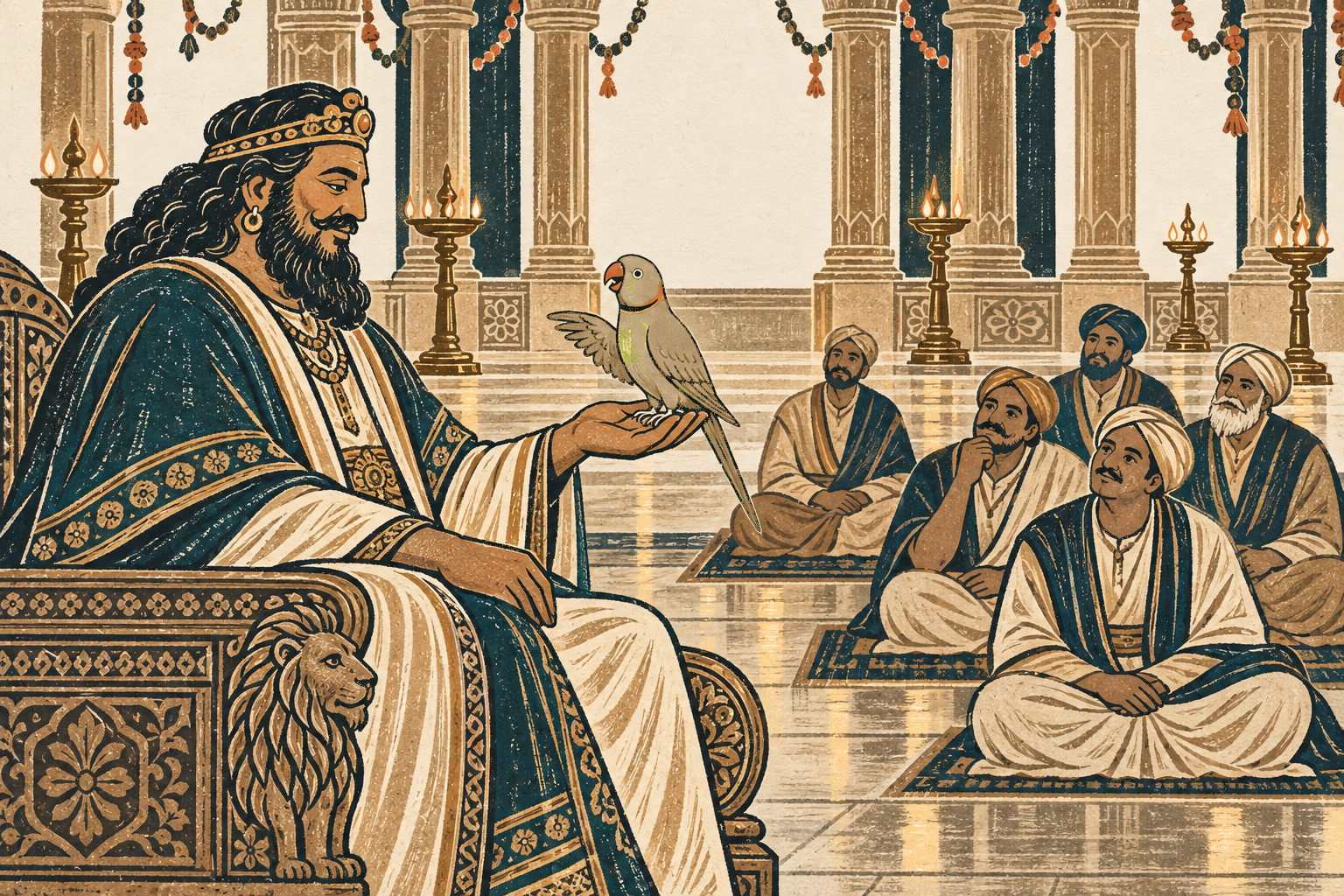
In the high court of heaven, there lived a parrot who belonged to the great god Indra himself. He was, everyone agreed, the loveliest bird anyone there had ever seen — his feathers held every green a leaf could be, and a few no leaf had ever managed — and his mind was as quick as his colours. He knew, by heart, more of the old and honoured sayings than any three gods put together, and he loved nothing better than reciting them out loud, turning each one over like a jewel he was showing off.
His favourite perch was Indra’s own open hand. He would settle there in the middle of the great hall, feel the warmth of that vast palm under his small feet, and let the words come — one grand saying after another, while the gathered gods and sages listened, some amused, some genuinely impressed, none of them bored.
He was in the middle of just such a recitation, one ordinary court day — the hall full of its usual comings and goings, servants crossing with garlands, minor gods trading news in low voices near the pillars — when a new arrival came through the great doors to make his bow to Indra, as every visitor was expected to do at the hour appointed for him.
It was Yama, the lord of the dead, arriving, as he always did, to make his bow to the assembly.
The parrot’s voice caught in the middle of a word. He went perfectly still — and then, without seeming to decide to, he began edging backward along Indra’s palm, wing brushing wing, putting as much distance as a hand’s width allows between himself and the doorway Yama had just come through.
It did not go unnoticed. A bird as bright and as talkative as that one does not fall silent quietly, and half the hall turned to look.
“Why do you shrink away like that?” the gods asked him, more curious than alarmed, at first. “What has that visitor ever done to you?”
The parrot did not have to think about his answer. “He is the one who comes for every living thing, in the end,” he said. “Tell me honestly — would any of you choose to sit close to that, if you had the choosing of it?”
Nobody laughed. His answer had landed somewhere true, and the gods, who were genuinely fond of their clever little courtier, did not like to see him frightened in their own hall. So a number of them went to Yama directly and made a request on the parrot’s behalf — as a favour, they said, to all of them, would he simply leave this one small bird alone?
Yama heard the request out fully, and did not dismiss it unkindly. But he shook his head. “That is not a thing I have the granting of,” he said. “Ask Time. These matters are reckoned by Time, not by me.”
So the whole bright company — gods, sages, and the parrot carried carefully among them — set out to find Time, who does not sit still for anybody and had to be tracked through more than one hall before he was caught up with. When they had him, they laid the same plea before him.
Time only opened his hands, empty, and shook his head in turn. “Nor is it mine to grant,” he said. “Death is the one charged with such things. You will have to ask Death.”
There was nothing to do but go on. Further than any of them had meant to travel that morning — past halls none of the younger gods had ever had cause to visit, into a quiet that grew deeper the further they walked — the whole company came at last before Death, to make their small, hopeful request one final time. Even the bravest among them found themselves walking a little more slowly, that last stretch, though none of them could have said why.
They never finished making it.
The moment the parrot’s eyes met the eyes of Death, something in him simply stopped. He grew still where he sat, and did not stir again, and did not so much as flutter a single green feather. He had died at the very sight of the one thing he had spent the whole long journey trying to outrun — before a single word of pleading had even left anyone’s mouth.
For a moment nobody in that whole bright company could speak at all.
Then the grief broke loose, and no small part of it turned on Yama. “What is the meaning of this?” they demanded, and there was real anger tangled up in their sorrow. “We asked only for a small mercy. Was this truly the only answer there was to give?”
Yama’s voice, when it came, was gentle — and entirely certain. “Nothing has been done to him that was not decided long before today,” he said. “It was fixed, from far back, that he would die at his very first sight of Death — not a breath sooner, and not a breath later. No hand was raised against him. No blow was struck. It was simply his hour, arriving in the shape of a glance.”
Some of them wanted, even then, to argue further — to say that surely one small green bird could not matter so much to the great turning of things, that surely an exception could be made just this once. But looking at Yama’s face, steady and unhurried and entirely without malice, they understood that this was not a decision he had made, only one he had been present for, and that there was no arguing with a thing that had already happened. There was nothing left to ask, after that, and nothing more that could be answered. Heavy-hearted, the whole company turned and made their way back to the high court of heaven — the same doors, the same long hall, the same open palm now empty of its brightest voice — carrying between them the plain, hard shape of a thing they had not managed to prevent. Not because they had failed to try. Because there had never, from the very beginning, been anywhere for trying to reach.
Here, under our tree, nobody said anything for a moment. Down the lane, the wedding drum was still going, unhurried, as if nothing in the world had happened to interrupt it.
Leo broke the silence first. “That’s not fair,” he said, low. “They were gods. Gods are supposed to be able to fix things.”
“They tried,” said Nani. “That’s the part to keep. They didn’t shrug and let it happen — they went all the way to Death to ask. It simply wasn’t a door that opened, not even for them.”
Mira sat with that a while, arms around her shins, and didn’t try to answer it.
Dev didn’t say anything at all. Somewhere above, unnoticed, Bupam had already gone to sleep, curled small in a fold of leaves.
For the grown-up (not read aloud): the heart of it — nothing can change what fate has fixed; even the gods pleaded for the parrot, and could not save him.
Where it comes from: retold from the Panchatantra (the parrot and Death, Book 1).
More stories for ages 9–12
The Trail of Fish · The Servant’s Two Mutterings · The Jackal’s Two Lies · The Treasure He Would Not Set Down · The Crab Who Looked Down · Three Warnings
 Banyan Story Studio