


Older listeners · ages 9–12 · comfortable from 8 with a grown-up · Retold from the Panchatantra
A heads-up: this is a story about a warning nobody would hear, and it stops right at the hard turn — nothing beyond that moment is shown or told.
Reading aloud? A note for you
This one is short and its ending is stern. Slow down for the bird’s second, third, and fourth attempts at the same warning, so a listener feels how patient she is being before the story turns — the repetition is the point, not padding. It stops the instant the monkey reaches for her; nothing after that is described, so there’s nothing further to prepare for, though an older child may still ask what happened next, and it’s fine to say the story stops there on purpose. In the old telling, this moment is followed at once by the bird’s death, stated plainly; here the telling ends at the reach, one breath before it, and lets the closing lines carry the weight instead. If your listener asks why she kept warning a monkey who clearly wasn’t going to listen, that question is worth sitting with rather than answering quickly.
Dev had caught his foot wrong on the porch step at dusk and was still working through it, wincing whenever he shifted his weight the wrong way. “Does it hurt?” Mira asked. “No,” Dev said, in a voice that suggested it did. Leo, uninjured and unbothered, was mid-argument with nobody in particular about whether he could have raced the last bus down the lane.
“Tonight’s story,” Nani said, settling herself against the root, “is the one Karataka told his brother Damanaka, once, on a night when nothing he said was landing at all. It’s about giving good advice to someone who has already decided, before you’ve even opened your mouth, not to take it.”
“Listen.” And Nani began.
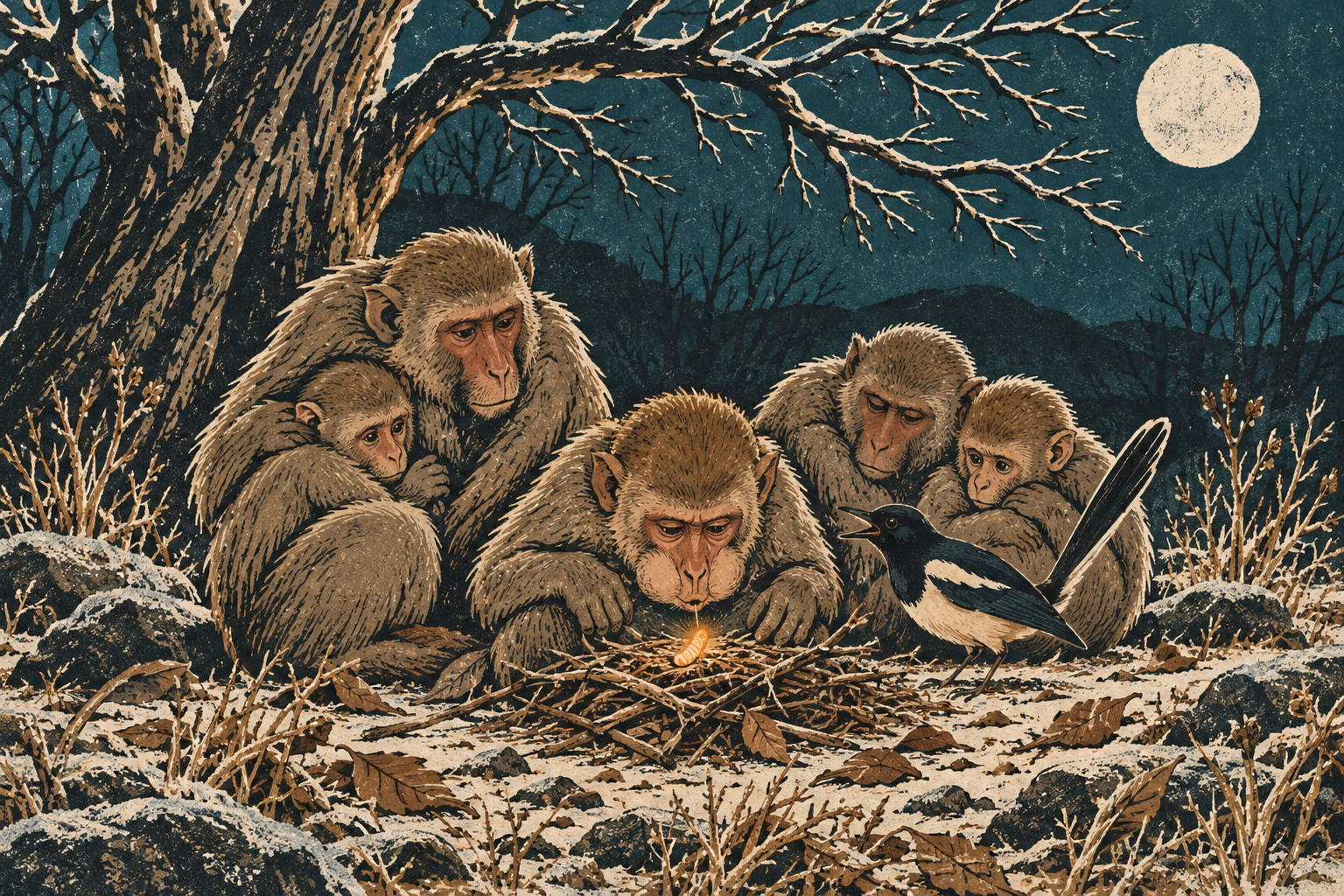
Deep in a stretch of forest, on one of those nights when the cold gets into the bones and stays there and will not be shaken loose, a troop of monkeys sat miserable in the dark. There is a particular kind of cold that makes even chattering animals go quiet, and this was that kind. They wrapped their arms around themselves and around each other, tails tucked close, teeth going, and every one of them wished hard, in whatever way monkeys wish, for the sun to hurry up and come back.
Then one of them saw something small and bright, low in the winter grass. It blinked — gold-green, on, off, on, off — steady as a heartbeat, like a coal that had somehow gone on glowing all by itself with no fire around it at all. None of that troop had ever seen a glow-worm before, not once in all their forest lives. And in the dark, and the cold, and the wishing, the whole group came to the same conclusion at the same moment, with the enormous relief of the truly desperate: they had found fire.
They went to work the way only the truly cold can — fast, and together, and without a single doubt among them. They gathered every dry twig and dead leaf they could reach in the dark and heaped it up, careful as a nest, around their small blinking treasure. They crouched low with their faces close to it and blew, long and careful, the kind of breath you save for a flame that matters to you. They pressed their backs to the pile and their stomachs to the pile and their whole aching, shivering bodies to the pile, arms out, sides out, chests out, gathering in whatever warmth was surely, any moment now, about to come.
Nothing came. Not a flicker of heat, not the faintest orange glow spreading outward the way a real fire spreads, not even the small crackle a true flame makes when it first catches dry grass. But cold makes some creatures patient and others simply stubborn, and often it makes the same creature both at once, and this troop went on believing, because believing was warmer, just then, than admitting they were wrong. The moon rose higher over the bare branches while they worked, and the frost thickened on the grass around them, and still not one of them thought to wonder why a fire that was surely catching gave off no warmth at all.
One monkey in particular — thinner-furred than the rest, or simply unluckier, or only the one who happened to be nearest the light when it was found — leaned in closest of all and blew hardest of all, over and over, never resting, the way you blow on embers you are certain are almost, almost catching, if only you keep at it one breath longer. The others let him take the lead in it, the way a cold, tired group will let its most desperate member set the pace, and none of them thought to ask him to stop and rest, because none of them wanted to be the one who stopped believing first.
That was when the bird arrived, dropping down off her branch to see what all the huffing and rustling below was about. She looked at the huddled, shivering troop, and the carefully heaped twigs, and the small steady light blinking at the centre of it all, and she understood the whole mistake in a single glance.
“That isn’t fire,” she said, landing close enough to be heard over the blowing and the shivering. “It only looks like fire, here in the dark. It gives off no heat at all. You’re wasting your breath on a beetle.”
The monkey didn’t stop blowing. He didn’t even turn his head to look at her.
She came a little nearer and said it again, plainer this time, choosing simpler words in case the first ones had been the trouble — and when that changed nothing at all, she tried a third way, as patient as she knew how to be, walking him through it the way you would explain something simple to someone you were quite sure had only misheard you. “It has wings, if you look closely. It has legs. It is an insect, and no more than that, and when the sun comes up it will fly away on its own, and you will see that I was right all along — and you will have spent this whole cold night hugging a light that never once warmed you.”
She could have flown off then. No one had asked her to stop, and no one had thanked her for stopping, and nothing about this troop and their glow-worm was any business of hers at all. But she had seen the whole cold night stretching out ahead of them, wasted on a beetle, and something in her would not let her leave it there unsaid.
Still nothing. The monkey blew on, steady as ever. The others blew on beside him, glad of the company in their belief, none of them so much as glancing her way.
So she tried once more, closer now, her voice raised to carry over the huffing and the puffing, saying the same true thing a fourth time — and then, when even that changed nothing, a fifth, the way you keep saying a thing you cannot quite believe hasn’t landed yet, certain that this time, surely this time, the words would finally get through.
They didn’t. And that was when the monkey — cold, and tired, and by now thoroughly out of patience with a bird who simply would not leave him and his fire alone — turned at last, reached out, and seized her.
No blade cuts through stone. No wind bends a tree that has already decided not to bend. And no true word, however many times it is said, however kindly, however patiently it is repeated — teaches a mind that has already made up, long before the first word was spoken, not to be taught.
Here, under our tree, nobody spoke for a moment. Bupam, who had fallen properly asleep partway through the telling, didn’t stir even now.
Dev flexed his sore foot carefully, wincing again, and still didn’t mention it.
Leo looked down at his own hands and said nothing.
Mira sat with her arms wrapped around her legs, watching the dark, and didn’t say anything either.
For the grown-up (not read aloud): the heart of it — no one can teach a creature that has already decided to learn nothing at all.
Where it comes from: retold from the Panchatantra (the monkeys, the glow-worm, and the bird who kept warning them, Book 1), freely reshaped.
More stories for ages 9–12
The Owl Who Cried at Dawn · Buried Between Friends · The Parrot Who Edged Away · The Trail of Fish · The Servant’s Two Mutterings · The Jackal’s Two Lies
 Banyan Story Studio