


Older listeners · ages 9–12 · comfortable from 8 with a grown-up · Retold from the Panchatantra
A heads-up: a holy man is robbed by someone he has come to trust completely, and the thief is never found or punished. A jackal, nearby, is killed by accident. No person in this story is hurt.
Reading aloud? A note for you
This one ends without the satisfaction of the thief getting caught — that’s the point of the story, not a loose thread, and your listener may want to argue with it. Let them; it’s worth sitting with. Slow down at the rams and the jackal, since it’s easy to read past quickly, but it’s really the whole story in miniature, playing out a second time in animal form while the holy man watches. In the old telling, this story runs much longer: the holy man goes on to spend a whole night as an unwilling witness inside a stranger’s house, watching things play out there that have nothing to do with children, and we’ve left that entire night out — the story here ends earlier, at the point where he’s still following the thief’s tracks and cannot find him. Devasharman is said dev-uh-SHAR-mun; Ashadhabhuti is uh-SHAH-dhuh-BHOO-tee — or “the pupil” works just as well aloud.
Leo lifted the corner of the sitting-mat to shake out a pebble and found a coin instead, small and tarnished, wedged half into the dirt beneath it. “Finders keepers,” he said at once, closing his fist around it.
Mira wasn’t so sure. “It has to belong to somebody,” she said. “It didn’t just grow there.”
Dev turned it over where Leo held it out, reading nothing off its worn face. “Ask around tomorrow,” he said. “If nobody claims it by dark, then maybe.”
Nani took the coin from Leo’s palm and weighed it in her own hand a moment before speaking. “Careful with that,” she said. “Some things do come loose if you’re patient. Others don’t, however long you work at them — and it helps to know which kind you’re holding before you start. Tonight’s story is one the jackal Damanaka tells his brother, right after admitting that all their troubles are his own doing. It’s about a jackal who ran in between two fighting rams, and a man who trusted a stranger with everything he owned. Both of them saw the danger coming. Neither could make himself stop.”
“Listen.”
Far off from any city, in a quiet stretch of country, stood a small monastery, home to a holy man called Devasharman, who earned his living by performing the sacred rites that people asked of him. Over many years the gifts of the grateful had made him rich — richer, certainly, than a man of his calling expects to be — and the wealth sat uneasily on him from the day he first had it. He would not set it down, and he would not tell a soul he had it. Night and day he kept the whole of it strapped against his own body, wrapped close beneath his robe, and he trusted no one near it — not the pupils who came and went from the monastery, not the villagers who brought him their gifts, not even, in his more restless hours, himself.
Word of this treasure reached a swindler named Ashadhabhuti, who lived by taking what other people had hoarded and had a sharp eye for anyone who kept money close. He came and watched the monastery for some days from a careful distance, turning the problem over the way a thief turns over any lock. Force would get him nowhere: the walls were thick stone, and the door was watched too closely for a stranger to slip past in the night. So he chose patience instead, which is slower than force but far harder to catch. He came to Devasharman with his palms pressed together and his head bowed low, and spoke movingly of how brief a life is, how little its pleasures are worth chasing, how heavy the world sits on a searching soul — and begged, with what looked exactly like real feeling, to be taken on as a pupil that very day. Devasharman, touched to find such seriousness in someone so young, agreed at once — though he set one rule from the first night: the new pupil would sleep outside the cell, at the gate, never within reach of the door once darkness fell.
Ashadhabhuti agreed to everything, and gave every appearance of meaning it. He set himself to being the most devoted pupil a holy man could ask for — fetching water before he was asked, running errands at a trot, doing every small service that wins a person’s affection one quiet act at a time. And he did win it. Devasharman came to love him like a son, and said so, more than once, to anyone who would listen. But the treasure never once left the old man’s arm — not for an hour, not for a minute, the whole time. Some part of him, it seemed, could be won over completely and still not let go.
Months went by like this. Then a letter came, asking Devasharman to travel to a nearby village for a ceremony held in his honour, and, as had become his habit by then, he took his new pupil along with him on the road, glad of the company and gladder still, he told himself, not to be alone with so much money.
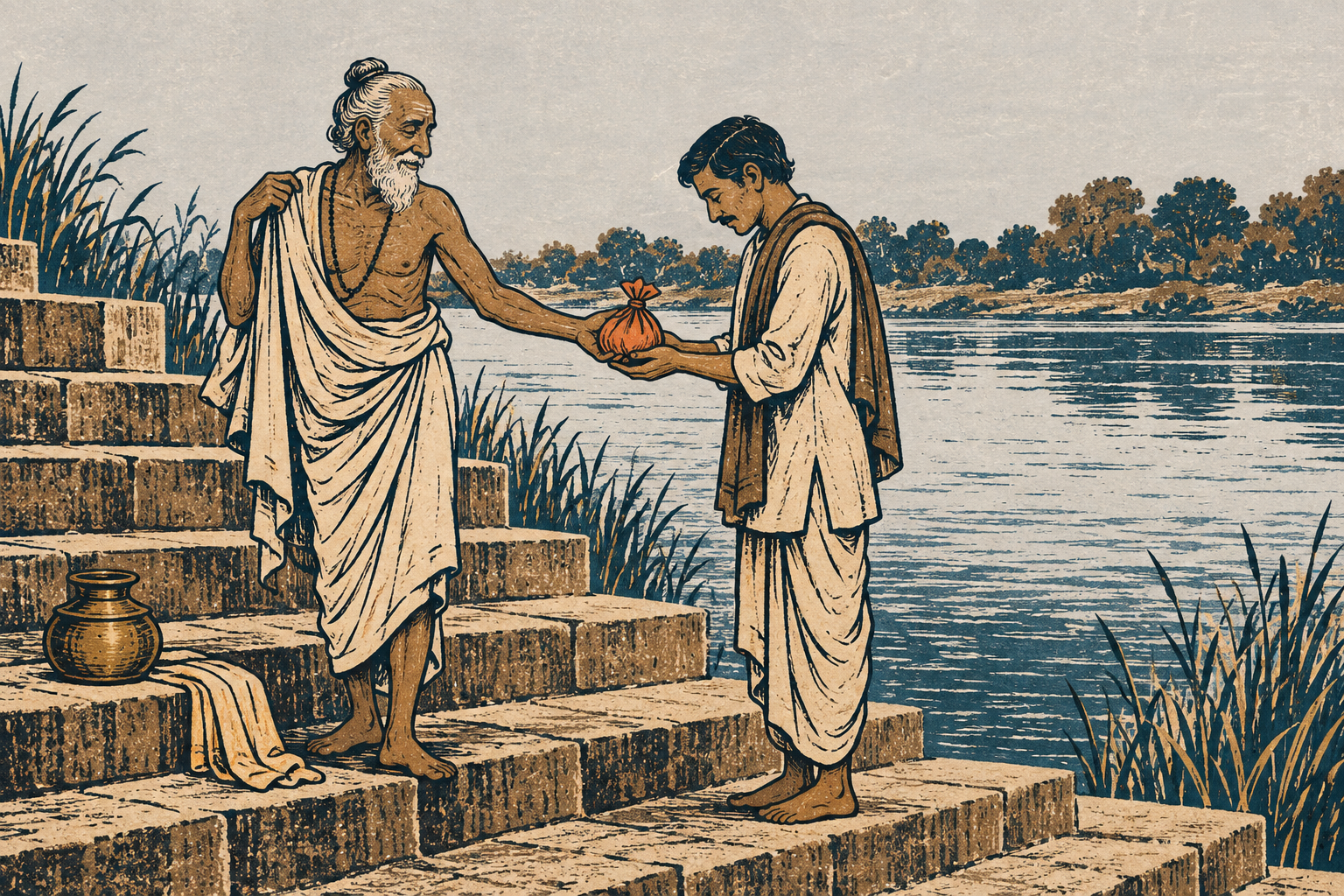
Their path crossed a river. Devasharman climbed down to the bank, unwound the treasure from where it rode against his arm, tucked it snugly inside a fold of his robe, and asked Ashadhabhuti to keep careful watch over the bundle while he stepped away a moment to wash and say his prayers. It was the first time in all those months that the treasure had left his own body, and he did it without a second thought, because by then there was no part of him left that doubted the boy. Ashadhabhuti agreed readily, with his usual quiet devotion — and the instant his teacher was out of sight, he snatched up the robe and everything folded inside it, and was gone down the road at a run.
Devasharman, knowing nothing yet, finished his prayers and settled comfortably on the bank to rest a while, at peace after all these months in a devotion he had let himself believe in completely. Nearby, a small flock of rams grazed in the long grass, and two of them turned suddenly on each other — backing off a few paces, then charging, their heavy skulls meeting with a crack that carried across the water, again and again, until the blows drew blood. A jackal came slinking out of the grass, drawn by the smell of it, and darted in close each time the rams pulled apart, to lap at the blood pooling on the ground between them, then leapt clear again before the next charge could catch it. Devasharman watched this for a while and thought, idly, almost with pity, that the jackal was playing a dangerous game — that it could see exactly where the two skulls would meet next, and kept going back anyway, and that sooner or later its luck would run out.
It did. The jackal lingered a heartbeat too long over the blood, greedy for one more mouthful, and the next time the rams charged, it went in between them for it — and the rams’ heads crashed shut on either side of it, and the jackal was killed on the spot, without a sound.
Only then did Devasharman rise, unhurried, to gather his own things and go on his way — and found neither the treasure nor the pupil he had left it with. He searched the riverbank first, telling himself there must be some ordinary explanation. He called Ashadhabhuti’s name into the empty air, again and again, his voice going ragged, until the truth of it settled on him fully and would not be argued away: he had been robbed, and robbed by the one person in the world he had trusted without any reserve at all. He found the pupil’s tracks pressed into the soft ground beside the road and followed them, walking and calling out long after calling out could do any good, past the point where anyone sensible would have turned back.
But the tracks led on and on, mile after mile, and never once led him to the man who had left them. He never found Ashadhabhuti. He never saw his treasure again.
“Here, under our tree,” Nani said, “that’s as far as this one goes.”
Dev turned that over before he spoke. “The pupil just walked off with everything,” he said, “and nobody ever finds out where he went.”
“It ends where the truth of it ends,” Nani said, “not where we’d like it to.”
Mira didn’t ask a single question, which was its own kind of answer.
Leo opened his fist and looked at the coin lying flat in his palm, suddenly less sure he wanted it. “I’ll ask tomorrow,” he said, and closed his hand around it anyway.
Nani watched him tuck it into his pocket and let the quiet sit exactly as it was.
For the grown-up (not read aloud): the heart of it — some troubles are ones we walk into with our eyes open, the way the jackal kept going back for the blood, and the way the holy man handed everything he owned to someone he had chosen, all on his own, to trust completely.
Where it comes from: retold from the Panchatantra (the holy man and his pupil, with the rams and the jackal, Book 1), freely reshaped.
More stories for older listeners
The Crab Who Looked Down · Three Warnings · The Light That Wasn’t Fire · The Owl Who Cried at Dawn · Buried Between Friends · The Parrot Who Edged Away
 Banyan Story Studio