


Growing listeners · ages 6–8 · comfortable from 5 with a grown-up · Retold from the Panchatantra
A heads-up: this story ends with a death — the guest who is let in does harm, and the one who trusted him does not survive it.
Reading aloud? A note for you
Slow down for the one rule the louse sets, and slow down again for the moment it gets broken — that is the whole hinge of the story. A child may ask why the flea wasn’t found too, or why the louse didn’t just say no from the start; both are fair questions, and the honest answer is that she was kind to a stranger before she knew what he was. We follow the gentler of the two old tellings, where the louse takes pity on the flea rather than being talked into it, and we put the one house rule and its breaking into plain, unadorned words. Nothing is added to the story; what changes is only how plainly a few lines are said.
Leo arrived with a case of hiccups he couldn’t shake, jumping every time one caught him, which only seemed to bring on the next one faster. Mira told him to hold his nose and count to ten, with the flat confidence of someone who has never once had hiccups herself. Dev, arriving last, quietly set a cup of water down in front of Leo without being asked.
Bupam hadn’t come down at all that evening — off somewhere in the dark past the wall, doing whatever it is he does when nobody’s watching.
“Tonight’s story,” said Nani, “is the one a jackal told a lion king, to prove that even something small and harmless-looking can do real damage once you’ve let it in. It’s about knowing who you’re taking in, before you take them in.”
Mira looked over at Leo, still hiccupping. “Is it about him?”
“Not exactly,” Nani said. “Listen.” And she began.
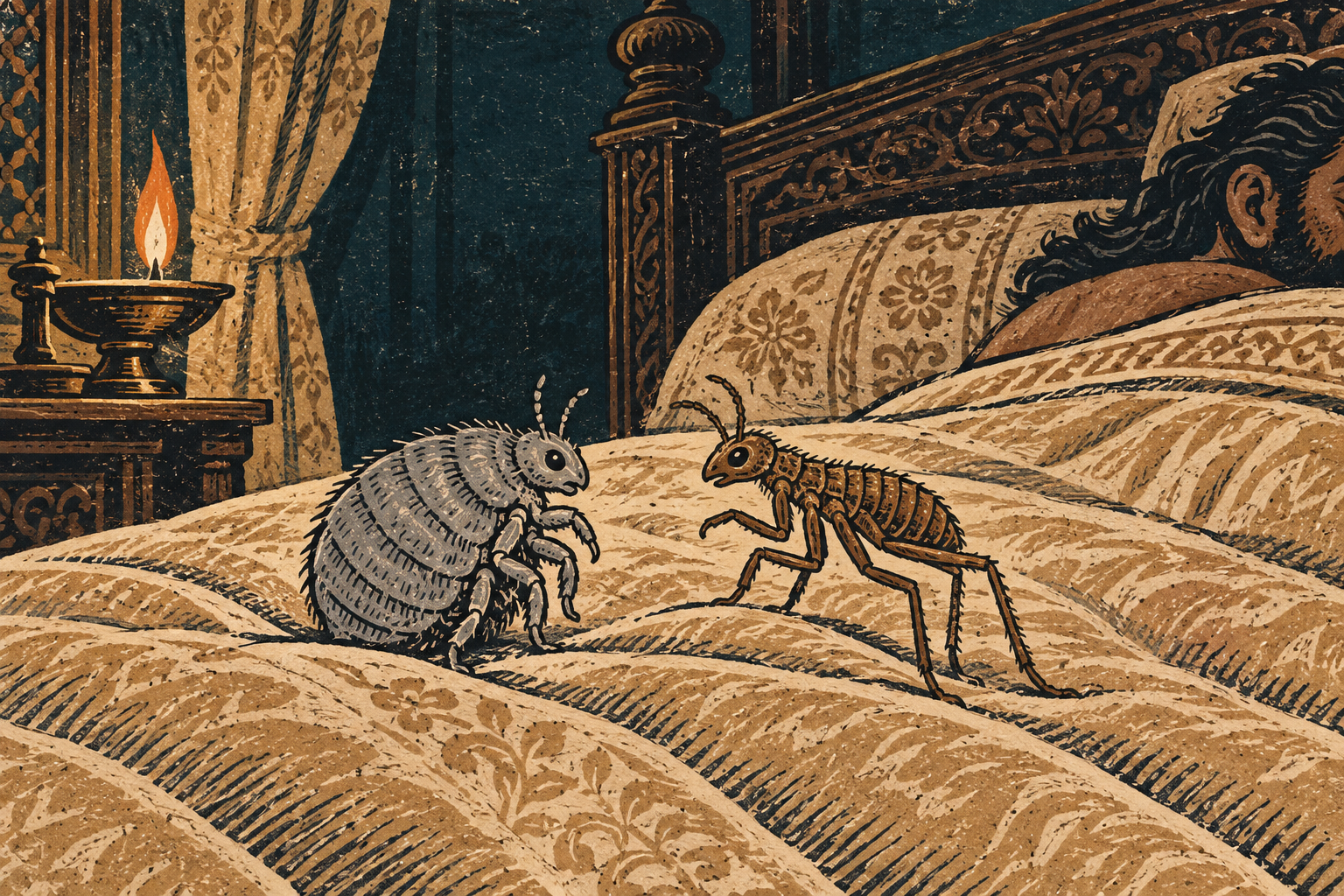
In a certain king’s palace stood the finest bed anyone there had ever slept in — deep and soft, with two pillows and a coverlet worked in silver thread, and a smell of sandalwood that never quite faded. And tucked into a fold of that coverlet lived a louse. Night after night, while the king slept, she fed quietly and carefully, taking only a little at a time so that he never once woke from it, and on that diet she grew round and glossy, and wanted for nothing.
One evening, a flea named Tintibha blew in on a gust of wind and came to rest on that very same bed. He had never felt anything so soft in his life — not the coverlet under his feet, nor the pillow, nor the warm smell of the place — and he could tell, even before he tasted it, that whoever slept here must have the richest blood in the kingdom. He darted from corner to corner in delight, turning circles on the silver thread, until he came face to face with the louse.
“You don’t belong here,” she told him. “This is a king’s bed. Go, before you’re found.”
Tintibha begged to be allowed to stay, just for one taste of something so fine — he had been blown a long way, he said, and had tasted nothing but thin, sour blood for days. He asked so humbly, and looked so thin and windblown, that the louse’s courtesy got the better of her, and she felt sorry for him, though she barely knew him at all.
“Very well,” she said at last. “But you keep to one rule, and you keep to it exactly. You wait until the king is fast asleep — truly asleep, not just lying still — and then, and only then, you may bite him, low down, where he won’t feel it and stir. Break that rule, and you’ll bring trouble on us both.”
Tintibha agreed to everything she said.
But Tintibha had never in his life waited for anything, and hunger is a poor kind of patience. The king had barely closed his eyes — was only just drifting toward sleep, not yet deep in it — when Tintibha could stand no more, and bit him.
The king came awake with a shout, as if he’d been stung by a hornet. He sat bolt upright, rubbing at the spot, and called for his servants. “Something bit me! Turn this whole bed inside out — don’t stop until you’ve found it.”
Tintibha heard the king’s voice and, quick as thinking, slipped himself into a crack at the edge of the bed frame — a gap so narrow that no lamp, no matter how carefully held, would ever find him there.
The servants came in with their lamps held low, and went over the bed inch by inch, turning back the coverlet and shaking out the pillows. And there, still in her own fold of the fabric — too slow, and too caught by surprise, to hide half so quickly as the flea had — they found the louse. She had broken none of her own rule. It made no difference. And that was the end of the one who had given him shelter.
Here, under our tree, Leo hiccupped once more, waited a long moment, and then didn’t again.
“Finally,” he said, mostly to himself.
Dev picked up the empty cup and turned it in his hands without saying anything.
Mira watched the dark past the wall, listening for Bupam, and didn’t find him.
For the grown-up (not read aloud): the heart of it — before you let someone into your home, know what sort of creature they are.
Where it comes from: retold from the Panchatantra (the louse and the flea, Book 1). In the old book, Damanaka the jackal tells it to Pingalaka the lion.
More stories for ages 6–8
The Chain in the Hollow · The Carpenter’s Lunch · The Promise of Silence · Small Bird, Great Sea · Three Fish and the Net · The Crow Who Wanted a Friend
 Banyan Story Studio