


Growing listeners · ages 6–8 · comfortable from 5 with a grown-up · Retold from the Panchatantra
A heads-up: this story ends at a risky moment, high in the air, and doesn’t tell you — or your child — what happens next.
Reading aloud? A note for you
Slow right down for the stretch where Kambugriva is carried between the two geese — let “higher and higher” breathe before the town appears below. Your child may ask why he couldn’t just stay quiet a little longer, or what happened to him after; the honest answer is that the old story doesn’t say, and neither do we — it stops at the instant his promise breaks, which is the point of the story, not something we’re hiding. In the old telling, the tortoise falls into the town below and does not survive it; here, we end the story at the moment his grip lets go, before that happens on the page. If your child goes quiet at the end, that’s a real, sitting-with-it kind of quiet — better held than smoothed over.
The air had changed that evening — a damp, mineral smell rolling in off fields gone dry for weeks, the kind of smell that meant rain was finally close. Mira noticed it first and lifted her face to it. “It smells like rain,” she said. Leo, delighted, declared it would pour by morning, and no one could talk him out of it. Dev said nothing, just breathed it in slowly, and Bupam, close by in the leaves, lifted his nose to the same wind, testing it the way the children were.
“Tonight,” said Nani, “is a story a wife told her husband — a plover, out by the sea, trying to make him listen to a warning. It’s about what happens when someone who loves you tells you something for your own good, and whether you can hold on to it all the way through.”
“Listen.” And she began.
In a certain lake there lived a tortoise named Kambugriva, and his two dearest friends were a pair of geese, Sankata and Vikata, who came to that lake to drink and rest every evening of the year.
Then came a drought that lasted twelve years. Season after season the rain did not come, and the lake shrank, and shrank again, until it was hardly more than mud in a wide, cracked bowl of earth, with dry reeds standing where deep water used to be. The geese knew what they had to do.
“We must go and find water,” said one goose to the other. “But first we must say goodbye to Kambugriva. We cannot leave a friend without a word.”
When they told him, the tortoise’s heart went heavy as a stone. “Why say goodbye?” he said. “I am a water creature. Without water I will not last long — and without the two of you, even less. Think which is the harder loss: going a little hungry, as you two would, or losing your life entirely, as I would. If you love me, find some way to take me with you.”
“We cannot,” they said. “We have wings. You do not.”
But the tortoise thought hard, the way tortoises think — slowly, and all the way through. “There is a way,” he said at last. “Bring me a stick.”
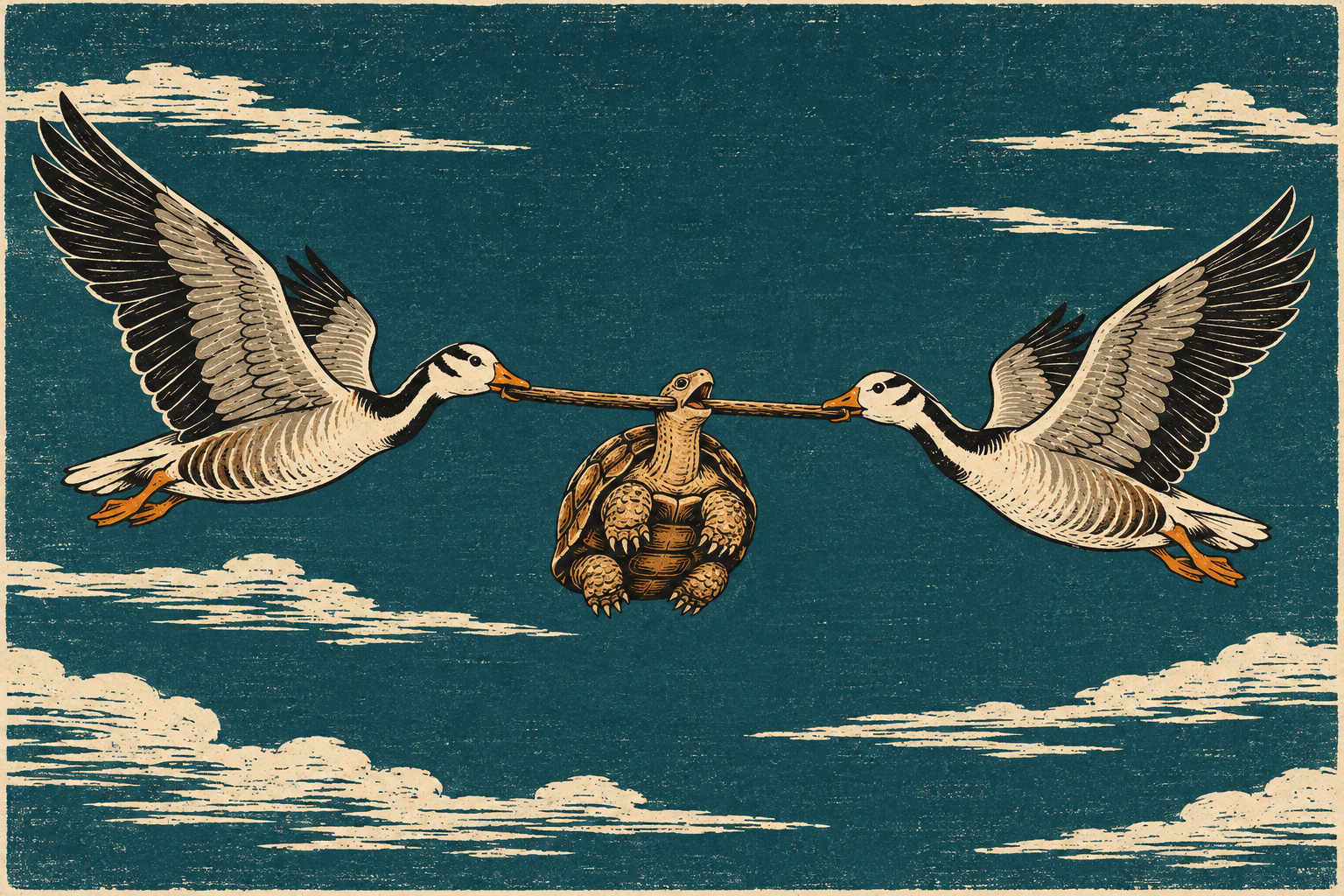
They brought one. “I will hold the middle of it in my mouth,” he said. “Each of you take one end in your bill, and fly, and carry me between you.”
“There is one danger in that plan,” said one of the geese. “If you open your mouth to speak even one word while we are in the air, you will fall.”
“Then I will not open it,” said the tortoise. “From this moment, until we land, I promise you my silence.”
So they lifted him — a stick gripped in his mouth, a goose on either end, and the tortoise hanging between them like a slow bell swinging on two ropes. Up over the dry lake they rose, and up over the cracked fields, and the wind that had been so hot down below turned cool and steady up where they flew. Higher and higher they went, until the world below looked small and folded, like a blanket someone had smoothed flat, and the rivers were only threads of silver stitched across it.
In time they came to fly over a town. People in the streets looked up and saw the strange shape crossing the sky — a stick, and something round and dark hanging from its middle, carried between two birds — and they began to point, and call out to one another, and gather in the road to stare, shading their eyes against the last of the light.
The tortoise heard their voices rising up to him. He had promised silence, and he meant to keep it.
But the wondering below got into his ears, and the wondering turned into a question he could not hold — and the tortoise opened his mouth to ask what all the fuss was about.
And there was nothing left to hold him to the stick at all.
That is the whole of what the plover’s wife told her husband: that once a promise like that breaks, it cannot be caught back again — so listen, all the way through, to the ones who love you enough to warn you.
Here, under our tree, no one spoke for a moment.
“He shouldn’t have opened his mouth,” Leo said at last — and then, catching himself, pressed his lips shut tight, on purpose, and held them that way for a long, deliberate stretch, as if testing how it felt.
Mira noticed and almost laughed, but didn’t. “He held on a long way, though,” she said quietly. “All that way over the dry country, with nothing but a stick between him and falling.”
Dev leaned into Nani’s side without a word, and she let her hand rest on his hair, and said nothing about whether it would be all right.
For the grown-up (not read aloud): the heart of it — when someone who loves you warns you, that warning is worth holding onto, all the way through, even when it is hardest.
Where it comes from: retold from the Panchatantra (the tortoise and the two geese, Book 1), freely reshaped.
More stories for ages 6–8
Small Bird, Great Sea · Three Fish and the Net · The Crow Who Wanted a Friend · A Thousand Tiny Teeth · The Reason Nobody Knew · What Four Friends Can Do
 Banyan Story Studio