


Growing listeners · ages 6–8 · comfortable from 5 with a grown-up · Retold from the Panchatantra
A heads-up: a hunter sets a trap in this story and a whole flock is caught in it — everyone gets away unhurt.
Reading aloud? A note for you
A hunter’s snare closes over a whole flock in the first minutes, and the danger is real — but no one is hurt, and the doves lift the net free together before the hunter can reach them. Slow down for the mouse’s refusal, “Crows eat mice” — it’s the hinge the whole friendship turns on, and it deserves a real pause. Your listener may ask why the crow keeps coming back after being turned away; that patience is the point of the story, not a plot hole. The tale doesn’t finish here — it turns, on the last line, into the mouse’s own sad story, which is a different night’s telling. Laghu, Hira and Mantu are said just as they’re spelled, no tricky sounds tonight.
A whole noisy crowd of mynahs came down into the tree just as the three of them arrived, dozens of them at once, shouldering for space on the low branches with a racket that made Leo clap his hands over his ears. “Why so many, all of a sudden?” he asked, once they’d more or less settled.
“Something must have startled them off wherever they were roosting,” Nani said. Bupam edged further along his perch to make room, unbothered, watching the newcomers with mild interest.
Mira, arriving right behind Leo with a question already forming, sat down and asked it at once. “Tonight’s a new book, isn’t it? You said the last one finished.”
Dev folded himself down quietly, arms around his shins, well after the other two, and waited.
“It is,” said Nani. “A new book starts the way a lot of good things start: with an argument nobody wanted to have — between a crow and a mouse, who by every rule of nature should never have been friends at all. This is the story of how they became friends anyway, and how far one of them had to go to earn it. It’s about what it costs to be trusted, and what it’s worth once you have it.”
“Listen.” And she began.
In a great banyan tree beside a wide, quiet lake lived a crow named Laghu — sharp-eyed, sharp-tongued, and the first to notice trouble before anyone else did. One morning he watched a hunter come near the tree, scatter a handful of rice on the ground, and hide a net beneath it, thin as a spider’s thread. Laghu warned every bird who lived in that tree to leave the rice alone, no matter how good it looked. They trusted him, and not one of them so much as looked at it twice.
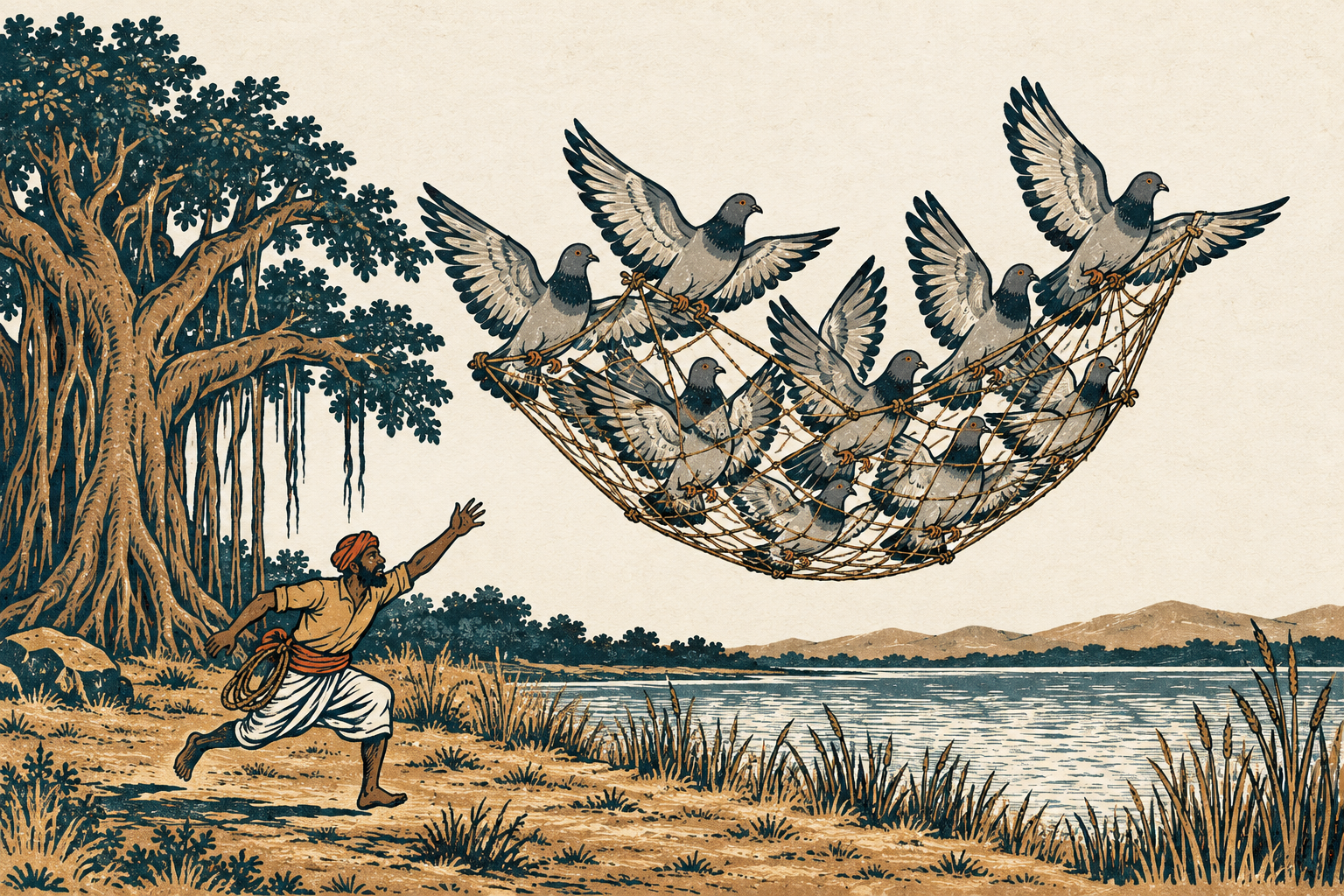
But a flock of doves came flying through that morning, led by their king, hungry from a long journey and thinking only of breakfast. They saw the rice from high in the sky and dropped down before anyone could stop them. The moment their feet touched the ground, the net sprang up around them, and the whole flock was caught.
The hunter came running, club raised, delighted at his catch. But the dove king kept his head. “We cannot save ourselves alone,” he told his frightened flock. “We rise together, or none of us rises at all.” In just a few words, he reminded them of two birds who had once shared a single body and lost everything by refusing to work as one. There was no time for more than that. “Now,” said the king. “Together. Fly!”
And on his word, every dove beat its wings at once, and the whole net — birds, cords and all — lifted off the ground and sailed into the sky like a strange grey cloud. The hunter chased them a long way, but the doves stayed together and outflew him, and at last he turned back toward home with nothing to show for his morning.
The dove king knew a place to go. Beneath the roots of a faraway tree lived a mouse named Hira, an old friend of his, clever enough to have dug herself a burrow with a hundred doors. The doves set down at her gate, and the king called for her. Hira came out at once and began gnawing through the cords with her quick teeth, starting, naturally enough, with the king’s own bonds first. But the king stopped her. “Free my flock before you free me,” he said. “They followed me into danger. I won’t leave them last.” So Hira freed the whole flock, one dove at a time, and the king waited his turn like everyone else, until every last one of them could fly free.
Laghu had followed the whole rescue from high above, too curious to look away, and what he saw took his breath more than the chase had. A mouse who had dug herself a hundred-doored fortress. A mouse who could have saved herself first, and chose to make her king’s flock go before her. Laghu thought, though he said nothing aloud: I have never in my life wanted a friend the way I want that one.
So he flew down, landed at Hira’s gate, and called out, “Friend! Will you be my friend too?” But Hira only looked at him and said, “You are a crow. Crows eat mice.” “I won’t touch you,” said Laghu. “I only want to talk.” Hira wasn’t so easily won. “Some enemies fight for a reason,” she said, “and once the reason is gone, so is the fight. But some are enemies by nature — always have been, always will be. A crow and a mouse are that kind. Trusting you would be foolish.” Laghu didn’t argue that she was wrong. He only said, “Maybe. But I’ll starve at your door before I leave it, because I meant what I said.” And something in the way he said it — plain, and patient, not the least bit clever — made Hira look at him differently. “You’re not a fool,” she said slowly. “A fool doesn’t talk like that. Come closer, then. Slowly.”
So Laghu came closer, slowly, and the two of them sat and talked until the sun was low. When he left, he came back with a piece of meat. Hira, who had been quietly keeping rice for exactly such a friend, brought some out to share. They ate together, and from that evening on, a crow and a mouse — who by every rule should have been enemies for life — were friends instead.
But the year turned dry. The rains that should have come didn’t, and back in the city the hungry people began setting bird-traps in every yard, even for a crow as clever as Laghu. One evening he came to Hira’s gate with his feathers drooping. “I have to leave this place,” he said. “There’s a lake far to the south where an old friend of mine lives — a tortoise — and it’s safer there, and kinder.” “Then I’ll come too,” said Hira. “But I can’t fly, and you can’t carry a mouse the whole way on foot.” “Climb on my back,” said Laghu, “and hold tight. I’ll fly gently.” So Hira climbed on, and Laghu flew, slow and steady, all the way south to the lake.
There they found the tortoise, whose name was Mantu — old, unhurried, and glad of any company at all. He welcomed them warmly, but he was too wise not to notice that Hira, riding on a crow’s back so far from home, had the look of someone carrying more than just a long journey. “Friend mouse,” he said gently, “something is troubling you. Will you tell me what it is?” And there, beside the still water, with the evening settling in around all three of them, Hira began — at last — to tell the long, sad story of everything he had lost before the day he met a crow.
Here, under our tree, Mira didn’t ask right away. She sat with it a moment first. “So the mouse is sad now? After all that?”
Dev, who had sat very still through the whole telling, asked the real question underneath it. “Will the crow stay with him? While he tells it?”
Nani only nodded, once, slow, and let the question sit in the dark a while before she said anything back at all.
Leo didn’t say anything. He just looked up into the tree, where the mynahs had finally gone still and quiet, packed shoulder to shoulder, settled for the night.
For the grown-up (not read aloud): the heart of it — friendship is won in small, unglamorous acts of fairness and patience, and it’s worth going the long way round for.
Where it comes from: retold from the Panchatantra (Mitra-samprapti frame story, Book 2).
More stories for ages 6–8
A Thousand Tiny Teeth · The Reason Nobody Knew · What Four Friends Can Do · Two Heads, One Tummy · The Mouse’s Hidden Hoard · What the Weaver Chose
 Banyan Story Studio