


Growing listeners · ages 6–8 · comfortable from 5 with a grown-up · Retold from the Panchatantra
A heads-up: a cat attack takes some of Hira’s followers, and later he is struck hard enough that it very nearly kills him. He lives, but both moments are real and onstage.
Reading aloud? A note for you
Two real dangers here: a cat attack some of Hira’s followers don’t survive, and a blow near the end that nearly kills Hira too. Both are stated plainly and pass quickly — you don’t need to slow down so much as just let them land. Your listener may ask why Hira didn’t ask his new friends for help sooner, or why losing money scared him enough to risk his life going back for it; the story doesn’t fully answer either, and that’s fine to say. He mentions two other people’s stories in passing, almost in the same breath, without stopping to tell them — read past those quickly, the way he does. By the end he chooses to live with less rather than guard a fortune again, and the story lets that cost something.
Dev arrived last, as usual, turning three found coins over and over in one fist, counting them for what had to be the tenth time since he’d found them by the well.
“You said the mouse had a story,” Mira said, before Dev had even sat down. “The one he hadn’t told yet.”
“Tonight he tells it,” said Nani.
Leo leaned in. “Good or sad?”
“A little of both,” Nani said. Dev, still turning his coins, finally sat down to listen.
Bupam curled up nearby in the grass, one eye cracked open, pretending he wasn’t listening too.
“You remember where we left them,” Nani said. “Laghu the crow and Hira the mouse, true friends now, flying to a lake they’d never seen, looking for somewhere new to live because home had grown too dangerous. There they found an old tortoise named Mantu, glad of company — and Mantu noticed that Hira looked careworn. So he asked why.”
“This is the story Hira told them both, at the water’s edge,” Nani went on, “how a rich little mouse became a poor one, and what he did about it after. It’s about what money can buy you, and what it can’t.” “Listen.” And she began.
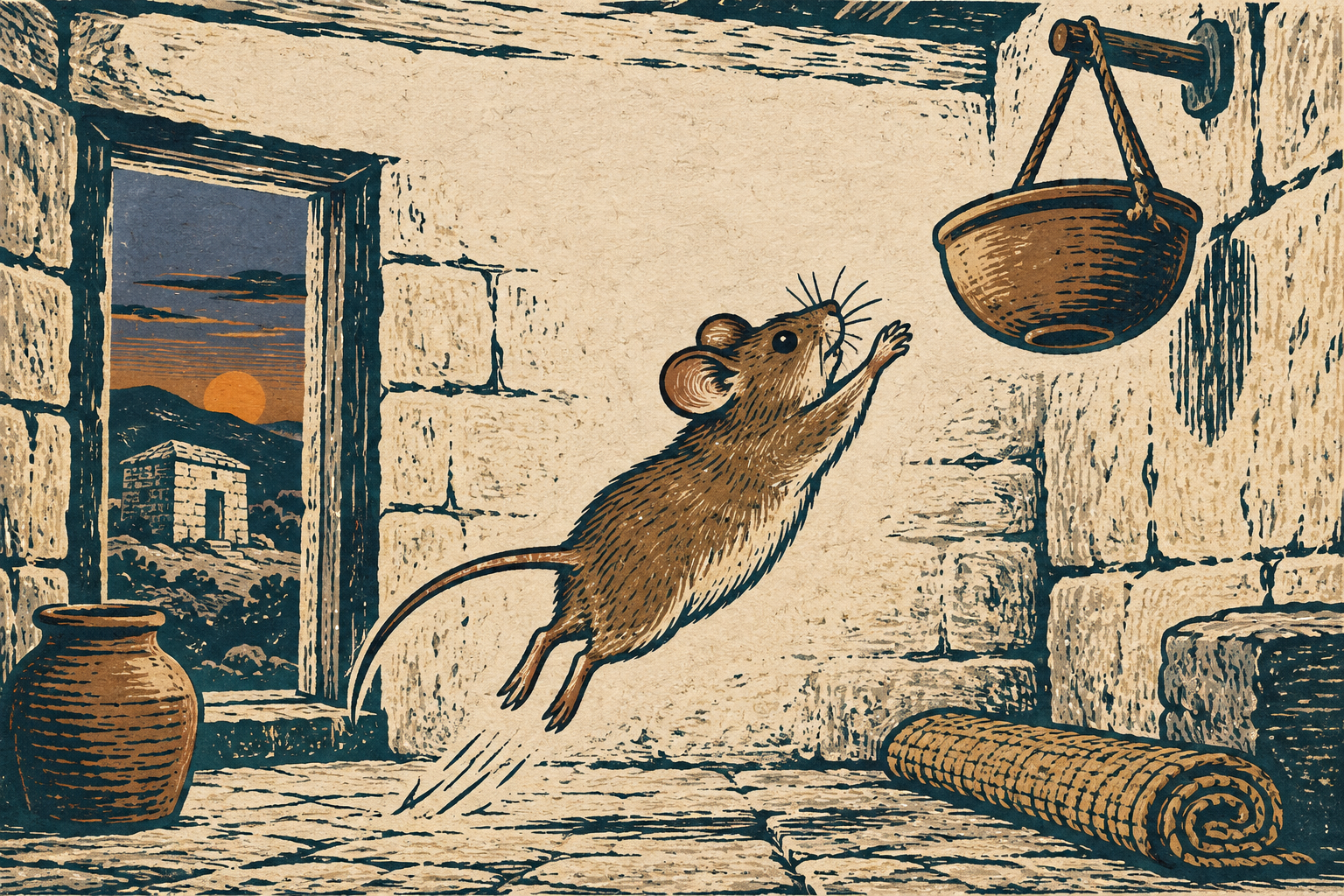
Near a certain city stood a quiet shrine, and near it, in a small stone cell, lived a hermit who begged his food each morning and hid what he didn’t eat, hanging the bowl high on a peg for the next day.
Hira found it anyway. However high the hermit hung it, Hira could jump higher, and he grew plump on the leftovers — plump enough that a whole train of mice fell in behind him, living exactly as well as he did.
One night the hermit had a guest, a holy man passing through. The two talked in the dark, but the hermit kept breaking off to strike the hanging bowl with a stick, scaring at a mouse his guest couldn’t even see. Once the guest understood why, he grew curious instead of offended: a mouse bold enough to out-jump a hermit’s best hiding place had to have something behind him. Quietly, he began to watch.
He found nothing that night. But Hira, listening from his hole, understood he’d been noticed — and to a mouse guarding a fortune, that feels like being found out, even before it’s true. He panicked. Instead of the safe, familiar path to the bowl, he led his followers a new way, through ground none of them knew.
A cat was waiting there. It struck fast, and by the time it was done, Hira’s followers were scattered and bleeding, blaming him — fairly, in a way — for the road he’d chosen. They fled home to the fortress where Hira kept his hoard, leaving a trail across the floor the whole way.
That trail was what gave him away. The holy man followed it and found, beneath the fortress, more silver than a hermit’s cell had any business holding. He and the hermit dug it up together and carried it off, and that night the holy man slept easily on Hira’s whole fortune, folded up for a pillow.
Hira came home to nothing — no hoard, no followers worth leading, no fortress left worth guarding. What followers survived didn’t come back to him either; a mouse with nothing to give doesn’t keep a train for long. He thought hard about what to do next. Robbery meant taking what belonged to someone else, and he wouldn’t be a thief. Begging meant living only on what others gave him, and he found he couldn’t bear that either. That left one path: to get back, somehow, what had been his.
So that night he went to where the holy man slept and chewed through into the bag he’d once called his own — and the holy man woke, and struck him, hard, with the same stick he’d used on the bowl for weeks. Hira very nearly didn’t get up again.
Even telling it, he paused here and there — once, to mention a housewife who’d traded good grain for a spoiled batch and turned out, in the end, to have had a better reason than anyone gave her credit for; and once more, for a young man blamed early for something not his fault, who was proven at last to have been owed far more than he was ever given. Small stories folded inside his own, the kind you tell when the real one is too heavy to say straight through.
But he came back, each time, to his own trouble. Lying there afterward, he thought hard about what a fortune had actually bought him — followers who left the moment it was gone, a hermit’s notice that had never really been friendship. And he thought about what it hadn’t bought him at all: a single friend who’d have come back for him with nothing to gain by it.
He gave up trying to rebuild the hoard. There didn’t seem much point in being rich again only to spend every night after just as frightened of losing it a second time. He decided he’d rather be a creature who had little and kept it lightly than one who had everything and never slept easy.
That, Hira told them, was where things stood when the drought came, and Laghu said it was time to leave. Hira agreed, and went with him, glad of somewhere else to be.
“So here I am,” he finished. “That’s the whole of it — why I looked so careworn, and the end of the story too.”
Here, under our tree, Dev turned his three coins over once more, then folded them into his fist and put them away, and didn’t mention giving them up.
Mira was quiet, turning something over. Leo, unusually, said nothing at all.
Dev spoke at last, low. “He almost lost everything twice,” he said. “The gold, and then almost himself.”
Nani reached down, banked what was left of the coals in the little fire by her feet, and only then looked up. “Time for sleep,” was all she said.
For the grown-up (not read aloud): the heart of it — losing a fortune costs more than the money itself, and chasing it back is not always the wisest answer; there is a kind of wealth in simply not needing to guard anything.
Where it comes from: retold from the Panchatantra (the mouse’s own account of his rise and fall, told within the frame story of the crow, the mouse, the tortoise and the deer, Book 2).
More stories for ages 6–8
What the Weaver Chose · The Jackal’s Slow Supper · The Song That Scared a Prince · The Crow Who Wanted a Friend · A Thousand Tiny Teeth · The Reason Nobody Knew
 Banyan Story Studio