


Growing listeners · ages 6–8 · comfortable from 5 with a grown-up · Retold from the Panchatantra
Reading aloud? A note for you
This one leans quiet rather than scary — slow down at the two losses under the banyan tree, since a six- or seven-year-old will want a beat to feel how strange it is to work hard and travel far and still end up with nothing to show for it. They may ask why the gold just vanishes both times: you can say it’s the story’s way of talking about luck, and about how fate can hand people very different portions no matter how hard they work. In the old telling, the weaver’s despair goes further — he comes close to ending his own life before the wish-giver stops him — and we have left that out entirely, keeping only his grief and the gift he is given afterward. When you reach the two rich men near the end, it’s nice to let a child guess which one they would rather be before Nani says which one the weaver chose.
Dev had spent the whole evening sorting the coin jar — the one the family had been feeding all month, penny by penny, toward new shoes for the school fair — and had counted it three times running, getting a different number each time.
“Money’s funny,” he said at last, giving the jar one more shake to hear how much was really in there. “It never comes out the same twice.”
“That,” said Nani, “is almost exactly what tonight’s story is about.”
Leo sat up. “Money that vanishes?”
“Vanishes twice, on the very same man, in the very same forest — and neither time was his own fault,” said Nani. “Old Mantu the tortoise told this one, long ago, to comfort a friend who’d just lost his own fortune in a single bad night. It’s about a man who’s never allowed more than his food and his clothes, however hard he works for it — and has to decide, in the end, what kind of rich he’s going to be instead.”
Mira tucked her feet under her and said nothing, watching the jar in Dev’s hands.
“Listen.”
In a town like many others there lived a weaver who made fine, patterned cloth good enough for princes, and yet somehow never earned more than what fed and clothed him. He watched neighbours who wove plain, coarse stuff grow rich while his own finer work brought him nothing extra, and it needled him. “This town has nothing more to give me,” he told his wife. “I’m going to try my luck elsewhere.”
His wife wasn’t so sure. “Fortune comes to whoever it’s going to come to,” she said. “Travelling won’t change what’s already decided.”
“Maybe,” said the weaver, “but nothing gets done by wishing, either. A man has to put his own hand to the work, or fate has nothing to work with.” Neither convinced the other, so he packed what little he had and left.
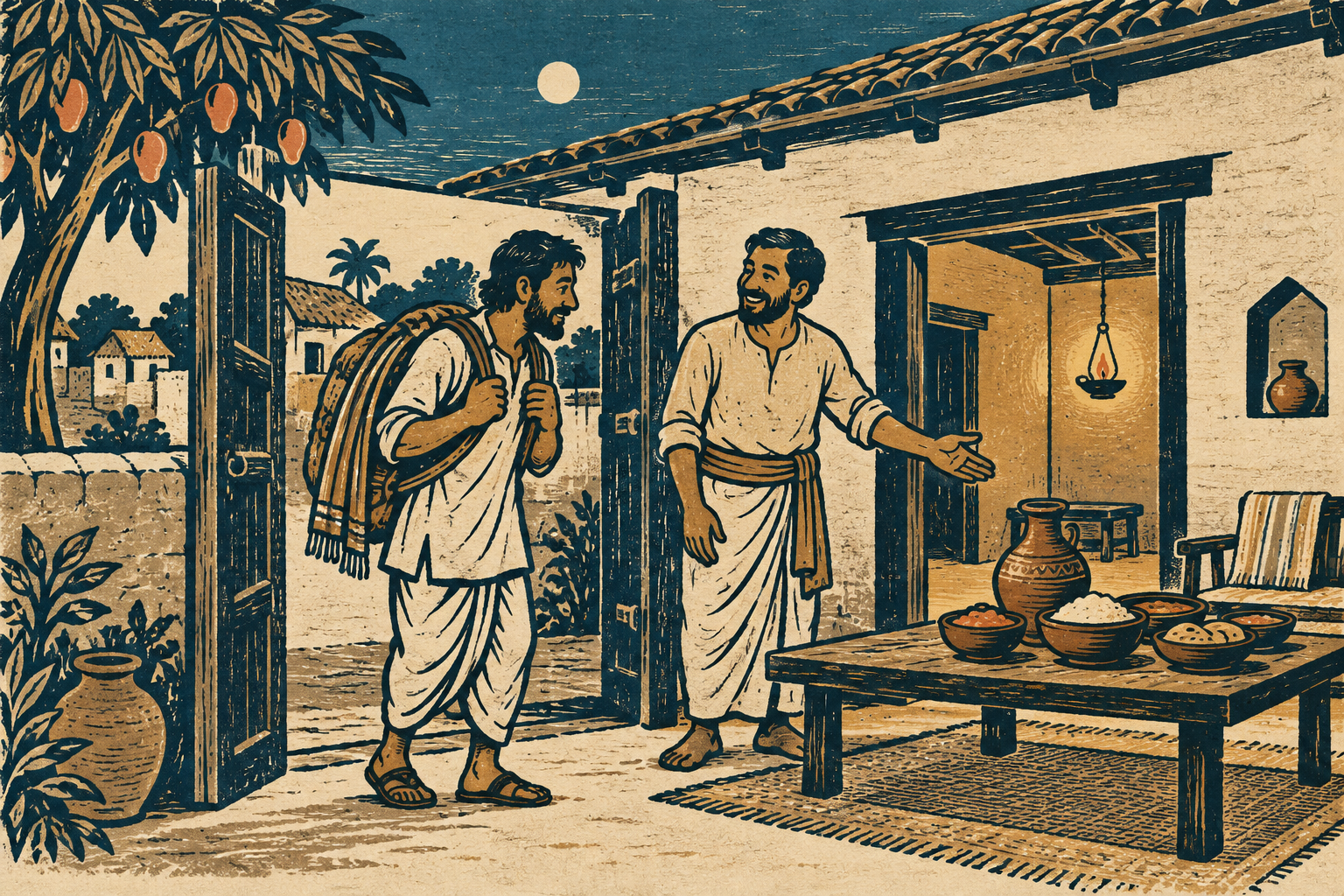
He travelled to a distant city and stayed three years, weaving as he always had, until he had earned three hundred pieces of gold — more than he’d ever held in his life. Satisfied, he started for home.
Partway there, night caught him in a wide forest, so he climbed into a great banyan tree to sleep safely above the ground. Deep in the night he half-woke to two shapes arguing somewhere below — furious, strange, and, it slowly dawned on him, arguing about him.
“Why did you let this man have three hundred pieces of gold,” one voice demanded, “when you know he’s never meant to keep more than his food and clothes?”
“I only give what enterprise deserves,” the other answered. “What becomes of it afterward is your business, not mine.”
The weaver didn’t understand a word of it — only that it seemed to concern him. When he woke fully and reached for his bag, it was empty. Three hundred pieces, gone, with no thief in sight and no explanation.
He was heartbroken, but not beaten. He went back and worked another year, and this time earned five hundred pieces of gold — even more than before. He started home by a different road, sure his luck would hold this time.
But the road brought him, somehow, to that very same forest, that very same tree. “Not this again,” he thought, and climbed up to sleep once more. And once more he heard the same two voices arguing over him — the same complaint, the same answer: whatever came to him was fairly earned, but what happened to it afterward was not this voice’s concern.
In the morning his bag was empty again. Five hundred pieces, vanished a second time, from the same tree.
This time the weaver sat a long while at its foot with his head in his hands, turning it over: what was the use of working so hard, travelling so far, if it only slipped away from him twice in the very same place? He was still sitting there when one of the two voices he’d heard arguing stepped out of the shadows in front of him, plain as day.
“Don’t take it so hard, friend weaver,” the figure said. “I’m the one who’s been taking your gold — the one who decides you keep nothing beyond food and clothes, whatever you earn. But you’ve seen me now, twice over, and that oughtn’t happen for nothing. Ask me for whatever you want.”
The weaver didn’t hesitate. “Then give me money. Plenty of it.”
“What good is money to a man who can’t spend it or give it away? That’s still the shape of things for you — food and clothes, nothing more, however much passes through your hands.”
“I don’t care,” said the weaver. “I still want it. Even a man who never spends a coin of his fortune is respected simply for having it.” And he thought, too, of another old story he half-believed himself, about a jackal who had watched one particular bull for fifteen years, waiting for something that never once fell — and decided that watching wasn’t foolish, if what you were watching for was worth having.
The figure considered this. “If that’s truly what you want, go to the city once more. There you’ll find two merchants’ sons — one who hoards everything he has, one who gives freely. Watch how each is treated, and choose for yourself which kind of rich man you’d rather be.” And then the figure was gone.
So the weaver went, tired and puzzled, back to the city a third time.
He found the hoarder’s house first. Though the man’s wife and children grumbled at the door, he was let into the courtyard and given a plain meal without a kind word, and left to sleep on the hard ground. Come morning he understood why the house had felt so joyless: its owner had been shut away sick for days, and no one there had a kind word to spare for anybody.
So he found the second house — the generous man’s — and there he was welcomed warmly, fed well, and given a soft bed. But that morning a messenger arrived from the king himself, bringing the generous man a gift of gold as thanks for some kindness done long before — more, the weaver guessed, than the man had spent on him and a dozen other guests besides.
Watching all this, the weaver understood at last what he had been shown. The hoarder’s wealth had brought him a shut door and a joyless house. The generous man’s had come back to him doubled, full of people glad to sit at his table. Wealth only kept was, in the end, no different from no wealth at all.
“If I’m only ever to keep food and clothes,” the weaver said to himself, “then let whatever passes through my hands do some good on its way through.” And from the day he decided that, the same fate that had twice emptied his bag under that tree seemed to turn and walk beside him instead of against him — and whatever came to him after, he gave away as freely as it had come.
Here, under our tree, Dev picked the coin jar back up and gave it one last shake, listening to the coins settle.
“I liked the kind one better,” he said. “He just seems nicer to be.”
“So do I,” said Nani.
Leo was already muttering sums under his breath — how many coins, how many shoes, how much would be left to give away if there was any.
Mira reached over and took the jar from Dev’s hands, gently, and set it down on the root between them, where it caught the last of the light.
For the grown-up (not read aloud): the heart of it — fate decides what comes and goes; what a person becomes about it is the part that is actually theirs.
Where it comes from: retold from the Panchatantra (the weaver who lost his fortune twice, Book 2), freely reshaped.
More stories for ages 6–8
The Jackal’s Slow Supper · The Song That Scared a Prince · The Crow Who Wanted a Friend · A Thousand Tiny Teeth · The Reason Nobody Knew · What Four Friends Can Do
 Banyan Story Studio