


Growing listeners · ages 6–8 · comfortable from 5 with a grown-up · Retold from the Panchatantra
A heads-up: this story has three deaths in it — a hunter, the boar he hunts, and the jackal who finds them afterward. Each one happens quickly and simply, with nothing dwelt on, but nobody comes back.
Reading aloud? A note for you
All three deaths are stated plainly and quickly — no wounds described, no lingering. A six- or seven-year-old may still want to stop and ask about them; a simple, calm answer is enough, and there’s no need to add anything the story itself doesn’t say. Slow down slightly where the jackal decides to eat slowly and carefully — that patience is the whole turn of the story, not a side detail. There’s no separate lesson tacked on at the end; the story makes its point and stops there.
The smell of a neighbour’s puris frying drifted over the wall, oil and hot dough, and Leo lifted his nose to it like a dog catching a scent. “I could eat six of those,” he announced.
Dev, sitting closest to the wall, said nothing, just kept sniffing at it every few seconds, saving each breath of it like it might run out.
Mira noticed him doing it and almost laughed. “You’re rationing a smell,” she said.
“There are worse things to be careful with,” Nani said, settling in. “Tonight’s story disagrees with you a little, though. A poor Brahman told it to his wife, one evening, to explain something about greed — not the loud, grabby kind, but the quiet kind, that dresses itself up as being careful, and doesn’t even know it’s greed at all.”
Leo sat up. “How can careful be greedy?”
“That’s the whole story,” said Nani. “Listen.”
There was once a hunter who went out one morning meaning to hunt, the way he had a hundred mornings before, with no reason to think this one would be any different. He hadn’t gone far before he came across a boar — a big one, heavy through the shoulders, rooting through the undergrowth with no idea he was being watched.
The hunter drew his bow and let the arrow fly. It went in deep. The boar staggered — but a wounded boar is not the same as a dead one, not right away, and this one had plenty of fury left in him. Before the hunter could ready a second arrow, the boar spun on him and drove one long fang straight into him. The hunter went down where he stood. Not long after, so did the boar; the arrow had been doing its own slower work the whole time. By the time anyone might have come looking, the two of them lay a few feet apart in the grass, each one brought down by the other, both dead within the hour.
Later that same day, a jackal came wandering through, thin and hollow-sided the way jackals get toward the end of a lean season, going from one patch of scrub to the next without much hope of finding anything worth the trouble. What he found instead was more than he had any right to expect: a boar and a man, both dead, both entirely his, with no other jackal, no vulture, no one at all nearby to argue him out of any of it.
A hungrier animal might have fallen on a find like that and eaten until he couldn’t move. This jackal didn’t. He sat back on his haunches and thought it through. Food like this didn’t come along twice in a season, and the sensible thing, he decided, was not to waste it by rushing. Eat slowly. Eat carefully. Start small and save the best for later, the way a wise creature would — not the way a foolish one gulps down a fortune in one sitting and has nothing left by morning.
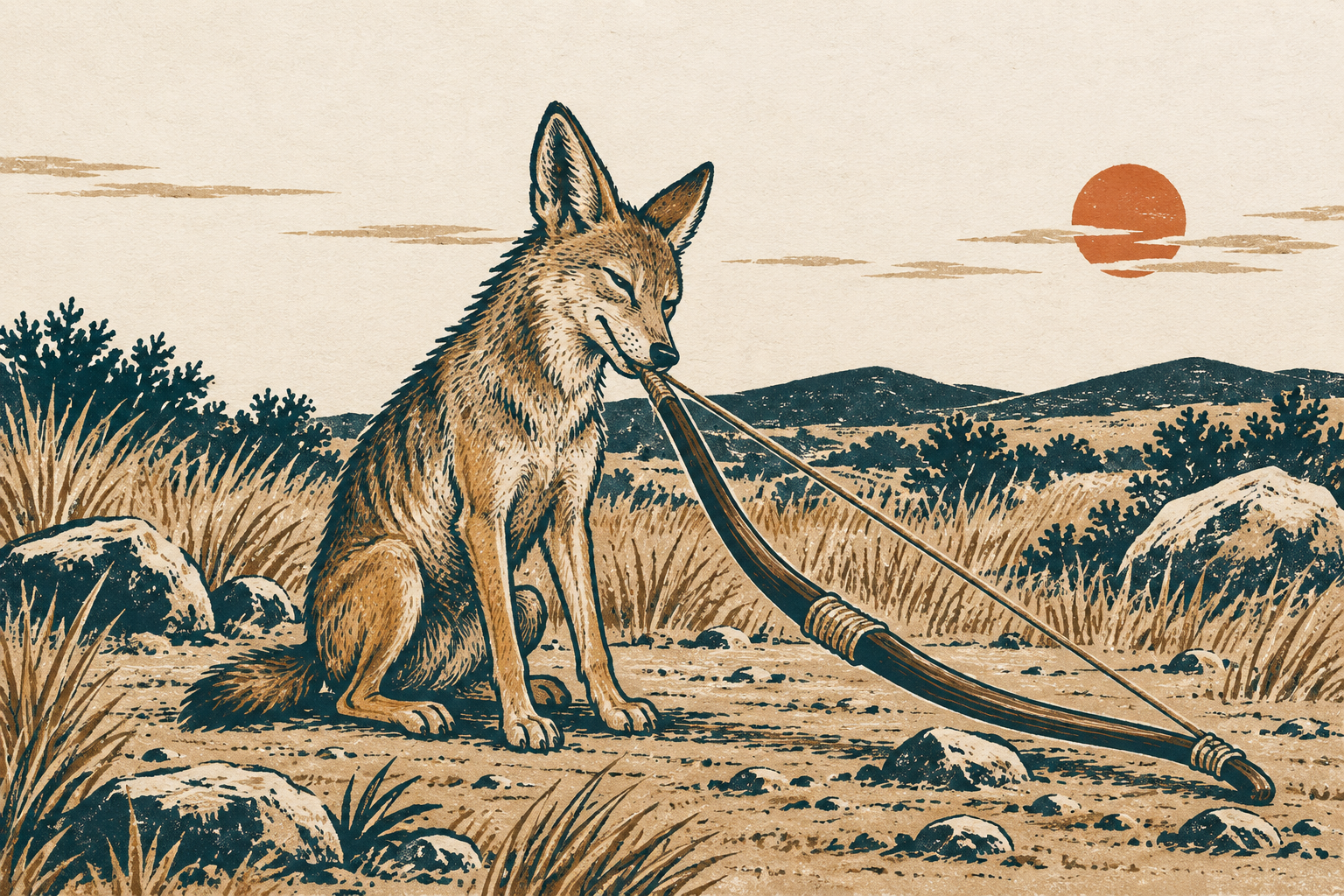
So he chose a modest place to begin: a length of sinew, still strung bowstring-tight across the dead hunter’s bow. It would hold him a good while, he reasoned, if he was patient with it — and being patient was exactly the point of the whole plan. He was going to do this properly.
He took the loose end of the sinew into his mouth and began to gnaw at it, slow and deliberate, quite pleased with his own restraint. A little at a time. Gentle enough not to snap it too soon. By his own reckoning he was being wise about it — wiser, certainly, than an animal foolish enough to wolf the whole thing down by sundown.
But a bowstring pulled to its very limit doesn’t know or care how carefully it is being chewed. It only knows how much give is left in it, and there wasn’t much. Between one careful bite and the next, the cord let go all at once, snapping back hard — and the freed tip of the bow drove straight up through the roof of the jackal’s mouth. He died there, beside all he had been so carefully saving.
All that patience. All that caution, weighed out so carefully bite by bite. And in the end it was the caution itself that undid him — not hunger, not carelessness, not some stroke of bad luck out of nowhere. He had been careful, most carefully, about exactly the wrong thing, at exactly the wrong moment, and no amount of forethought could take that back once the string had gone.
Here, under our tree, the smell of puris had faded from the wall, the frying long finished next door.
“I don’t think I want to be that careful,” Dev said quietly.
“No,” Nani agreed. “Neither do I.”
Bupam had fallen asleep somewhere in the dark overhead, one small paw twitching now and then. Leo, for once, didn’t say anything at all — he just sat there, still thinking about the puris he never got.
For the grown-up (not read aloud): the heart of it — being careful can shade into the same greed it’s meant to guard against, and once it has, no amount of forethought can undo the harm.
Where it comes from: retold from the Panchatantra (the hunter, the boar, and the jackal, Book 2).
More stories for ages 6–8
The Song That Scared a Prince · The Crow Who Wanted a Friend · A Thousand Tiny Teeth · The Reason Nobody Knew · What Four Friends Can Do · Two Heads, One Tummy
 Banyan Story Studio