


Growing listeners · ages 6–8 · comfortable from 5 with a grown-up · Retold from the Panchatantra
A heads-up: some mice are hurt before the story properly begins, and later the whole herd of elephants is caught and tied up — everyone is free by the end.
Reading aloud? A note for you
This story earns its move up to Growing Listeners honestly — real elephants hurt real mice in the first minutes, and the herd’s capture later on is described, not softened away. Slow down at the elephant king’s choice to change his whole herd’s path for creatures he could barely see underfoot; that’s the moment worth sitting in. Children often want to know how a thousand mice’s teeth could possibly free something so much bigger than themselves — let that question breathe for a beat before the story answers it. Hold the ending steady when you get there: every single elephant walks free, not just the king, and that whole-herd moment is the point the whole story has been walking toward.
Leo had decided he could carry the full water pot by himself, both arms wrapped around its belly, and got exactly three steps from the well before his legs gave out and he had to set it down hard, water slopping over the rim. He tried again, grunting, and it didn’t move an inch further. Mira crouched down beside him, more curious about why it wouldn’t budge than about helping him win the argument with it. “Grab the other side,” Dev said, already doing exactly that.
Between the two of them, it lifted easily.
“Funny how that works,” Nani said, watching them carry it the rest of the way together. “Tonight’s story is about elephants,” she said, “and the smallest friends an elephant ever had. It’s a story a deer once told, to prove to a wary new friend that the size of a creature is no measure of the kindness it can offer — about how a kindness, once given away freely, has a way of coming back to you exactly when you need it most.”
“Listen.” And she began.
In a stretch of country where the houses and temples had long since crumbled and nobody had ever come back to mend them, the mice had made the ruins their own. They had lived there so many generations that mothers and fathers and sons and grandchildren had all been born and grown old inside the same tangle of burrows, until the whole broken place was laced through underground with mouse-tunnels. They held their own festivals down in the dark, and their own wedding-feasts, and told each other stories, and thought themselves entirely safe.
Then one evening the ground began to shake.
An elephant king was leading his herd toward a lake on the far side of the mouse city — thousands of elephants, marching in one long grey column, none of them able to see what lay beneath their own enormous feet. As the herd crossed the ruins, elephant after elephant came down on ground the mice called home. Mice were crushed underfoot before they could so much as call a warning to their neighbours. By the time the whole herd had passed, the mouse city had lost more of its own than anyone wanted to count.
The survivors gathered that very night. “We cannot let this happen again,” said the oldest among them. “If the herd comes this way a second time, too few of us will be left to start over.” So a small band of the bravest mice went out to the lake, climbed up to where the elephant king could see them, and bowed low.
“O King,” they said, “our families have lived on that ruined ground longer than anyone can count. Tonight your herd crossed it, and many of us did not survive the crossing. We ask only this — that you find another path to the water. Even a creature as small as we are may prove useful to you, someday.”
The elephant king looked down at the small, trembling shapes gathered at his feet for a long moment. Then he bowed his great head. “You ask fairly, and I grant it,” he said. “From tonight, my herd takes the long way round.” And they did — every evening after, the whole herd turning aside rather than cross the mouse city again.
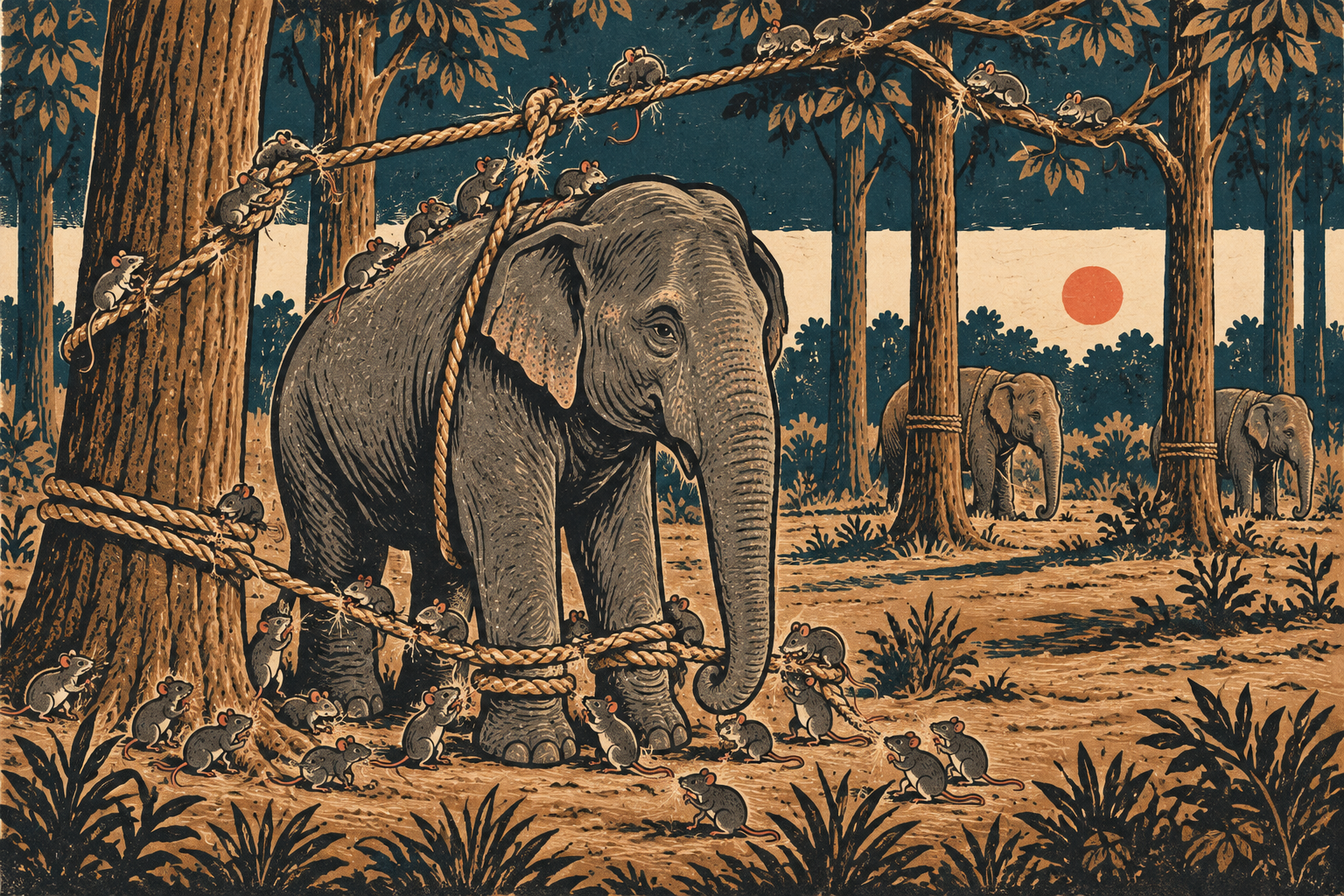
Seasons passed, and the elephant herd grew easy near that lake, the danger half forgotten by everyone but the mice, who never forgot a kindness or a threat. Then, one year, people came from over the hills and built a trap at the water’s edge — ropes hidden and disguised so cleverly that the herd walked straight into it, not understanding what had closed around them until it was too late. Three days later they dragged the whole herd out with ropes and heavy tackle, and bound every elephant fast to the trunks of stout trees through that stretch of forest — the king among them, tied as tightly as any of his herd.
For a long while the elephant king strained against the ropes and could not move them at all. When they had finally gone, he lay still and thought. “There is only one way I might be freed,” he said at last, “and it is not in my own strength to manage.” He remembered the mice.
Among his herd was one elephant-cow who had wandered wide of the trap and had never been caught. To her the king gave a message, exact and urgent, telling her precisely where the herd lay bound — and sent her running for the mouse city as fast as she could go.
When the message reached them, the mice did not hesitate for even a moment. They came pouring out of every burrow by the thousand, a grey river of them flowing across the ruined ground and on toward the forest where the herd lay tied. They found the elephants exactly as the message had said — king and herd both, roped fast to the trees, unable to so much as shift a foot.
The mice went to work at once. They climbed the ropes where they were pegged to the ground and gnawed them through, strand by strand. Then they swarmed up the trunks and out along the branches overhead, and gnawed through the ropes thrown high, one after another, until every single line holding a single elephant had been cut clean through.
One by one, and then all together, the herd stood free — the great king first to test his legs, and then every elephant behind him, until not one animal was left bound to a tree in that whole stretch of forest. Mice no bigger than a thumb had done, together, what no strength of trunk or tusk could manage alone.
That is how it happened — how the smallest friends in that whole forest, remembered for one small kindness given long before, came back and gave a kindness far too large for any one of them to have managed on their own.
Here, under our tree, Dev and Leo set the water pot down together by the roots, not a drop spilled this time.
“I couldn’t do it alone,” Leo admitted, “even trying really hard.”
“Nobody said alone was the point,” said Nani, and it wasn’t only about the pot.
Mira looked at the two of them a moment longer than she needed to, like a thousand mice all pulling the same rope, and said nothing at all.
For the grown-up (not read aloud): the heart of it — a small kindness, once given freely, has a way of coming back exactly when it’s needed most, however unlikely the friendship.
Where it comes from: retold from the Panchatantra (the mice who set an elephant herd free, Book 2).
More stories for ages 6–8
The Reason Nobody Knew · What Four Friends Can Do · Two Heads, One Tummy · The Mouse’s Hidden Hoard · What the Weaver Chose · The Jackal’s Slow Supper
 Banyan Story Studio