


Growing listeners · ages 6–8 · comfortable from 5 with a grown-up · Retold from the Panchatantra
A heads-up: fishermen net a lake, and one of the three fish is caught. The story stops there — nothing more is said.
Reading aloud? A note for you
Slow down for the three fish’s three answers near the start — that’s the whole shape of the story, so let each one land before moving to the next. Your listener may ask what happens to the third fish; the honest answer is that the story doesn’t say, and that not knowing is part of the point. In the old telling, the net’s catch is described and the third fish is clubbed and dies; here, the story stops at the moment the net closes around him, and goes no further. Keep your pace even through the ending — it isn’t a twist to perform, just the quiet place the story chooses to end.
The tank down the road had its net spread out along the wall to dry, and Leo arrived still picking bits of torn netting off his sleeve — his kite had gone down into it that afternoon, and it had taken him a scolding and twenty minutes to get free. Mira dropped down cross-legged, a question about the story already half out of her mouth before she’d even sat. Dev settled quietly nearby without anyone noticing him arrive, close enough to hear everything without needing to ask a thing.
“Tonight,” said Nani, “I’ll tell you what the plover’s wife told her husband, down by the sea, when she was trying to make him listen to a warning. It’s a small story inside a bigger one, about three fish who all faced the same bad news — and about how only planning ahead, or thinking fast, gets you through it. Waiting for things to turn out fine is no plan at all.”
Leo, still smelling faintly of river and rope, opened his mouth to ask something else entirely.
“Listen.” And she began.
In a wide, quiet lake lived three fish who had been neighbours there for years. One of them was always watching ahead for trouble before it came. One trusted his own quick thinking to get him out of whatever happened. And one believed that whatever was going to happen would happen, and that no fish alive could do a thing about it.
One evening the watchful fish overheard two men talking on the bank. “The lake’s full of fish,” one of them said. “We’ll come back tomorrow and net the whole thing.”
The watchful fish didn’t wait to hear more. He found the other two and told them exactly what he’d heard. “We should leave tonight,” he said, “and find a quieter lake, before the nets come.”
The quick-thinking fish shook his head. “I’ve lived in this lake my whole life,” he said. “I’m not leaving it over a little talk on the bank. If the men do come, I’ll think of something when the time comes.”
The third fish only laughed. “There are lakes enough in the world,” he said. “Who’s to say they’ll even come back here? A fish shouldn’t leave the lake he was born in over some gossip. Whatever happens, happens — planning ahead never changed that yet.”
The watchful fish saw that neither one would change his mind. That night, while the other two stayed where they were, he swam away alone, out of that lake and into another one, where the water ran quiet and no one was talking about nets.
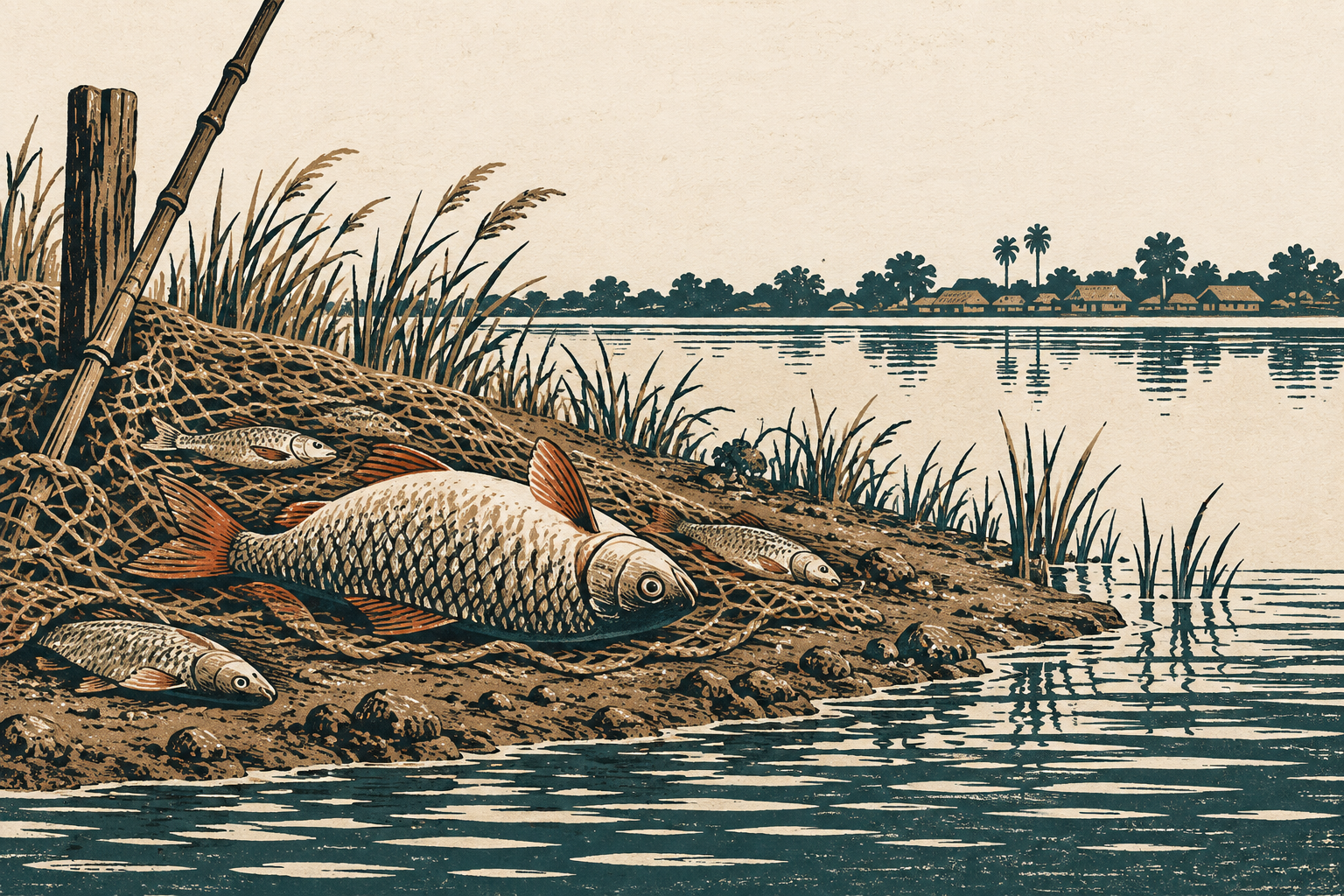
Sure enough, the very next day, the men came back — with their sons this time, and with the net — and they drew it closed around the whole lake at once, so that every fish still swimming in it was caught together.
The quick-thinking fish felt the net tighten around him, and he didn’t thrash the way the others did. He went still instead — belly up, eyes open, not moving a fin — until the men, hauling their catch up onto the bank, saw him and said to each other, “That big one must have died of fright before we even had him.” They lifted him out and laid him down with the rest. And the moment their backs were turned, he gave one flick of his tail and was gone, back into the water, swimming for his life.
But the third fish — the one who had trusted that nothing would happen — fought the net with everything he had, this way and that, and the more he fought it, the tighter it held him. And there, caught fast in the mesh of the net, is where this story stops.
Two of the three fish had something ready for the day trouble finally came — one of them had already left and found somewhere safer, and the other had a trick, quick as thought, right when he needed it. The third had nothing ready at all. And nothing ready was the one thing that net was never going to forgive.
Here, under our tree, Leo turned the scrap of net over once more in his fingers, saying nothing. Nearby, Bupam had already lost interest and gone back to working loose a fig, unconcerned with fish or nets or nets closing on anyone.
“I would have left with the first one,” Mira said finally, quiet and sure. “The very first night.”
Nani nodded, watching the dark settle deeper into the leaves. “So would I.”
Dev reached over and took the scrap of net gently from Leo’s hand, and held onto it instead, as though it needed somewhere safe to be.
For the grown-up (not read aloud): the heart of it — when trouble is coming, only two things actually help: leaving in time, or thinking fast when the moment arrives. Waiting to see what happens is not a third option.
Where it comes from: retold from the Panchatantra (the three fish and the fishermen’s net, Book 1), freely reshaped. In the old telling, the net’s catch is described in full and the third fish is beaten and killed; here, the story stops the moment he is caught fast in the net, and says no more.
More stories for ages 6–8
The Crow Who Wanted a Friend · A Thousand Tiny Teeth · The Reason Nobody Knew · What Four Friends Can Do · Two Heads, One Tummy · The Mouse’s Hidden Hoard
 Banyan Story Studio