


Growing listeners · ages 6–8 · comfortable from 5 with a grown-up · Retold from the Panchatantra
A heads-up: the sea takes the plover’s eggs. They come home safe, but it takes the whole story — and some very large help — to get them there.
Reading aloud? A note for you
Slow down after “We have lost our young” — let that land before the plover starts making his plan. Your child may ask why the sea did it at all; the old story only says the sea wanted to see what the small, loud bird could really do, and that is a fair thing to leave unanswered. Two old stories the plover’s wife tells her husband, to warn him, are left out here — they get their own evenings another night. The oldest telling of this tale gives the mother’s grief no more than grief; we have kept it that way, and left out a line found in a later telling where she speaks of harming herself. When the birds first try to beat the sea back with their own wings, let that struggle sound as hard and as useless as it is — the story does not let them win that way, which is the whole point of what happens next.
It had rained hard that afternoon, and even now, with the sky gone violet at the edges, a puddle by the far root hadn’t drained away. Leo had been jumping the width of it since before anyone else arrived, and landed one final time, right in the middle, so his sandals came out soaked. Mira didn’t even try to hide her laugh, though she stayed well back from the splash. Bupam picked his way along the driest strip of ground he could find and settled onto the root beside Nani, tail tucked well clear of the water.
“Tonight’s story,” Nani said, once Leo had wrung out a sock and given up on his sandals entirely, “is the one a jackal told a bull, the night before the bull went to fight the lion — to warn him: find out how strong an enemy truly is before you take him on. It’s about a small bird who didn’t wait to find that out, and a sea that found it out the hard way.”
Dev looked at the puddle. “Water can be strong?”
“Wait and see,” said Nani.
“Listen.” And Nani began.
By the edge of the great sea, where the water never once lay still, a plover made his home with his mate. When her time came to lay her eggs, she wanted to move somewhere safer, further back from the water. Her husband would not hear of it. This shore was their home, he said, and besides — the sea knew him. The sea would never dare reach for anything of his.
She tried to warn him with old stories she knew, about creatures who did not look before they leapt and paid for it dearly. He laughed at every one of them. So, in the end, she laid her eggs where he wanted, in the warm sand he loved.
But the sea had been listening to the whole argument, wave after wave, and he thought to himself: everyone speaks so highly of themselves. I wonder what this small, loud bird can actually do. The very next day, while the two plovers were off hunting for their supper, the sea sent one long reach of water up the sand and pulled the eggs down into itself, just to see what would happen.
When the plover’s wife came home to an empty nest, her whole body went cold. “We have lost our young,” she said. “Our children are gone.”
“Watch what I can do,” the plover told her. “I mean to dry up this sea with my own bill, if that is what it takes to get them back.”
His wife told him plainly that his bill held one drop of water at a time, and the sea held every river that had ever run to it — how could that ever be a fair fight? But she told him one true thing besides: if he truly meant to take this on, he should not take it on alone. He should call his friends first.
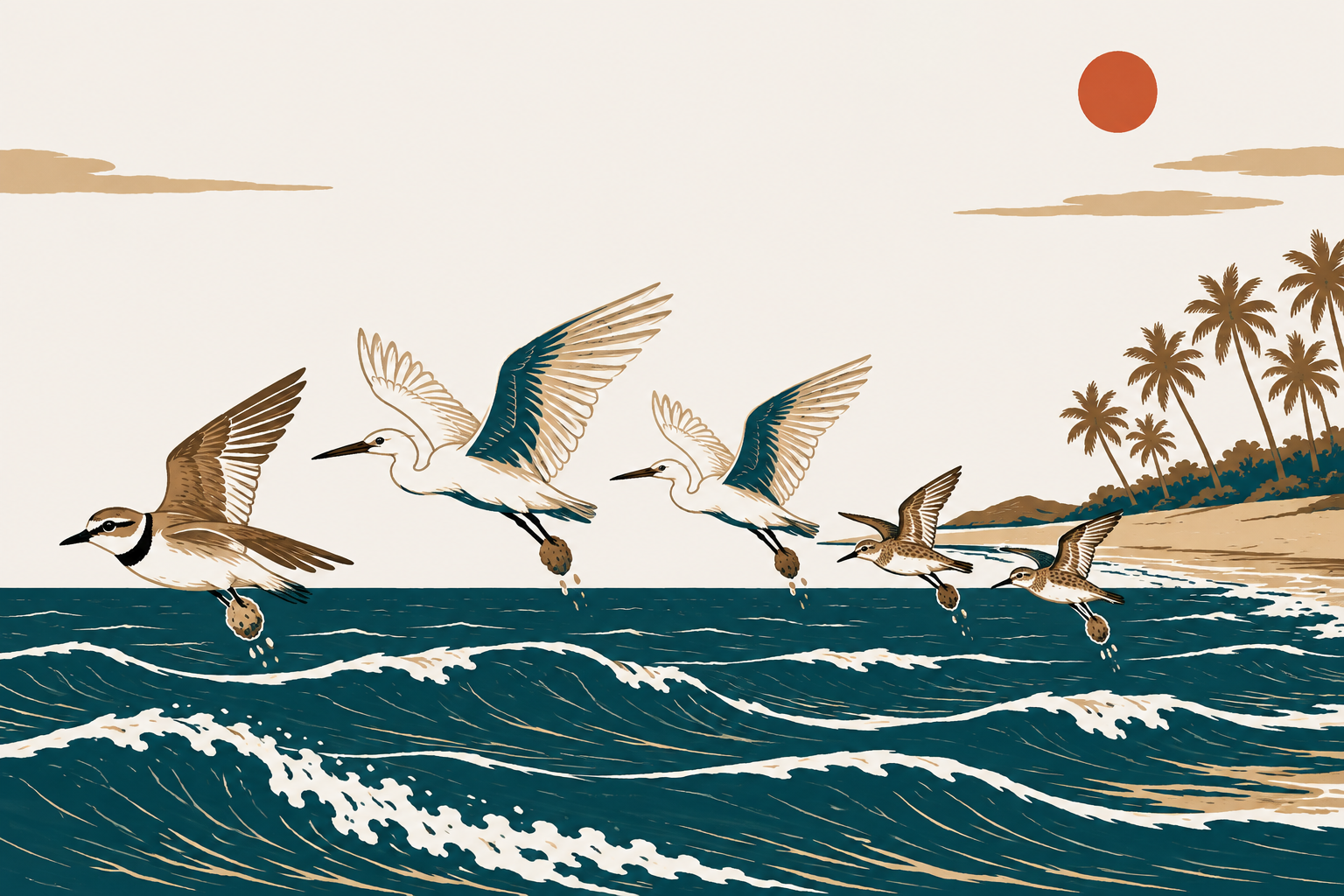
So the plover called every bird he knew down to the shore and told them what the sea had done. And they were angry together, all at once. The birds beat at the waves with their wings. They carried clods of mud and sand in their bills and dropped them into the water, trying to fill up the sea from above. It made no difference at all. The sea only rolled on, exactly as it had before, as if it had not noticed.
Then one of the birds said what they were all beginning to think: we are not a match for the sea, wing against wave. But there is one who might be — Garuda, who rules over every bird. Let us carry our grief to him, instead of wearing ourselves out against something we cannot beat alone.
So they went to Garuda and told him everything: the eggs, the empty nest, the sea that had not even troubled to hide what it had done. And it happened that Garuda had just been called to the side of Vishnu himself, for a great battle was coming. But Garuda would not go, not yet. “The sea has stolen from one of my own,” he said, “and shamed me by doing it. I will set this right first.”
When Vishnu heard that his servant Garuda held back — angry, and for good reason — he did not send for him again. He came himself, down to where Garuda waited, and listened to the whole story of the plover and his empty nest. Then he turned to the sea, fitted an arrow of fire to his bow, and spoke a single warning: give the eggs back, or be driven back yourself, all the way to dry land.
At that, the great sea, who a day before had not troubled to hide behind so much as a wave, trembled through every current he had. He reached down, found the eggs exactly where he had put them, and set them back on the shore, safe and whole, before Vishnu had to ask a second time.
So the sea learned, in the end, what every creature ought to find out before it starts a fight — how strong is the one across from you, truly, and not merely how strong you hope you are. The small bird found this out for himself, and would not let go until it was proven. The great sea found it out only once it was already too late to matter.
Here, under our tree, Leo looked over at the puddle he’d been jumping in earlier, gone dark and flat and ordinary now that the story was over.
“The sea gave it back,” he said, like he still couldn’t quite believe it.
“It gave it back,” Nani agreed, and nothing more.
Dev didn’t say anything. He was watching the puddle too, the way you watch water when you’ve just heard what it can hide.
For the grown-up (not read aloud): the heart of it — find out how strong an enemy really is before you take them on.
Where it comes from: retold from the Panchatantra (the plover and the sea, Book 1). In the old book, Damanaka the jackal tells it to Sanjivaka the bull.
More stories for ages 6–8
Three Fish and the Net · The Crow Who Wanted a Friend · A Thousand Tiny Teeth · The Reason Nobody Knew · What Four Friends Can Do · Two Heads, One Tummy
 Banyan Story Studio