


Older listeners · ages 9–12 · comfortable from 8 with a grown-up · Retold from the Panchatantra
A heads-up: this trickster eats trusting animals off the page, night after night, and the story ends right at the moment danger finally turns on him — not after.
Reading aloud? A note for you
Slow down through the middle, the string of quiet evenings where fewer and fewer fish come home — that steady, unremarked-upon loss is where the real danger of this story lives, more than in any single scene. Your child may ask what happens to the heron after the crab’s claws close, or why the fish kept trusting him even as their numbers thinned; both are worth sitting with rather than rushing to answer. This telling stops deliberately at that grip closing — it isn’t a cut corner, it’s where the point lands. In the old telling, the story goes on to show the heron’s death and the crab carrying proof of it home; here it stops before that, at the claws closing round his throat.
Leo arrived still finishing off a mango, sucking the last of it from around the stone, sticky to the wrist and unbothered by it. Mira had already claimed her usual spot and was watching him with faint disapproval, arms crossed. Dev, full and drowsy after dinner, took his time crossing the yard and folded himself down without much ceremony, eyes already half closing.
“Tonight’s story,” Nani said, “was told by a jackal, once, to two crows who had made friends with someone they shouldn’t have — a stranger who seemed very kind, for a long time. It’s a story about a hunger that never once stops asking for more, until, one evening, it asks the wrong one.”
Leo looked up from the mango stone, suddenly less interested in it.
Mira uncrossed her arms slowly, already turning the idea over.
Dev didn’t open his eyes, but he was listening — you could tell by how quiet he’d gone, waiting for the story to start properly.
“Listen.” And Nani began.
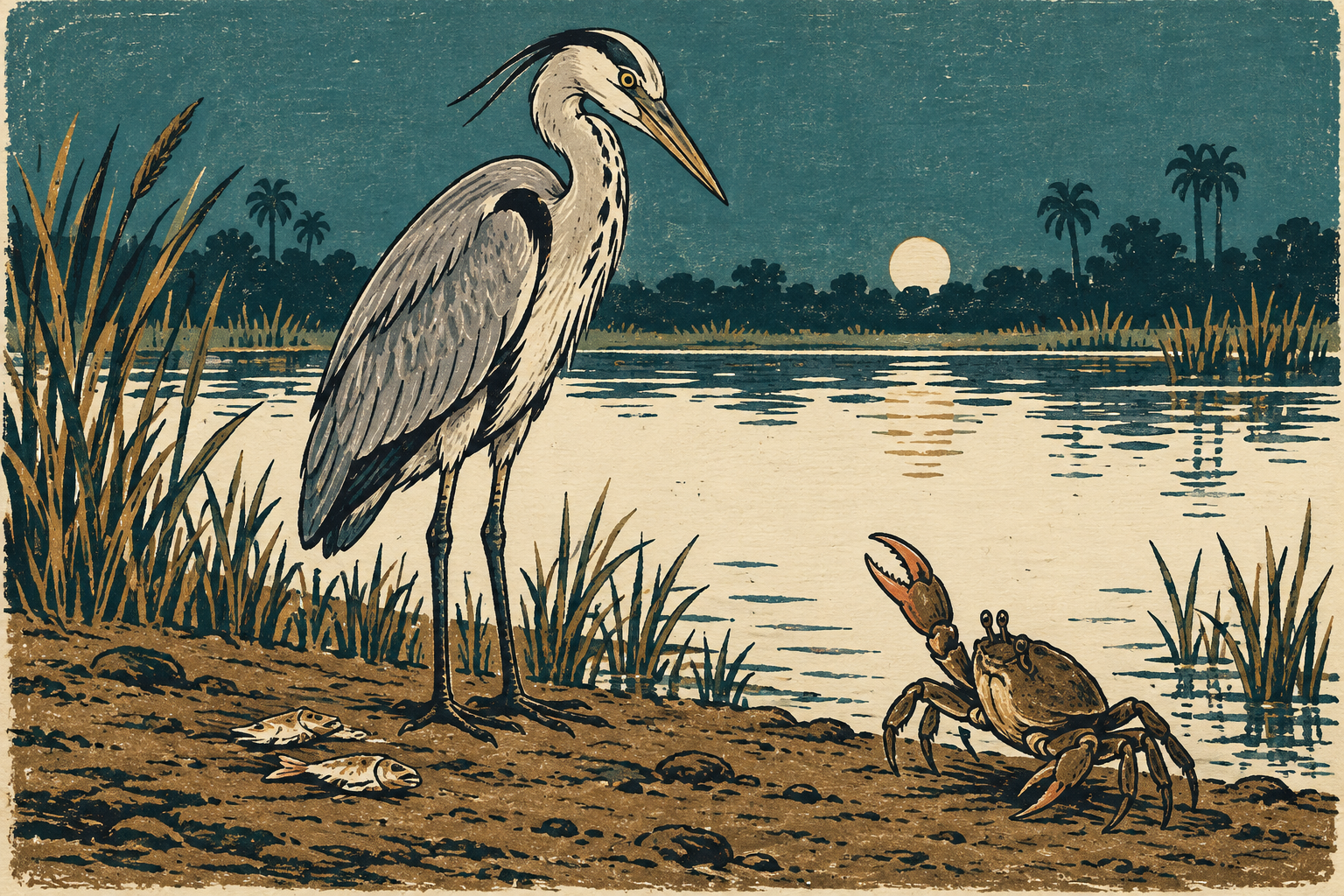
Beside a certain pond, in a certain place, there lived an old heron.
He had fished that water for so many years that plain fishing no longer satisfied him, and one evening he did something the pond had never once seen him do: he stood at the water’s edge, still and silent, wings folded, and touched no food at all. He let his usual hour for eating come and pass, and the fish that swam near his feet — fish he would, on any other evening, have snapped up without a thought — he let go untouched.
A crab who lived among those fish noticed, and came close to ask about it. “Uncle,” he said, “why do you leave your supper tonight, and your amusements too? You are not yourself.”
The heron sighed, long and heavy, before he answered. “I have been listening to men talk,” he said. “Fishermen, down at the water’s edge, this very morning, laying their plans where they thought no one could hear. They said this pond of ours is a rich one, full of fish, and that as soon as tomorrow, or the next day at the latest, they mean to draw their nets straight through it, from one bank to the other. When that day comes, there will be nothing left of this pond, or of any of you who live in it — and nothing left for an old bird who has fed here his whole life, either. That is why I have no heart for eating tonight. I am thinking only of what is coming.”
The word went from fish to fish faster than any of them could swim, out to the farthest corner of the pond, until every last one of them had heard it and was afraid. They crowded close around the heron, jostling each other in the shallows, and begged him: “Uncle! Friend! You know of this danger before any of us — surely you must know some way to save us from it.”
The heron let them wait a moment before he answered, as though the idea pained him to give, as though he were only offering it now, reluctantly, because they had asked so hard. “I am only a bird,” he said. “I cannot stand against men and their nets, and I would not try. But I happen to know of another pond, not far from here, one the fishermen have never found and never will — a pond with no bottom to it at all, and water enough for every fish in this one twice over. I could carry you there myself, to safety, a few of you at a time, in my bill. If you would trust me to.”
And because they were afraid, and because a face they had known for years is the easiest one in the world to trust, they did. Each one who heard the offer thanked him for it, and none of them asked why an old fish-eating bird should trouble himself to save the very creatures he had always eaten.
Each evening after that, the heron lifted a mouthful of fish from the pond in his bill and rose into the darkening air with them, and flew off toward the pond he had promised, the one with no bottom. And each evening, fewer of those who had gone with him came home again to tell the others how it had gone. The ones left behind noticed the water growing emptier around them, day by day, but they told each other it must simply take fish some time to settle into a new home so far away, and that surely their own turn was coming soon enough — and went on trusting him exactly as they always had, because nothing about him had ever given them reason not to.
It was the crab, in the end, who grew frightened enough of his own turn to ask for himself. “Uncle,” he said, when the day came that the pond held hardly any fish at all, “will you carry me to safety too, the way you carried the others?”
The heron looked at him a long moment before he answered. He had grown tired, if truth be told, of the same plain fish night after night — and a crab, he thought to himself, might make a pleasant change from his usual diet, something different for once. So he agreed, and when the crab climbed up, he lifted him carefully in his bill and rose into the evening air, just as he had with all the rest.
The crab noticed something, though, that the fish before him perhaps never had the chance to notice. They were not flying over any water at all — not the pond behind them, not any pond ahead — but toward a bare, sun-scorched stretch of rock, far out past the last trees, where nothing grew and nothing pooled. “Uncle,” he asked, careful to keep his voice steady, “where is this bottomless water you promised us? I see no water here at all.”
The heron only laughed at that, a short, satisfied sound. “Do you see that rock below us?” he said. “Every fish I have carried from your pond has found its rest there. Now it is your turn, little friend, to find your rest there too.”
The crab looked down, then, at what lay waiting beneath him — and it was no pond at all. It was a great heap of fish bones, picked bare and clean, scattered white across the hot stone in every direction: the “rest” that every one of those trusting fish had found, night after night, for as long as the heron had been offering to carry them to safety.
He understood everything then, all in a single rush: where the fish had gone, and why not one of them had ever come home again to say so, and what exactly was waiting for him the moment the heron’s bill opened over that rock, the way it must have opened for every fish before him.
There was no time left to be afraid of it, and no time to think of anything clever to say. With all four of his claws at once, the crab reached up and closed them, hard, around the heron’s throat —
— and there the story stops, at the moment the crab’s claws close tight round the heron’s neck, exactly where its telling has always stopped. Because that is the whole of it, and nothing more needs saying past this point: a hunger that eats and eats, trusting meal after trusting meal, sooner or later reaches for the one throat it cannot get its bill around.
Here, under our tree, Leo looked down at the mango stone still in his hand and set it aside, not finishing the last of the flesh clinging to it after all.
Mira spoke first. “He trusted a face he’d known for years,” she said slowly. “That’s exactly why it worked on him, every time — right up until it didn’t.”
Dev didn’t say anything at all. He only opened his eyes, found Nani’s in the near-dark, and held them a moment, as if checking something in himself against something in her.
Nobody explained what that was, and nobody asked.
For the grown-up (not read aloud): the heart of it — a hunger that eats and eats will, one day, reach for the one throat it cannot swallow.
Where it comes from: retold from the Panchatantra (the heron and the crab, Book 1), freely reshaped.
More stories for ages 9–12
Three Warnings · The Light That Wasn’t Fire · The Owl Who Cried at Dawn · Buried Between Friends · The Parrot Who Edged Away · The Trail of Fish
 Banyan Story Studio