


Growing listeners · ages 6–8 · comfortable from 5 with a grown-up · Retold from the Panchatantra
A heads-up: two hungry friends want to hurt someone in this story, but nothing happens to him, and he gets safely away.
Reading aloud? A note for you
A lion’s two hungry hangers-on decide they want the carpenter for their dinner, and the lion refuses but still leads them to him — that middle stretch, from “we’ll settle him” to the three of them setting off together, is where a child may reach for your hand. The carpenter is never in real danger; he sees the three coming from a distance and gets himself and his wife safely up a tree well before anyone arrives. The old telling has the jackal and the crow say plainly what they mean to do to the carpenter; here they only say there will be meat enough to go around, so the threat is felt without being dwelt on. There is no rescue scene and no reconciliation to wait for — the story simply ends with the carpenter staying up the tree, which is the point of it. Nothing here is invented; every beat is in the old telling.
Nani had a jar of green limes going in salt on the step beside her, turning it over every so often so the brine reached every piece evenly. Leo kept trying to reach past her for one, and kept getting his hand batted away before he could manage it. Mira sat close enough to watch the jar without asking for anything from it. Dev sat with his back against the root, listening to the evening settle before he said a word.
“So did the man in tonight’s story,” said Nani. “This is the one a bull told a jackal, back when a lion and a bull were still the best of friends. It’s about what it costs to be good to someone, when the company that someone keeps is not good to you at all.”
Mira looked over. “That sounds like a warning.”
“It is,” said Nani. “Listen.” And she began.
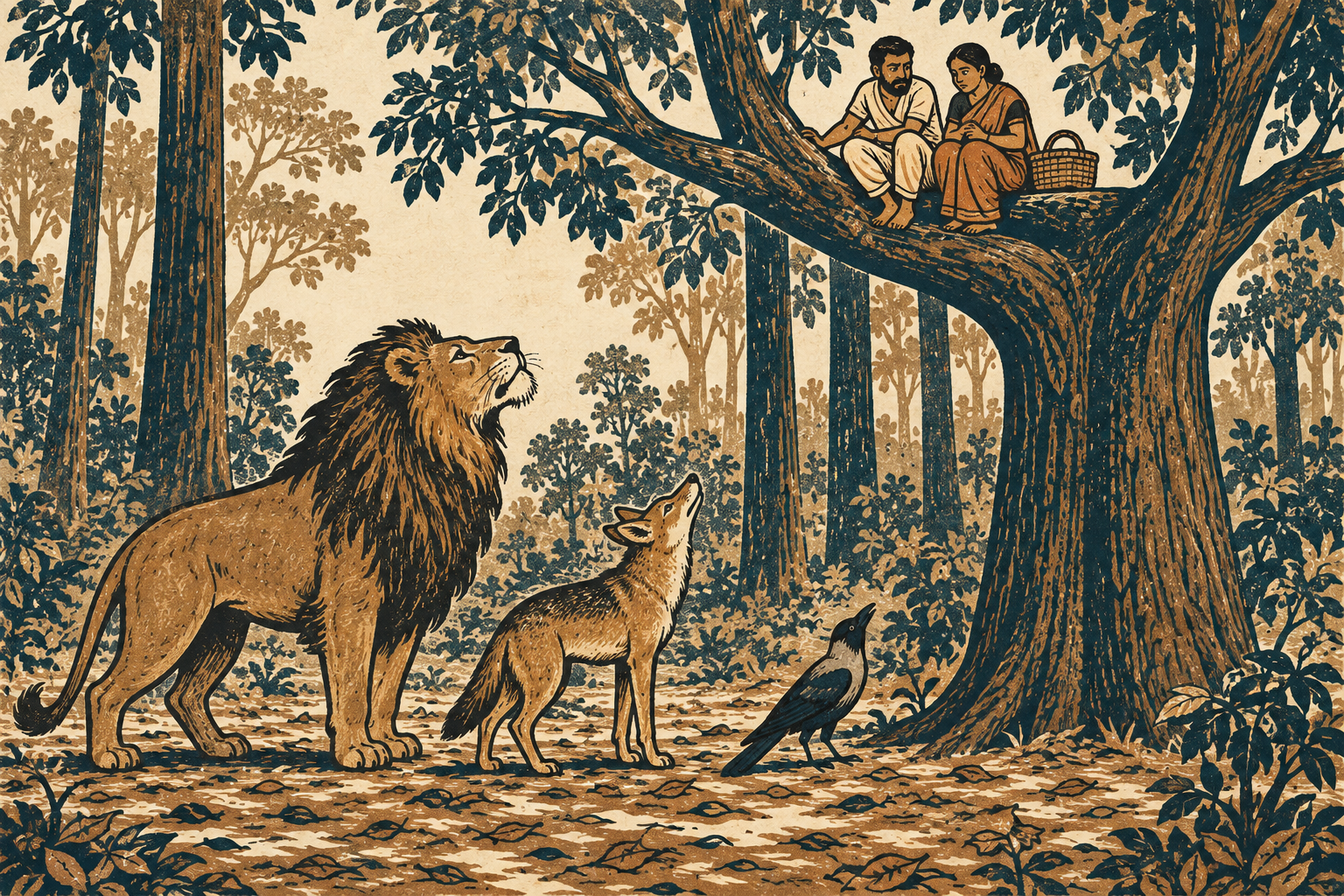
In a certain city there lived a carpenter, who carried his lunch into the forest each day, and his wife went with him, and there among the great trees he cut his logs — anjana wood, hard and heavy, good for building.
In that same forest lived a lion, and two hangers-on kept him company, living off whatever he left behind — a crow and a jackal.
One afternoon the lion went walking through the forest alone, with neither of them trailing after him, and came upon the carpenter at his work. The carpenter looked up at that great lion and thought fast, and rather than run, which he knew would only invite a chase, he walked toward him instead, bowed low, and said, “Friend, you must share my dinner today — my wife has cooked enough for two.”
The lion considered this. “I eat meat, not rice and cakes,” he said, “but I like the look of you. I’ll taste what you have.”
So the carpenter opened his basket and fed him — sweet cakes and buns, rich with butter and spice, better than anything a lion catches for himself — and the lion, delighted, promised him safe passage through the whole forest from that day on, and called him friend.
“Come every day,” said the carpenter. “But come alone.”
And so it went, day after day. Every afternoon the lion came to the carpenter’s fire and ate well, and the two of them sat together while the wife packed up her cooking things, and the lion grew so fond of those dainties that he gave up hunting altogether.
Now the crow and the jackal, who had always lived on whatever the lion left behind, began to go hungry, and at last they asked him outright: “Where have you been going off to, every single day — and why do you come home so pleased with yourself?”
“Nowhere,” said the lion. But they pressed him, and at last, because they kept at it, he told them of his friend the carpenter, and the food his wife cooked.
The two of them put their heads together. “Let’s go to this carpenter,” they said. “We’ll settle him, and there will be meat enough to keep us fed for a long while.”
But the lion had heard every word of it. “I gave him my word,” he said. “I won’t turn on a friend, not for you or anyone. But I’ll bring you something good from him too, so you needn’t go hungry.” And the two of them agreed to that, grumbling but agreeing, and the three of them set off together to find the carpenter.
The carpenter caught sight of them while the three of them were still a long way off across the clearing — the lion, and beside him the crow and the jackal, none of them creatures he had invited — and he did not like the look of it one bit. He and his wife climbed quickly into the nearest tall tree, up past the lowest branches, and waited.
The lion came up beneath it and called, “Friend, why have you climbed up there? It’s only me. Don’t be afraid.”
But the carpenter stayed exactly where he was, high in the branches, and looked down at the three of them standing in the clearing.
“Your jackal doesn’t put my mind at ease,” he said, “and your crow’s beak doesn’t either. I can see exactly what your friends are, even if you can’t. I’ll stay up here, thank you.”
Here, under our tree, Nani reached over and finally let Leo take one lime from the jar, now that the brine had had its evening.
Leo bit into it, grimaced hugely, and didn’t ask for a second.
Dev watched him do it and said nothing, which for Dev was its own kind of amusement.
Mira was quiet, thinking about the jackal and the crow, and didn’t say what she was thinking.
For the grown-up (not read aloud): the heart of it — someone’s goodwill toward you cannot keep you safe while the company they keep still wants you for dinner.
Where it comes from: retold from the Panchatantra (the carpenter who befriended a lion, Book 1). In the old book, Sanjivaka the bull tells it to Damanaka the jackal.
More stories for ages 6–8
The Promise of Silence · Small Bird, Great Sea · Three Fish and the Net · The Crow Who Wanted a Friend · A Thousand Tiny Teeth · The Reason Nobody Knew
 Banyan Story Studio