


Growing listeners · ages 6–8 · comfortable from 5 with a grown-up · Retold from the Panchatantra
A heads-up: this short, old tale ends with its bird dying — both heads together, since they shared one body — after one refuses to share and the other refuses to forgive it, and nothing worse than that is shown.
Reading aloud? A note for you
This is a story inside a story — a king, mid-crisis, telling his frightened flock something to make a point, fast. If your listener asks how a bird can have two heads and one stomach, there’s no trick to it — that’s simply how the old tale imagines the creature, and it’s worth letting the oddity sit for a moment rather than rushing past it. Slow down on the line “We are fed by the one stomach” — that’s the whole idea of the tale in one sentence, worth letting land before you go on. This telling ends exactly as the old one does — nothing is added and nothing is saved.
Dev’s shoelace had come undone three times already by the time he sat down, and the third time he just left it, deciding it wasn’t going anywhere important tonight. Leo pointed this out loudly, twice. “Leave it alone,” Mira told him, not for the first time that evening. Bupam, somewhere overhead, chose that moment to let a leaf drift down and land squarely on Leo’s head, which did more to quiet him than Mira had managed.
“Tonight’s story is a small one,” said Nani, “and it lives inside a bigger one I haven’t told you yet — about a flock of doves caught in a hunter’s net, and a king with only a few frightened seconds to make them act as one. He told them this, right there in the net, to make them understand why.”
“A story inside the story?” Leo asked, picking the leaf off his own head.
“While they were still stuck,” Nani agreed. “It’s about a strange bird — one body, two necks, each with its own head and its own mind, sharing just one stomach between them.”
“Does it end all right?” Dev asked.
Nani didn’t look away from the question. “Not this one,” she said. “Listen.” And she began.
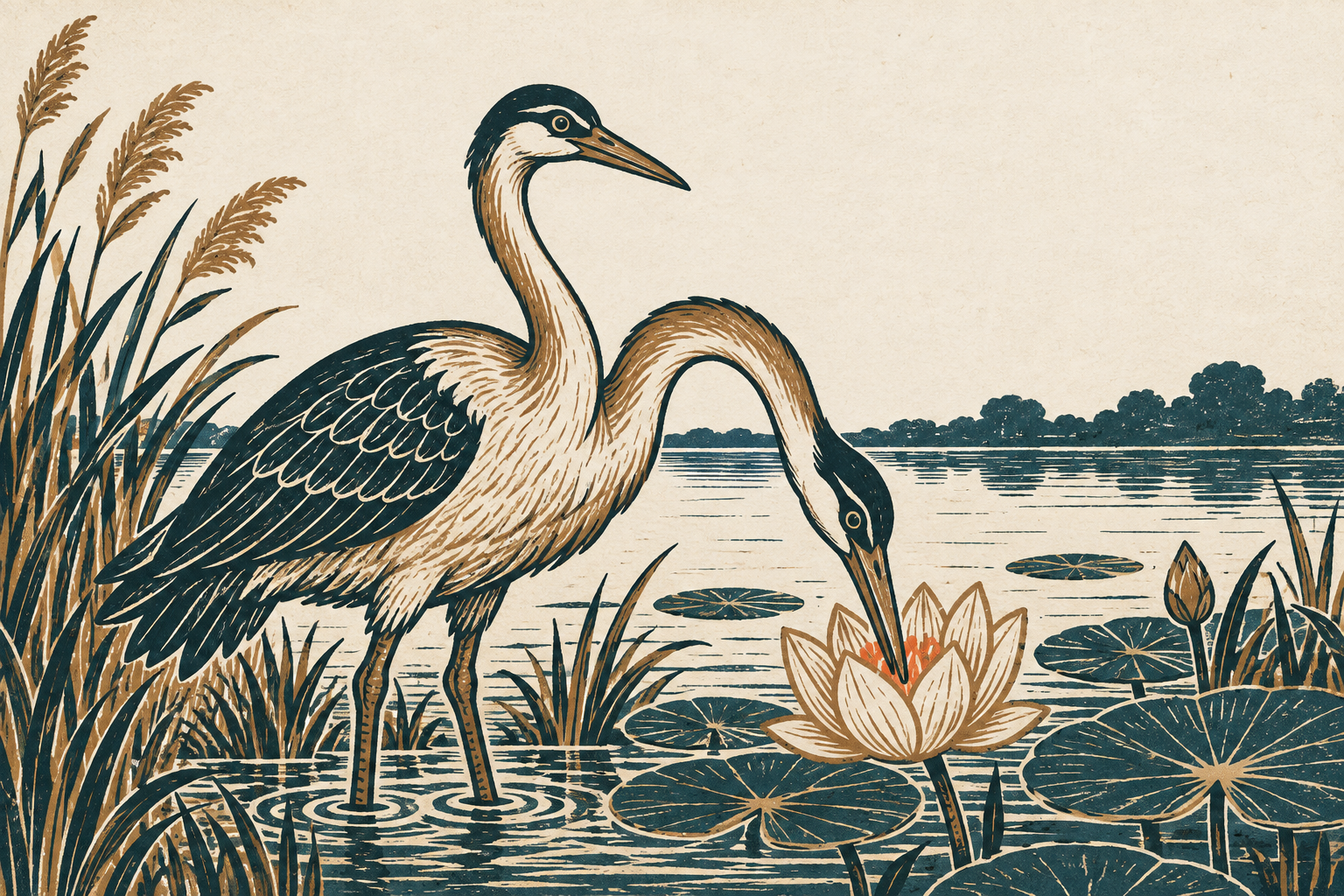
There was a lake, and beside it lived a kind of bird found nowhere else — the bharunda, the old tale calls it. It had one body, one pair of wings, one round belly under its feathers — and two necks rising side by side, each ending in its own head, its own beak, its own mind.
Whatever either mouth swallowed, both heads were fed by, since there was only the one stomach beneath them.
One evening, walking the reeds at the lake’s edge, the first head found a taste of nectar, sweet and rare, caught deep in the throat of a flower low among the reeds — the kind of find that comes along once in a long while, and never lasts. It drank it down at once, without a word, while the second head turned and watched, close enough to catch the scent of it on the evening air.
“We are fed by the one stomach,” said the second head, when the nectar was gone. “You might have shared it with me.”
But the first head would not. It turned away and said nothing more.
The second head did not let that go. Close by, half-hidden in the sand where the reeds gave out, lay a strange, pale fruit — the kind that every bird on that lake knew by sight to leave alone, because it carried poison. Before the first head could stop it, the second head snapped the fruit down, out of pure spite, and swallowed it whole.
The poison did not know, and could not have known, that it had been fed to only half a bird. It went down the one throat into the one stomach they had always shared — and it did its work on the whole bird, not half of it.
Because they had shared one belly all their lives, they shared one death as well. Both heads went still together, that same evening, by that same lake, sinking low over the water as the last light went out of the sky, and neither outlived the other by so much as a breath.
Two necks, one body — and in the end, no life left over for either one, once they had turned against each other.
Here, under our tree, nobody spoke for a moment.
Leo picked a second leaf out of his hair, just in case, and found nothing.
Dev finally leaned down and tied his shoelace, this time in a double knot.
“Finally,” Mira said, watching him do it.
For the grown-up (not read aloud): the heart of it — creatures bound together lose everything the moment they stop acting as one.
Where it comes from: retold from the Panchatantra (the tale of the two-necked bird, told by the dove king to his flock, Book 2).
More stories for ages 6–8
The Mouse’s Hidden Hoard · What the Weaver Chose · The Jackal’s Slow Supper · The Song That Scared a Prince · The Crow Who Wanted a Friend · A Thousand Tiny Teeth
 Banyan Story Studio