


Growing listeners · ages 6–8 · comfortable from 5 with a grown-up · Retold from the Panchatantra
A heads-up: one of the monkeys gets hurt near the end — the story leaves the how of it unsaid, and so do we, but a little listener may ask.
Reading aloud? A note for you
This is a short, plain tale, and it moves fast — the whole thing happens in under a minute of story-time, so there’s no need to rush. Slow down instead on the moment the monkey sits on the log; that pause is where a child pictures the danger coming, even though nothing is shown. The old telling names exactly what got caught in the crack of the wood; we leave that unsaid, following a trick the storyteller himself uses — trusting the listener to fill it in rather than spelling it out. Your child may ask what happened to the monkey. “Something that hurt, because he wasn’t careful with something that wasn’t his to touch” is enough of an answer. There’s no rescue and no funny recovery to look forward to — the story means for the moment to sting a little, so that its point lands.
Somewhere over the wall, a neighbor’s dog had been barking at nothing for the better part of an hour — no cat, no stranger at the gate, just barking, on and on. Mira counted the barks under her breath before losing interest. Leo, unbothered, was busy flattening a patch of grass with his heel. Dev sat listening past the barking, toward the quieter sounds underneath it.
Nani turned toward the noise once, then let it go. “Tonight’s story is about someone who couldn’t leave a thing alone either,” she said. “Two jackals argue about it in the oldest telling — one wants to go poking his nose into a matter that isn’t his, and the other, his brother, tells him this story to prove why he shouldn’t. It’s about meddling — putting your hands into a thing that has nothing to do with you, just because you can.”
“Listen.” And Nani began.
There was a city, and near it a grove, and in that grove a merchant had workers building a temple to the gods. Every day, when the sun stood straight overhead and the heat grew too much for working, the foreman and the workers put down their tools and walked back into the city to eat. And every day, for that hour or two, the grove stood empty and quiet, waiting for them to come back.
One such afternoon, a whole troop of monkeys came swinging down out of the trees at the grove’s edge and found the half-built temple with no one there to mind it.
They were delighted. Monkeys always are, finding a place like that all to themselves. They chased each other over the stacked roof-beams, along the low unfinished walls, and up and down the piles of cut and waiting wood, chattering and leaping and tumbling the way monkeys do when they’re sure no one is watching.
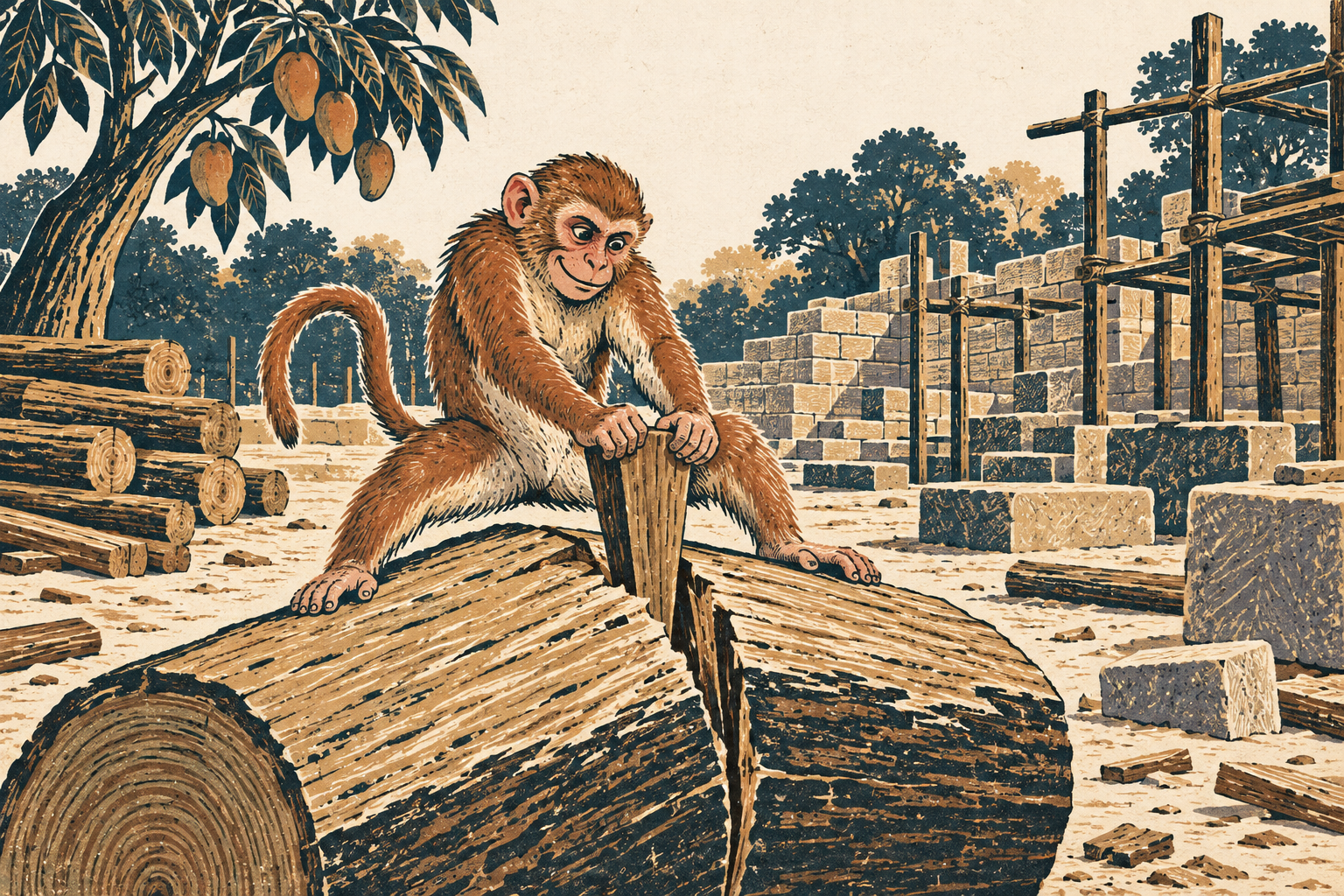
Among the timber lay one great log that the workers had begun to split down its whole length, to shape it for the building. To hold the split open while they worked at it, they had driven a wedge deep into the crack — a good, tight-fitting wedge, wood against wood, doing exactly the job it had been put there to do.
One of the monkeys came bounding across the woodpile and landed square on top of that log, straddling it the way you’d sit astride a horse, one leg either side. He looked down between his knees at the wedge jammed there in the wood, and turned it over in his mind, and could not for the life of him see any good reason why it should stay where it was.
It was, after all, right there. And it was, after all, so very easy to reach.
So he took hold of it with both hands, set his feet against the bark, and began to work it loose — rocking it one way and then the other, pulling harder each time, exactly the way you’d wiggle at a tooth that wasn’t ready yet to come out.
It came out anyway. All at once, the way a stuck thing always does, the moment it finally gives — no warning, just there and then suddenly not.
And what the closing crack did to the monkey who’d been sitting astride it, right at the narrowest part of the wood, right where he’d been holding on — well. You can guess that part for yourself. The story doesn’t say it out loud, and neither will I.
That is why the wise keep their hands off what doesn’t belong to them. A thing that is not yours to pull is a thing you leave exactly where you found it, and walk on past.
Here, under our tree, the dog next door had finally given up and gone quiet.
Leo glanced toward the wall. “About time.”
Mira just listened to the new quiet, not needing to add anything.
Dev picked at a blade of grass and let it go again.
For the grown-up (not read aloud): the heart of it — meddling in what isn’t yours to touch can cost you more than you bargained for; the wise leave it alone.
Where it comes from: retold from the Panchatantra (the monkey who pulled the wedge from the split log, Book 1). In the old book, Karataka the jackal tells it to his brother Damanaka.
More stories for ages 6–8
The Guest Who Couldn’t Wait · The Chain in the Hollow · The Carpenter’s Lunch · The Promise of Silence · Small Bird, Great Sea · Three Fish and the Net
 Banyan Story Studio