


Growing listeners · ages 6–8 · comfortable from 5 with a grown-up · Retold from the Panchatantra
A heads-up: this old tale opens with a lion killing without restraint, and the animals striking a bargain to send him one of their own each day so the killing will stop — none of it is shown in detail, and the story turns on the lion’s own pride rather than on any animal coming to harm on the page.
Reading aloud? A note for you
This is a story told inside another story — one jackal telling it to another, to prove that good sense beats brute strength. Your listener will likely feel for the animals having to send one of their own each day; that arrangement is stated once, plainly, and never shown happening, so there’s nothing to linger on there. The turn to watch for is the well: the lion sees his own reflection and hears his own roar come back at him, and mistakes both for a rival — if your listener asks how a lion could be fooled by an echo, that confusion is the whole hinge of the story, worth letting them puzzle out before you explain it. In the old telling, the story states outright that the lion dies in the well; this telling ends at the leap itself and follows straight on to the hare bringing the good news home, because a stated death isn’t a part this studio carries into the telling.
Earlier that evening Leo had shouted into the empty water tank behind the kitchen just to hear his own voice come back at him, over and over, until his mother told him to stop before he woke the whole street. He was still grinning about it. Mira arrived unimpressed, arranging herself cross-legged with the particular calm of someone above such things. Dev had already settled in close by the time the other two sat, quiet as ever, listening before anyone had said a word.
“This is the story one jackal told another,” Nani said, “when the second jackal didn’t believe that a small, clever creature could ever get the better of a lion. It’s about where real strength actually lives — not in claws or a loud roar, but in a mind that knows how to use what it has.”
Leo leaned forward. “Can a small creature really beat a lion?”
“That,” said Nani, “is exactly what this story is about.”
“Listen.” And she began.
In a stretch of forest lived a lion named Bhasuraka, and he was drunk on his own strength. He killed as he pleased, whenever he pleased, giving no animal in that forest a moment’s safety — until the forest around him grew quiet and thin, its creatures fewer every season.
At last the animals who were left went to him together, heads bowed low, and made him an offer. Let the king stay in one place and rest, they said, and they themselves would send him, of their own will, one animal every day for his meal, so that he need never go hunting again — and so that the forest would not be hunted down to nothing.
Bhasuraka turned this over and agreed to it — on one condition. If even one day passed with no animal sent to him, he warned, he would go back to killing however and whenever he liked, exactly as before.
So the animals agreed, and from then on, each day, one of them went to him. Each kind of creature took its turn in its own order, so that the burden fell on all of them together, and on no one family alone.
One day the turn came round to the hares. And the hare whose lot it was sat and thought the trouble over. How, he wondered, could a creature his size ever get the better of a lion? And yet, he thought further, there is very little that a clear head and a little daring cannot manage, put to the task properly. I believe I can outwit even a lion, he decided at last.
So instead of hurrying, he went slowly, choosing his pace on purpose, turning his plan over and over as he walked and letting the day wear away around him.
By the time he came into Bhasuraka’s sight, the sun was nearly down, and the lion was ravenous with waiting, and furious besides at being kept so long from his meal. “Small as you are, and late as you are,” the lion roared, “your life is forfeit for it — and in the morning I will finish what I started, and hunt down every last one of you myself.”
The hare bowed low. “Master,” he said, “the fault was not mine, nor any of ours. Let me tell you the reason for it, if you will hear it.”
“Tell it quickly, then,” said the lion, “or you’ll be my meal before you finish.”
“Master,” said the hare, “the other animals chose me to come to you today, with five hares besides me, since we are small and could be spared. But on the way, another lion stopped us — one who came up out of a great den in the ground and asked where we were bound. We told him we were on our way to you, as our agreement required. ‘This forest is mine,’ he said, ‘and every creature in it owes its due to me, not to any sneak-thief who has claimed it for himself. Bring him here, and let the stronger of us settle which of us is king.’ That is why I am late, master. The rest is for you to judge.”
At this Bhasuraka’s rage caught fire all over again. “Show me this thief of a lion,” he said, “at once. I will have no peace until I have settled with him.”
“Warriors fight for their own honour, master, when they are challenged in the open,” said the hare. “But this one hides himself away in a den, and a den is hard to take. Still — if the master commands it, I will show him the way.”
“Then show me,” said Bhasuraka. “Wherever he hides, I will find him and finish him.”
So the hare led the way, walking ahead of him, until they came to a deep well, its water dark and still far down below. “Master,” said the hare, “this is where he hides. The moment he sees you, he will know he cannot stand against you.”
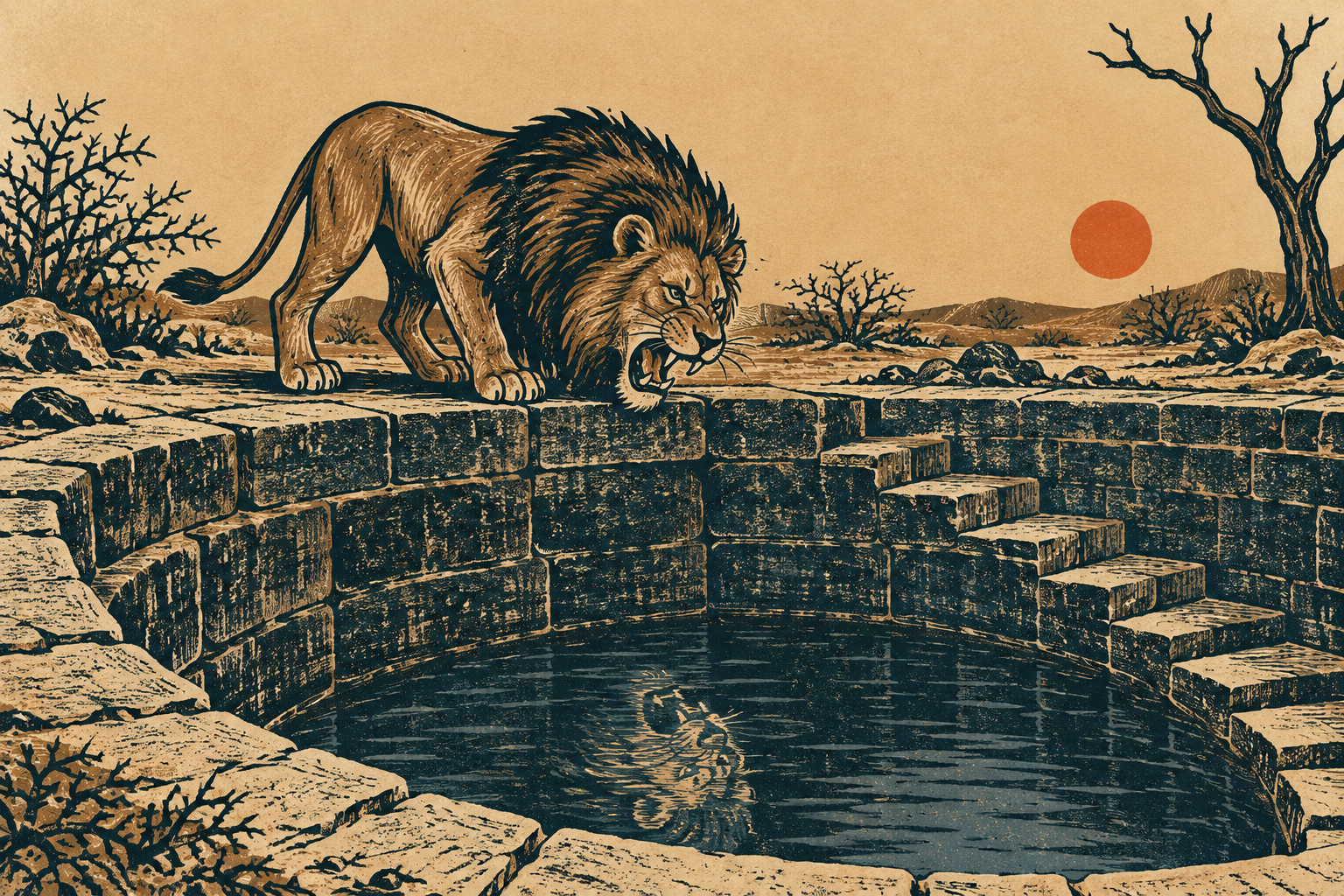
Bhasuraka came to the well’s edge and looked down. And there in the still water he saw his own reflection looking back up at him — and being a proud fool, and no judge of his own likeness, he took it for the rival he had come to kill. He let out a tremendous roar. And the well, being deep and round, sent the roar straight back to him, twice as loud as he had made it.
Hearing that answering roar, Bhasuraka was certain now that his rival was the stronger of the two of them — and gathering all his strength behind him, he sprang down into the well after it.
The hare did not wait to see what came next. He turned and ran back through the forest as fast as his legs would carry him, and brought the other animals the news himself. They gathered round him and thanked him, every one, for what his cleverness had done for them all. And the hare went on living there afterward, content, in the forest that was now as much his as anyone’s.
A creature’s real strength, in the end, is only as good as the sense that carries it. A clear mind can turn even a lion’s own pride back against him, and bring him down by nothing more than the echo of his own roar.
Here, under our tree, nobody said anything for a moment.
Then Leo dropped his voice low, testing it, the way he’d tested the water tank earlier. “The hare didn’t even have to fight him.”
“He didn’t need to,” said Nani. “He only needed to understand him — how proud he was, how fast his temper could be turned against himself.”
Mira was turning it over. “So the jackal who told this — not really about a lion at all, was it?”
“Not really,” Nani agreed.
Nearby, Bupam tipped his head first one way and then the other, as if trying to catch an echo of his own.
Dev said quietly, “I liked that the hare went home.”
“So did I,” said Nani, and let the quiet settle over all of them.
For the grown-up (not read aloud): the heart of it — real strength lies in good sense; strength without it can be turned into its own ruin.
Where it comes from: retold from the Panchatantra (the lion and the hare at the well, Book 1), freely reshaped.
More stories for ages 6–8
The Wedge in the Log · The Guest Who Couldn’t Wait · The Chain in the Hollow · The Carpenter’s Lunch · The Promise of Silence · Small Bird, Great Sea
 Banyan Story Studio