


Older listeners · ages 9–12 · comfortable from 8 with a grown-up · Retold from the Panchatantra
A heads-up: this story ends with a death, told plainly and not shown, and the friendship at its heart is not saved.
Reading aloud? A note for you
This is a story about being talked into believing something false — twice over, by the same person. It moves briskly at the start, through a merchant’s journey and a lonely lion’s fear of a sound; you may want to slow down once the second jackal starts talking to the lion and the bull separately, because that is where the real damage is done. Your listener may ask why the jackal who knows better doesn’t simply tell the truth — the story doesn’t have him try, and that’s worth sitting with rather than explaining away. The ending is sad on purpose: the two friends do not make up, and the bull does not survive it, though the telling doesn’t linger on how. In the old telling, this frame carries some twenty further tales inside it, told by the animals to one another along the road — we’ve left those out here and kept only the frame story itself, since several of them get their own tellings elsewhere.
Voices had carried up from the road a little earlier — two neighbours going back and forth over something neither one would name outright, until a door shut hard and the street fell quiet again. Mira was still turning it over. “What were they even arguing about?” she asked, to no one in particular, settling onto the flattest root.
“That’s rather the question tonight,” said Nani, lowering herself down beside them.
Leo dropped down next to her, chewing on that thought instead of asking one of his own for once. Dev came last, and sat close by, working a loose thread on his sleeve between two fingers without looking up.
“This is the story a teacher named Vishnusharman told to three young princes, long ago, to make them wise in the ways of kings and counsellors,” Nani said. “It’s the very first story he told them, of all the many that followed. It’s about a king who let a flatterer talk him out of the truth, and lost the friend he loved most because of it. Before you trust anyone’s advice, look hard at the one who’s giving it.”
“Listen.”
In the south, in the country beyond the hills, there was once a merchant who dealt in goods of every kind, and who set out one season with a train of loaded carts to sell them in a distant city. Among his animals were two fine bulls, and the stronger of the two was named Sanjivaka.
The road led through a forest, thick-grown and shadowed, where the wheel-track narrowed to little more than a track of trodden leaves, and in the forest the ground turned soft and wet where water ran down from the hills and pooled unseen beneath the fallen leaves. There Sanjivaka’s foot sank deep, and try as he might, straining and lunging against the cart’s weight, he could not haul himself and the cart free of the sucking mud. The merchant waited a few days, hoping the bull would recover, but at last, with the season pressing him onward and the rest of his animals restless to move, he could wait no longer. He left the animal behind with enough grass and water to last, and went on his way, telling his people to bring the bull along later if he lived, or else to see to him properly if he did not.
Sanjivaka, though, did not die. Left alone in that quiet stretch of forest, with no cart to haul and no master to answer to, he strained and struggled a while longer, until at last the mud gave him up, and he pulled himself free and wandered on, footsore and thin, until he came to a river, where the grass grew thick and green along the banks and the water ran cool over the stones. There, with no one to drive him onward and nothing asked of him, he grazed in peace for a long time, resting through the heat of the day in the shade and returning each morning to the same rich grass, and slowly he grew strong again — stronger, in fact, than he had ever been, his flanks filling out and his coat growing glossy — until one morning his bellow rolled out over the water, deep and enormous, loud enough to carry for miles through the still forest air.
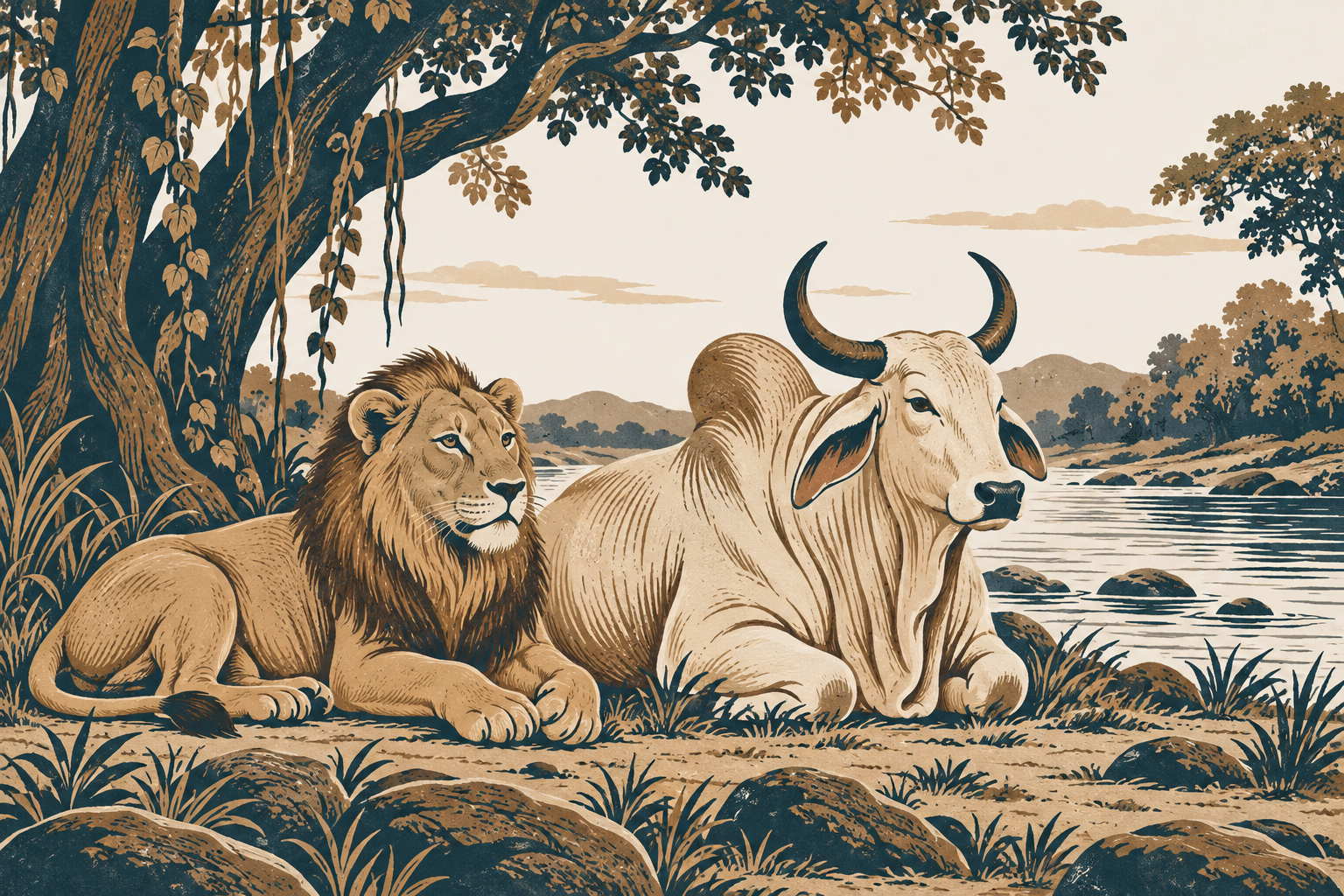
Now it happened that a lion named Pingalaka ruled that stretch of forest, and one evening he came down to that same river to drink, with his court trailing behind him as it always did. He heard Sanjivaka’s great voice roll out across the water, and though he had never in his life met a danger he could not face, though he had faced down every ordinary beast of that forest without a moment’s doubt, this new sound — a sound with no shape to it, coming from no creature he could see, out of the dark trees on the far bank — unsettled him more than he wanted to admit, more than he would have owned to a single one of his followers. He hid the feeling as best he could behind a lion’s usual bearing, and drew his court up short under a spreading tree while he tried to decide what to do, his mind turning the sound over and over and finding no shape that fit it.
Among his followers were two jackals, brothers whose father had once served as royal counsellor, though the sons themselves held no post at court now and lived on whatever scraps came their way, trailing at the edge of the group and watching how things stood. The elder of the two, Damanaka, was restless and ambitious, forever turning some scheme or other over in his mind, and always looking for a way back into the king’s favour. The younger, Karataka, was content with less, and cautious about meddling in things that were not his business, and it was the two of them, talking low and apart from the rest of the court, who first noticed how unlike himself their king had become.
“Look at our king,” Damanaka said. “Something has him worried, and I mean to find out what. It might be my way back into his good graces.”
“Leave it alone,” Karataka told him. “We have no post at court any more. Whoever goes looking for trouble usually finds it.”
But Damanaka would not be talked out of it, and went to Pingalaka and offered his old family’s service. The lion, glad of a familiar face, admitted at last what was troubling him — the enormous voice he had heard, and his fear of the creature behind it. Damanaka, seeing his chance, offered to go and find out what manner of beast it was, and the king, relieved to have someone else carry the risk, let him go.
Damanaka followed the sound and found nothing more than a bull, grazing by the river, and he saw at once how useful this discovery might be made. He went back to Pingalaka and told him only that the creature was no danger at all — and, in time, under safe conduct, he brought the bull before the king himself. Sanjivaka, for his part, was as glad of company as Pingalaka was of a new companion, and the two of them — lion and bull, each strange to the other’s kind — became close friends, spending their days together and trusting each other more than either trusted anyone else at court.
This was not at all what Damanaka had hoped for. He had wanted a place at the king’s side for himself, not a rival for it, and now that Pingalaka had a friend he no longer needed a jackal’s advice on anything. Shut out and going hungry, Damanaka grew bitter, and resolved that if he could not have the king’s favour, he would at least have his revenge on the bull who had taken it.
He went to Pingalaka in private and told him that Sanjivaka had been overheard planning treachery — that the bull meant to gore him and seize the throne for himself, and that the king would know it was true if he saw Sanjivaka approach him warily, horns lowered, instead of at his ease as before. Then Damanaka went to Sanjivaka and told him, just as quietly, that Pingalaka had decided to kill him for a feast, and that he would know it was true if he saw the lion crouch low and lash his tail as he drew near.
Neither friend had reason to doubt a servant who had brought them together in the first place. So when they met again, each was already watching for exactly the sign Damanaka had described — and each, watching hard enough, found it, in the ordinary crouch and lowered head that any two animals show when they are wary of something they cannot name. Neither one asked the other a single question. The fight began at once.
While the two of them tore at each other, Karataka came forward and spoke sharply to his brother, there in the open, telling him plainly what he had done and what kind of counsellor breaks apart what he cannot rule. Damanaka had no answer that held up, and slunk away out of the fighting.
The fight went on without him. In the end it was Pingalaka’s claws that decided it, and Sanjivaka did not get up again.
When the fighting was over and the forest had gone quiet, the lion’s anger went with it, and what was left was grief. He had killed, with his own claws, the one friend he had trusted above his whole court, and no feast and no throne was worth what that had cost him.
Damanaka crept back then, and tried to talk the king out of his sorrow, saying that such things were simply the business of kings and not worth this much mourning. Whether his words did Pingalaka any good, the story does not say.
But Karataka came and stood by the king a while, and when he spoke at last, it was this: that a ruler who wants to keep what he loves must weigh the one who brings him news before he weighs the news itself — must ask who is speaking, and why, and what that speaker stands to gain, before he ever acts on what he’s been told. A story is only as true as the one who tells it.
Here, under our tree, the road outside had gone quiet again, the argument long since spent.
Mira sat with her arms wrapped around her legs. “The jackal never got in trouble for it,” she said. “The one who lied.”
“No,” said Nani. “Not in this telling.”
Leo said nothing, turning that over. Dev worked the same loose thread on his sleeve, slower now, and didn’t look up.
In the dark past the roots, Bupam settled somewhere out of sight, and only a small rustle told them he hadn’t gone far.
Nani rested her hand on Dev’s shoulder, just for a moment, and said no more.
For the grown-up (not read aloud): the heart of it — a king who listens to a flatterer instead of judging the one who’s speaking loses the friend he loved most; before you trust advice, look hard at who is giving it.
Where it comes from: retold from the Panchatantra (the lion, the bull and the two jackals, Book 1), freely reshaped. In the old telling, this frame holds some twenty further tales told inside it by the animals along the way; we have told the frame alone, as its own whole story, and left those tales for their own tellings.
More stories for ages 9–12
The Treasure He Would Not Set Down · The Crab Who Looked Down · Three Warnings · The Light That Wasn’t Fire · The Owl Who Cried at Dawn · Buried Between Friends
 Banyan Story Studio