


Growing listeners · ages 6–8 · comfortable from 5 with a grown-up · Retold from the Panchatantra
A heads-up: when the animals see through his trick, they turn on him and he has to run for it — the story ends right there, with nothing more shown or said.
Reading aloud? A note for you
Slow down for the moment the forest animals first catch sight of the blue jackal — that startled, wide-eyed hush is the turn of the whole story. Your child may ask why the animals believed him, or what happened after he ran; you can say only that he had to run, and leave it there, the way the story does. This telling stops the moment he turns to flee — the old telling goes further and says plainly what becomes of him, and we do not. Chandarava is said chan-da-RAH-va.
Leo arrived scrubbing furiously at his hands, which had gone a deep blue-black from a leaking pen at his desk, and no amount of spit and rubbing was getting it off. “It won’t come out,” he said, holding them up for Nani to see, half worried, half proud of the disaster.
Mira examined the stain with real interest. “You look like you dipped them in ink,” she said. “Or dye.”
Dev glanced at Leo’s hands and then away, saying nothing, but a small smile stayed on his face a moment longer than it needed to.
“Funny you should say dye,” said Nani, settling herself among the roots. “Tonight’s story is about a jackal who fell into a dye-vat and came out an entirely different color — and what he decided to do about it. A jackal told this one to the lion he served, to warn him against leaving his own for someone new and unfamiliar. It’s about what happens to a creature who turns his back on the ones who know him, for strangers who don’t.”
“Listen.” And she began.
Beyond the edge of a certain city, in a cave among the hills, there lived a jackal named Chandarava. One night his hunger got the better of his caution, and he crept in past the city walls to look for scraps. The town’s dogs found him first. They came at him snapping and barking from every side, and Chandarava ran — through one street, then another, with no idea where he was going, only that he had to keep moving.
He burst through an open door and landed, all four legs at once, in a great vat of dye. It closed over his head and let him go again, and by the time he had scrambled out and shaken himself off, the dogs had lost him and gone home. But something had changed. The vat had belonged to a dyer, and the dye in it was indigo — and Chandarava, from nose to tail, had come out a deep, unmistakable blue.
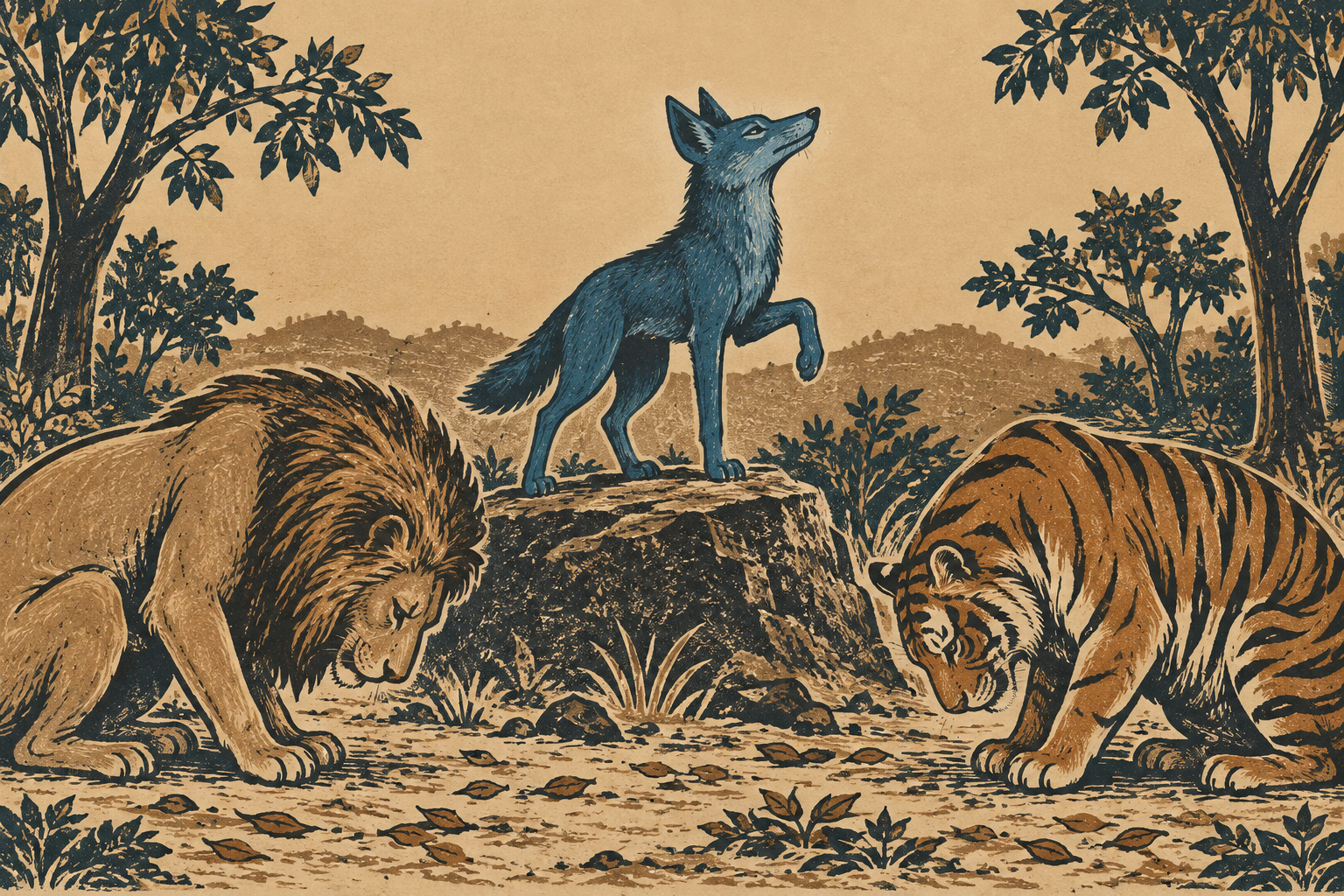
He limped back to the forest before sunrise, glad only to be alive. But when the forest creatures saw him coming, they did not see a tired, ordinary jackal. They saw a blue animal none of them had ever laid eyes on, and they scattered — lions, tigers, monkeys, rabbits, deer, even Chandarava’s own kind — crying out that a strange and unknown creature had come among them, and that no one could say what such a creature might do.
Chandarava watched them run, and a thought came to him. He called out, loud and grand: “Wait! Do not be afraid. The great god Indra himself, seeing that the forest had no king, has set me over you. I will keep you safe.”
The animals crept back one by one, unsure, and then bowed low before him. “Tell us our places, Majesty,” they said.
So Chandarava gave out the places. The lion he made his minister. The tiger stood at his door. The leopard carried his betel box, the elephant kept the gate, and the monkey held the parasol over his blue head, and each of them took up the post gladly, glad to have a strong king to serve. Only to his own kin, the ordinary jackals, he gave nothing — he sent them away with a snarl, as if he had never been one of them at all, as if the blue on his fur had washed the memory of them out of him too. And after that he lived as a king lives, fed and served by the very animals who used to be his equals, while his own kind kept their distance in the trees beyond his court, watching him from far off and understanding less and less why he would not have them near.
This went on for some time, and Chandarava grew used to it — the bowing, the parasol, the food brought and laid before him. Then one evening, sitting in the middle of his court exactly as a king sits, he heard, far off in the dark, a pack of jackals begin to howl.
Something in him rose up at the sound before he could stop it. His chest filled, his eyes stung, and before he knew what he was doing, Chandarava threw back his blue head and howled along with them, long and high, the way only a jackal howls.
The court went silent. The lion and the tiger and all the rest looked at one another, and then at him, and understood at once what he was.
“We have been tricked,” said the lion slowly. “He is only a jackal.”
Chandarava saw their faces change, and he turned to run.
It is an old and simple truth, and this is where the story returns to it: leave your own kind for strangers who do not know you, and it is only a matter of time before what you left shows through — and by then there may be no one left on your side at all.
Here, under our tree, Leo looked down at his own stained hands and went quiet, turning them over once.
“He looked like somebody else,” he said slowly. “But he wasn’t, really.”
Nani reached for the cup of water by her feet and drank, unhurried, saying nothing yet.
Dev let out a short laugh, surprised at himself. “He howled right in the middle of being king,” he said. “That’s almost funny.”
Mira didn’t laugh. “It’s a little sad too,” she said. And nobody argued with her.
For the grown-up (not read aloud): the heart of it — leave your own kind for strangers, and ruin follows.
Where it comes from: retold from the Panchatantra (the jackal who turned blue, Book 1), freely reshaped — the old telling states what becomes of him after he runs; this one stops as he turns to flee. In the old book, Damanaka the jackal tells it to Pingalaka the lion.
More stories for ages 6–8
The Hare Who Came Late · The Wedge in the Log · The Guest Who Couldn’t Wait · The Chain in the Hollow · The Carpenter’s Lunch · The Promise of Silence
 Banyan Story Studio