


Growing listeners · ages 6–8 · comfortable from 5 with a grown-up · Retold from the Panchatantra
A heads-up: this story ends sadly for two of the three friends — it is told gently, from a distance, and never shown.
Reading aloud? A note for you
This one moves fast — slow down right after the fishermen speak by the water, and let that quiet settle before the frog raises the alarm. Your listener may ask why the two fish didn’t just leave with their friend; there’s no tidy answer beyond confidence getting the better of caution, and it’s fine to leave it sitting there. In the old telling, the net closing is followed at once by a line stating plainly that the two fish were killed, and the frog watches the fishermen carry them off; here the story stops right as the net closes and moves straight to the frog, already safe, telling his wife what happened in a few plain lines rather than showing it happen. If your child wants more, it’s enough to say the two friends who stayed did not make it home.
Far off, past the edge of the fields, thunder rumbled low and long, the kind that meant rain was still an hour off but certainly coming. Dev had gone round twice already, quietly pulling the washing off the line and folding it over his arm before anyone asked him to.
“Leave it, it’ll be fine a bit longer,” Leo said, already settling onto a root.
“It won’t,” said Dev, and kept folding anyway.
Mira laughed and helped him with the last of it. “Where does tonight’s one come from, anyway?” she asked, once they’d all settled in.
“This is a story the wheel-bearer told the gold-finder,” Nani said, “the two of them arguing back and forth on the road about luck and cleverness. And it’s about whether being clever is enough, all on its own, to keep you safe.”
Another low roll of thunder crossed the sky, farther off now. “Listen.”
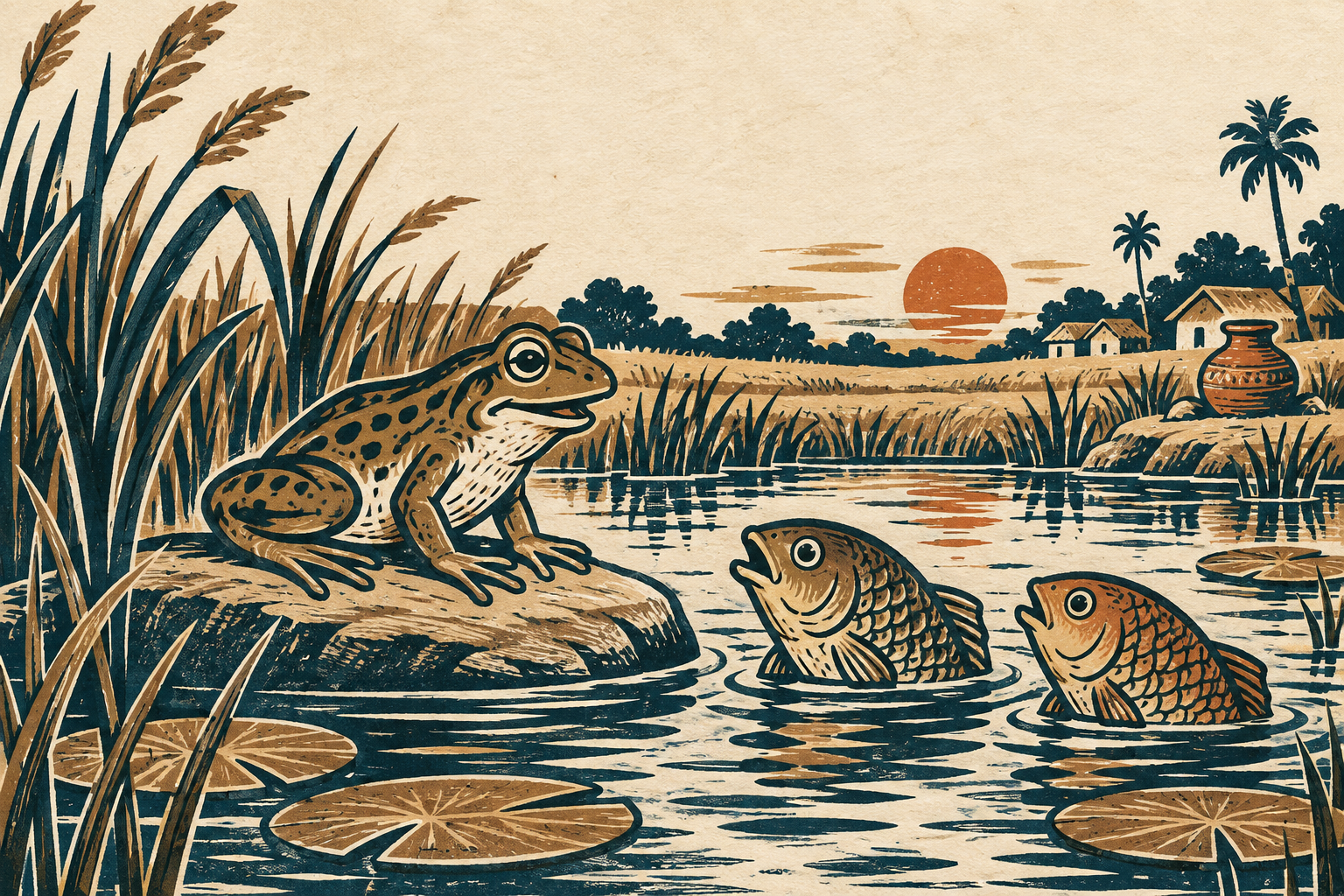
There was once a shallow pond where two fish, Shatabuddhi and Sahasrabuddhi, made their home alongside their friend, a frog named Ekabuddhi. The three of them had grown up together in that water, and most evenings, once the heat had gone out of the day and the light turned soft and low over the reeds, they gathered at its edge to talk — about nothing much, usually, the small comfortable talk of friends who have known each other their whole lives.
One such evening, while they were talking, some fishermen came along the bank with their nets over their shoulders, tired from a long day and looking for one more pond to mark before they turned home. The fishermen looked out over the water and said to each other, “This pond is full of fish, and it’s shallow besides — an easy catch. We’ll come back for it at dawn.” Then they walked on, and went home to sleep, thinking no more about it.
But the three friends had heard every word, and it landed on them like a clap of thunder rolling in off a clear sky. They drew close together at once, in the reeds, to decide what to do.
“Friends,” said the frog. “Should we go tonight, while we still can?”
One of the fish laughed it off. “Go? Don’t lose your nerve over a few words you happened to overhear. And even if they do come back, I know a hundred tricks for getting clear of trouble in this water — turns and hiding places and slips of speed I’ve used a dozen times before. I’d get us both out without breaking a sweat.”
“He’s right,” said the other fish. “Nobody packs up and leaves their own family’s home over something they merely heard secondhand, on the bank, from strangers. Stay. Between the two of us, our wits will carry us through whatever comes tomorrow — they always have.”
The frog looked at them both a long moment, then shook his head slowly. “I’ve only got the one wit, and no tricks at all to speak of — but that one wit is telling me only one thing, plain as anything: leave. I’m taking my wife and going to find another pond tonight, before the sun’s even down.” And under cover of dark, that’s exactly what he did, without waiting to see if either of his friends would change their minds.
The two fish stayed right where they were, curled comfortably among the reeds, certain that cleverness alone would see them through whatever the morning brought.
At dawn the fishermen came back, just as they’d said, and cast their nets clear across the water before the pond had even finished waking up. Every creature in that shallow pond was gathered up together, all at once, the net drawing tight around the whole of it — the two fish caught inside it with the rest, along with every trick either of them had ever known.
Far off, in a quiet spring where he and his wife had settled the night before, Ekabuddhi sat safe among cool, unfamiliar reeds. He turned to his wife.
“Look, my dear,” he said. “Neither Shatabuddhi’s hundred tricks nor Sahasrabuddhi’s thousand were enough this morning, and neither one of them is coming home. And here is your husband, who only ever had the one small wit, paddling safe in the clear, quiet water.”
He told her, and it has held true ever since that morning: being clever is not the same thing as being safe. Cleverness only carries you as far as your willingness to listen does.
Here, under our tree, the thunder had rolled off somewhere else entirely, and the first drops hadn’t come after all.
“I would have gone with the frog,” Dev said quietly.
“So would I,” said Mira. “You already did, actually — with the washing.”
Dev almost smiled at that.
Bupam had already lost interest in the sky and was nosing around the empty snack bowl instead.
Leo, still not fully convinced it was going to rain, looked up at the clear patch over the banyan and said nothing, for once willing to be wrong later rather than argue now.
For the grown-up (not read aloud): the heart of it — being clever doesn’t make you safe; listening to a warning does.
Where it comes from: retold from the Panchatantra (the two fish who trusted their own cleverness, and the frog who listened instead, Book 5), freely reshaped.
More stories for ages 6–8
One Song Too Many · The Fiend’s One Rule · The Jar of Big Plans · The Jackal’s Warning · The Scar That Wasn’t a Sword · The Borrowed Stripes
 Banyan Story Studio