


Growing listeners · ages 6–8 · comfortable from 5 with a grown-up · Retold from the Panchatantra
Reading aloud? A note for you
The middle of this one is a single long daydream that keeps piling higher — goats, then cows, then buffaloes, then horses, then a house, then a son — and it reads best if you let it speed up a little with every step, the way a person’s own thinking runs away with itself. Your listener may ask why the man in the daydream gets so angry with someone who isn’t even listening to him; you can say simply that he imagines losing his temper, the way minds sometimes do even inside a daydream. In the old telling, that imagined temper lands on his wife by name; here we’ve kept the flash of anger but left out who it’s aimed at, so the story stays about the jar and the plan rather than about a marriage. The actual kick, when it finally lands, is real, and it’s funny rather than frightening — the only thing that gets hurt is the barley-meal, and the man’s pride.
Somewhere behind them, in the kitchen, the milk had very nearly boiled over before Nani noticed and pulled it off the flame just in time — she came out still fanning the scorched smell away with her hand, laughing a little at herself.
“That’s what happens when you stop watching something for one minute,” she said, settling onto her root.
Mira had already claimed the flattest spot, knees pulled up, ready. Leo arrived mid-hop and landed on both feet as if he’d meant it all along. Dev set his cushion down carefully, exactly where he always sat.
“Tonight,” said Nani, “is a story one traveler — people called him the wheel-bearer — once told another, the gold-finder, ruefully owning up to a mistake that was entirely his own doing. It’s about what happens when your hopes get so far out ahead of you that they leave the ground.”
Mira tilted her head. “A mistake he made on purpose?”
“Not on purpose,” said Nani. “That’s rather the trouble with it.” She looked round at all three of them. “Listen.”
There was once, in a small town, a Brahman who got by on whatever food he could beg from door to door, and who was known up and down the street for guarding every last grain that came his way — a coin saved, to him, mattered a great deal more than a coin spent. One evening he came home with more barley-meal than he’d need for supper, ate his fill, and poured the rest into a clay jar for later, tying the lid down snugly, the way a man ties down something precious.
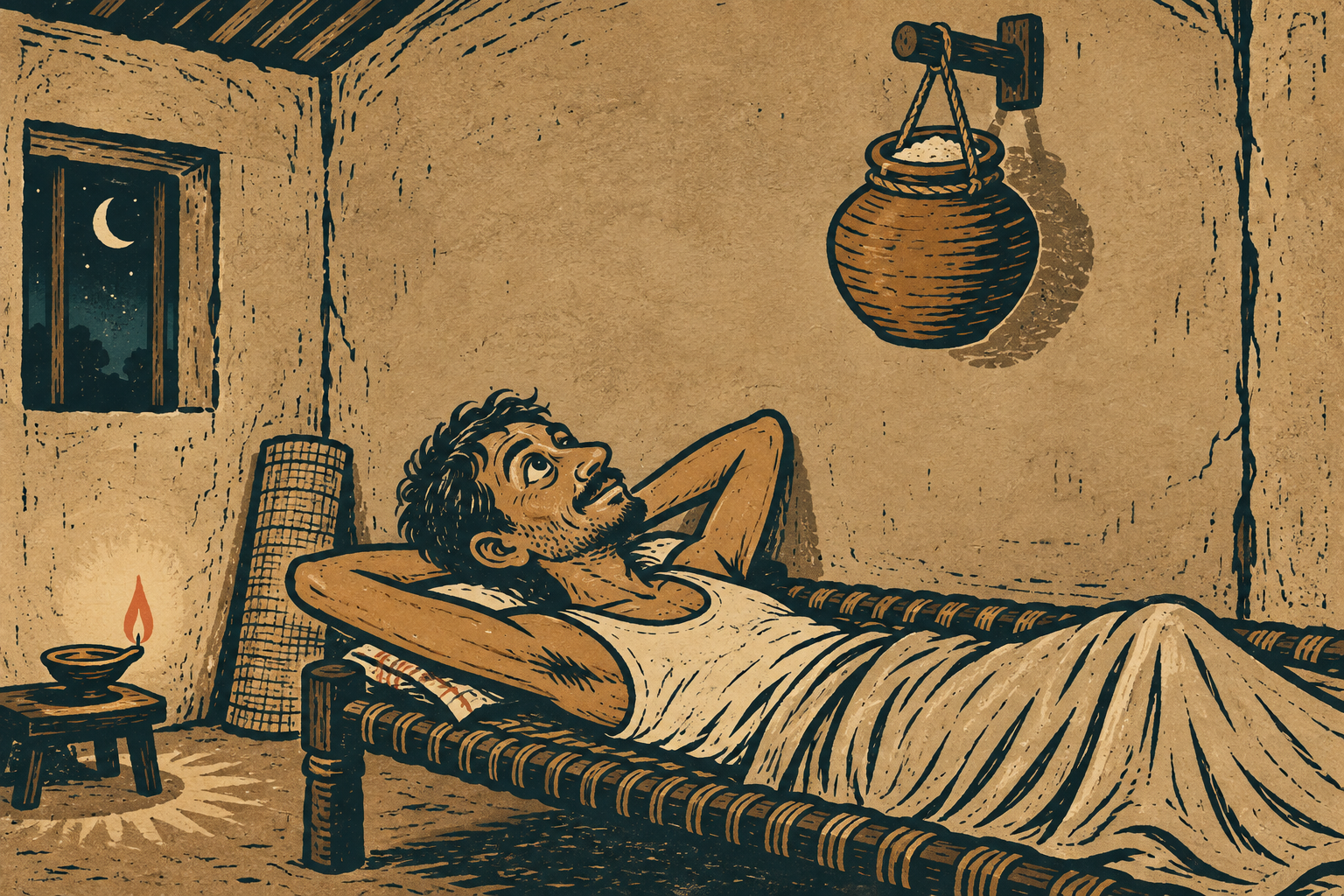
That night he hung the jar from a peg above his bed, dragged his cot underneath it, and lay down meaning only to rest a moment. Instead his eyes fixed on the jar, and looking turned to wondering, and wondering carried him clean away.
Suppose a hard year came, he thought — a jar of meal like that would fetch a fine price. With the money he’d buy two young she-goats. Goats bear twice a year, so before long there’d be a whole herd trotting and bleating in his yard, and a herd could be traded up for cows. The cows would calve, and the calves would sell for buffaloes, and the buffaloes for mares, and the mares — his own mares, in his own field — would foal him horses worth real gold at market, sturdy ones, the kind people traveled from other towns to buy. That gold would come to more, in fact, than a man in his position usually saw in a lifetime.
With that gold, he decided, he’d raise a house grand enough to have its own inner courtyard, the kind of house people slowed their steps to look at as they passed. A house like that would draw notice, and before long some good family would come asking whether their daughter might marry into it, bringing a handsome dowry along with her. She would give him a son — and he already knew what he’d call him: Somasharman.
He could picture it perfectly, down to the smallest detail. Little Somasharman, just old enough to want to ride on his father’s knee, chubby and quick on his feet. Himself, up on the flat stable roof with a book, deep in his own thoughts, the afternoon warm and slow around him, while the boy wriggled down out of his mother’s lap, eager to reach him, and toddled, in his hurry, a little too close to the horses tied below.
The father in the daydream sat bolt upright. He’d call out sharply for someone to come and pull the child back this instant — but whoever he called to would be busy with some chore of their own, and wouldn’t hear him, or wouldn’t listen, which in a temper feels like the same thing. And the Brahman, lying on his cot with his eyes still fixed on a jar of barley-meal, felt his daydream-self’s patience snap entirely — felt himself rise up and kick out —
— and the real leg, attached to the real Brahman, kicked too.
It caught the jar square on. The jar came off its peg and broke apart on the floor, and the barley-meal that had already bought him goats and cows and buffaloes and horses and a grand house and a wife and a son came down over him instead, white from his hair to his feet, sitting in the ruins of his own someday.
He had built the whole of that fortune before a single grain of it was even sold — and in reaching for all of it at once, he lost the one small thing he’d actually had.
Here, under our tree, Nani got up and went to check the milk pot once more, just to be sure this time.
“He worked so hard for stuff that wasn’t even real,” Leo said, half to himself.
Mira considered this. “He didn’t actually lose anything he had,” she said slowly. “Just — some meal. And a plan.”
“That’s still something,” said Leo.
Dev, on his cushion, only nodded, as if that had settled something for him privately, and didn’t say anything more.
For the grown-up (not read aloud): the heart of it — a hope is a fine thing to carry, but carry only as much of it as you actually have.
Where it comes from: retold from the Panchatantra (a Brahman’s daydream of fortune, Book 5), freely reshaped.
More stories for ages 6–8
The Frog Who Went That Night · One Song Too Many · The Fiend’s One Rule · The Jackal’s Warning · The Scar That Wasn’t a Sword · The Borrowed Stripes
 Banyan Story Studio