


Growing listeners · ages 6–8 · comfortable from 5 with a grown-up · Retold from the Panchatantra
A heads-up: a stranger tells a Brahman he plans to eat him — it’s said once, plainly, and nothing happens; he gets cleanly away.
Reading aloud? A note for you
This one has real tension but resolves cleanly — the fiend never catches up, and the Brahman is never actually touched. Slow down at the line about the vow (“I am bound by a vow…”) so your child registers that this fiend has a rule he cannot break; that single detail is the whole hinge of the escape later. Your child may ask why a fiend would even keep a promise — there’s no single right answer, only that it’s simply how he’s built, like a law of his own nature rather than a kindness. Pause again once the Brahman is walking away from the water and let that release land before you go on.
Mira arrived last and barefoot, carrying her sandals in one hand, both feet still dark with the mud of a puddle she’d insisted on stamping straight through on the way over. She dropped down into the roots and started picking at the mud between her toes without any embarrassment at all. “I couldn’t help it,” she said, catching Nani’s look. “It was right there.”
Leo was already settled, tapping a fast little rhythm against the root, restless the way he always got before a story started. Dev had gone and washed his own feet twice over before he’d sit, and only then folded himself in beside Nani, watching Mira’s muddy ones with careful interest.
“Is this a scary one?” Mira asked, giving up on the mud.
“A little,” Nani admitted. “There’s a fright in it. But nobody gets hurt, and the one in danger gets clean away — I’ll promise you that much before we even start.”
“This is a story a chamberlain once told his own king,” she went on, “about noticing the one rule a dangerous stranger lives by, and using it to save yourself.” She glanced down at Mira’s bare, still-dirty feet and almost smiled. “Feet matter more than you’d think, in this one.” “Listen.”
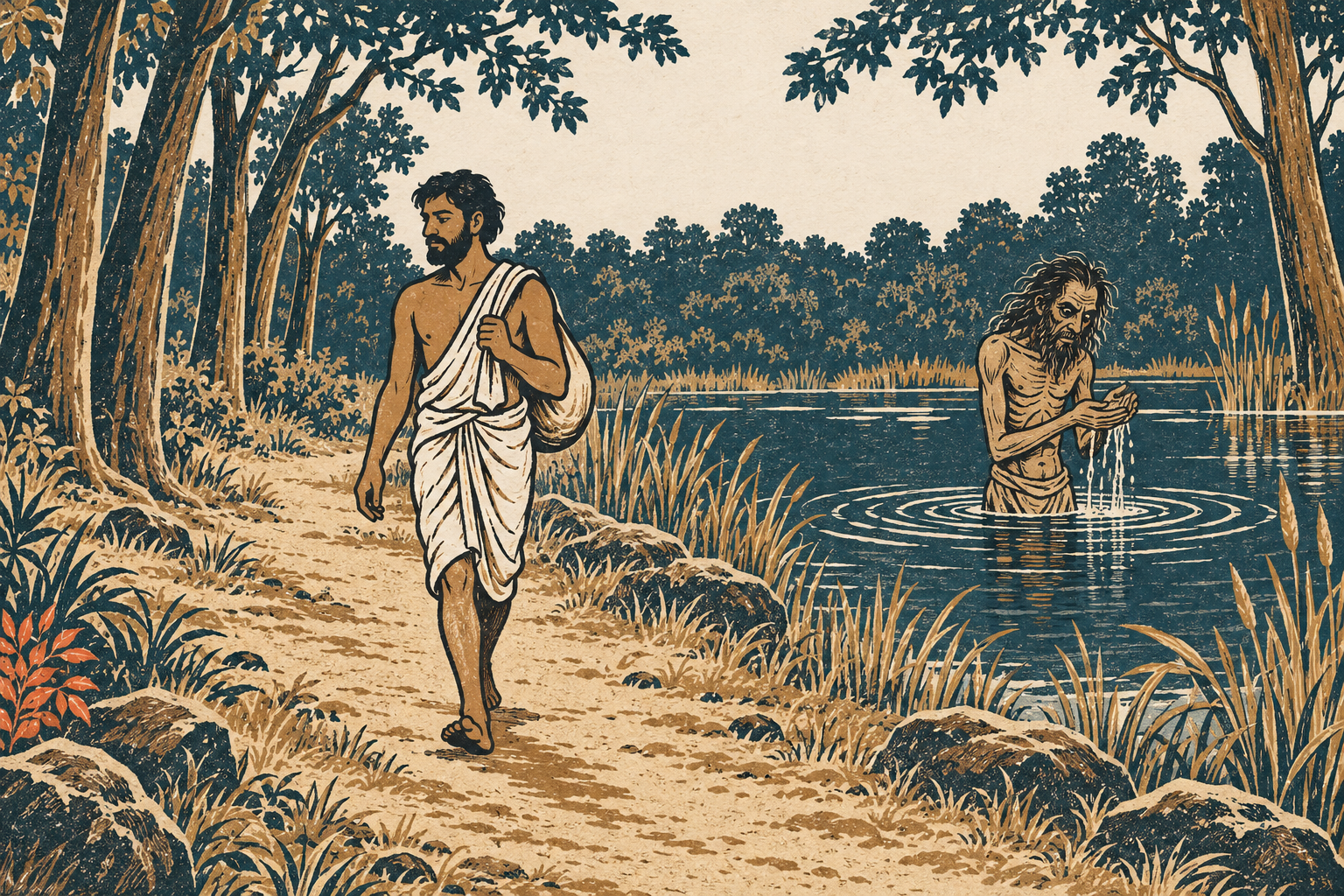
In a wide forest, there lived a fiend. Late one evening he came upon a Brahman walking alone on the forest path, climbed straight up onto his shoulder, and told him, in a voice that left no room for arguing, to keep walking.
The Brahman, badly frightened, did exactly as he was told. But as they went on together, he noticed something strange: the feet resting against his shoulder were soft. Too soft — softer than any feet that had ever walked barefoot over stones and roots and forest floor. So, working up his courage, he asked why.
“I am bound by a vow,” the fiend told him. “I may never let my bare feet touch open ground — not until they’ve been properly washed.”
The Brahman turned this over carefully as they walked on. And it wasn’t hard to guess why a fiend would want a man carried along all to himself like this: to eat him, most likely, once his prayers for the day were finished. Fiends did not go to the trouble of carrying people on their shoulders out of friendliness. Whatever happened next, the Brahman decided, he would need to already be walking away — not standing still — the very moment those soft feet touched water.
Before long they reached a lake. “Wait here,” the fiend said, climbing down at last onto the bank. “I’m going in to bathe and say my prayers before I do anything else today.” And with that, he waded into the water.
The instant the fiend’s feet touched the lake, the Brahman turned and walked off — quickly, but not running, not once looking back, straight along the ordinary dry path through the trees.
The fiend finished his bathing, came up dripping, and looked around for the Brahman. He was already well down the path, out of reach, standing on plain dry ground that the fiend’s own washed and waiting feet could not yet cross. Bound by the very rule he lived by, the fiend could do nothing but stand at the water’s edge and watch him go.
And that was the whole of the chamberlain’s story: a clever man got free of a dangerous stranger not by being stronger than him, but by noticing the one rule that stranger could never break.
Here, under our tree, Dev sat with it a moment, quiet, before he spoke. “He got away,” he said, like he needed to say it out loud to believe it.
“He got away,” Nani agreed. “Clean away, and never once had to run for it, not really.”
Leo was already sitting bolt upright. “Because the fiend couldn’t get his feet wet — no, wait, couldn’t get them dry —”
“Couldn’t get them onto dry ground,” Nani said, smiling, “not until he’d washed them first. His own rule caught him where nothing else could.”
Mira wiggled her own bare, still-grubby toes, newly interested in them. Beside her, Bupam patted at his own small feet with both paws, checking, as if he too might have a rule about clean ones he’d forgotten.
For the grown-up (not read aloud): the heart of it — noticing the one rule someone else lives by, even a dangerous someone, can be the very thing that keeps you safe.
Where it comes from: retold from the Panchatantra (the story of the fiend bound by his own vow, Book 5).
More stories for ages 6–8
The Jar of Big Plans · The Frog Who Went That Night · One Song Too Many · The Jackal’s Warning · The Scar That Wasn’t a Sword · The Borrowed Stripes
 Banyan Story Studio