


Growing listeners · ages 6–8 · comfortable from 5 with a grown-up · Retold from the Panchatantra
A heads-up: this story ends with the donkey’s trick found out, and he does not survive it.
Reading aloud? A note for you
This one has a real ending, so read the heads-up above before you start. Slow down at the barley field, where the donkey is genuinely thriving — let your child enjoy that part before the turn comes. Your child may ask why the farmers were fooled, or why the donkey brayed if he knew better; both are worth sitting with rather than rushing past. In the old telling, the ending names exactly how the donkey was killed; ours does not, and there is no other change to the events. If your child is sensitive to loss, you can close the book after “sooner or later, what’s underneath finds its own voice” and skip straight to a hug.
Nani was already threading a needle when the children arrived, mending a tear in one of Leo’s old shirts with a scrap of cloth that didn’t quite match. Bupam reached down and tugged at the loose scrap until Nani swatted his paw away without even looking up. Mira watched the mismatched patch take shape and made a face. “It’s a different color,” she said. “You can tell right away.” “You can,” Nani agreed, “close up. From across the garden, nobody will look twice.” Leo arrived at a run and dropped down cross-legged in the dirt. Dev, who had been standing at Nani’s elbow the whole time watching the needle work, simply sat down where he already was.
“Tonight’s story is one the monkey told the crocodile,” Nani said, “back when the two of them were still finding their way to being friends again. It’s about a donkey who found himself a very easy life — and about how hard it is to go on pretending to be something you’re not.”
“Listen.” And she began.
In a certain town lived a washerman named Shuddhapata, and he owned a single donkey, so thin from lack of proper feed that its ribs showed plainly through its coat. Every morning it carried great bundles of wet cloth down to the river and back, and every evening Shuddhapata scraped together whatever feed he could find and still it was never quite enough. It troubled him to see the poor animal go hungry, day after day, for work he could not pay it back in food.
One evening, walking home through the forest with an empty sack over his shoulder, he came upon a tiger lying still and lifeless among the ferns — fallen, perhaps, in some fight with another beast, or simply old and worn out, the way all creatures eventually are. He stood looking at the striped hide for a long moment, turning something over in his mind, and slowly, an idea took shape.
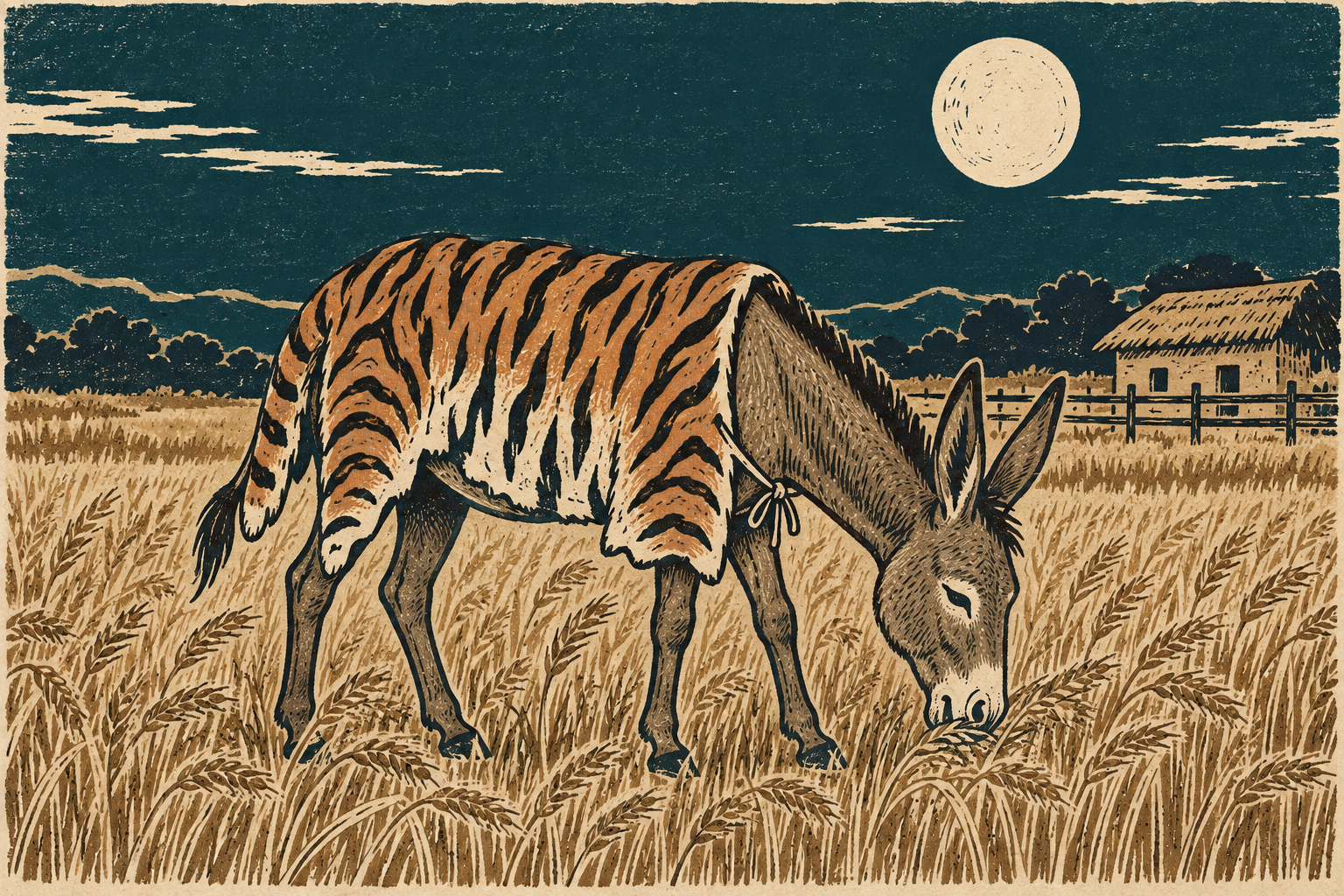
That night he worked the skin free and fitted it over his donkey’s back, lacing it snug at the chest and legs. Then he led the donkey to the edge of a barley field, out past the last farmhouse, and simply let him go.
By moonlight, no farmer looking out over his crop could tell a striped donkey from a real tiger. A shape like that, moving low between the stalks, was enough to make a grown man stay indoors and bolt his door. Word passed quietly from field to field: leave the big cat be, and it will leave your family be. So night after night the donkey wandered the barley untouched, filling himself as he pleased, ears twitching at every sound but never once chased off, and before dawn each morning Shuddhapata came quietly and led him home again, hidden safely under the hide until the next nightfall.
This went on for a long while — weeks, then months. The donkey grew round and glossy, stronger than he had ever been in his life, sleeping through the days on a full stomach and grazing through the nights on someone else’s barley. His coat filled out until it shone. Not a single farmer came near him, and Shuddhapata, watching his donkey thrive at no cost at all, thought he had found the cleverest trick in the world.
Then one night, out among the tall stalks, the donkey heard something carried faintly on the wind — the bray of another donkey, somewhere far off in the dark. Something in him rose up at the sound, warm and urgent, and before he could stop himself he lifted his head and answered it, long and loud and completely, unmistakably himself.
The farmers, watching from the field’s edge, went very still. No tiger made a sound like that, not ever. They crept closer for a better look, lanterns low, and there under the borrowed stripes they saw the truth plainly at last — a donkey’s ears, a donkey’s legs, a very ordinary animal dressed up far bigger than his own size.
The trick unravelled in a moment. Furious at having been fooled night after night, the farmers drove him from the field that very hour, and that was the end of him.
A borrowed skin can win you a full season of easy meals. It cannot change what’s underneath — and sooner or later, what’s underneath finds its own voice.
Here, under our tree, Leo turned it over for a moment. “He just — couldn’t help it?”
“Not once he heard someone worth answering,” Nani said.
Dev picked at the hem of his own sleeve, thinking. “I would have stayed quiet.”
“Maybe,” Nani said, smiling down at him. “Maybe not. It’s harder than it sounds, staying quiet when something in you wants to answer.”
Nani snipped the last thread and held the mended shirt up to the lamp, the patch still plainly a different color.
For the grown-up (not read aloud): the heart of it — a disguise can feed you for a while, but it can’t change who you really are underneath, and eventually that truth finds its way out.
Where it comes from: retold from the Panchatantra (a donkey dressed as a tiger, Book 4), freely reshaped.
More stories for ages 6–8
The Dog Who Came Home · The Jackal’s Warning · The Scar That Wasn’t a Sword · The Lion Who Called Out · Told Three Times · The Owl Who Almost Wore a Crown
 Banyan Story Studio