


Growing listeners · ages 6–8 · comfortable from 5 with a grown-up · Retold from the Panchatantra
A heads-up: near the end a family secret comes out, and one character has to leave the only home he’s ever known — nothing violent happens on the page, but the ending is quietly sad.
Reading aloud? A note for you
This one turns twice: first when the two lion cubs lose their nerve and their brother doesn’t, and again at the very end, when we learn something about him that changes everything. Go slowly through the mocking scene — a child this age will feel for him before they understand why he gets so angry. They may ask why the mother lion never told him sooner; there isn’t a tidy answer, and it’s fine to say so. Let the last page sit quietly rather than rushing to explain it.
“The neighbour’s new puppy doesn’t look anything like its mother,” Dev said, settling down before the other two had even arrived. “Different colour completely. I don’t understand how that happens.” Leo, arriving a beat later, had a theory ready — something about the father dog, though he wasn’t sure of the details. Mira arrived last and didn’t offer one at all, more interested in hearing whether Dev’s question had an actual answer.
“Funny you should ask that tonight,” said Nani. “This is a story a king once told, to explain why he was sending a man away. He told it about a family in a forest — a lion, a lioness, and the three cubs they raised as if they were all the same kind. It’s a story about what you’re born as, and what you’re raised to be, and how those two things don’t always agree with each other.”
Dev forgot the puppy entirely and leaned in.
“Listen.” And Nani began.
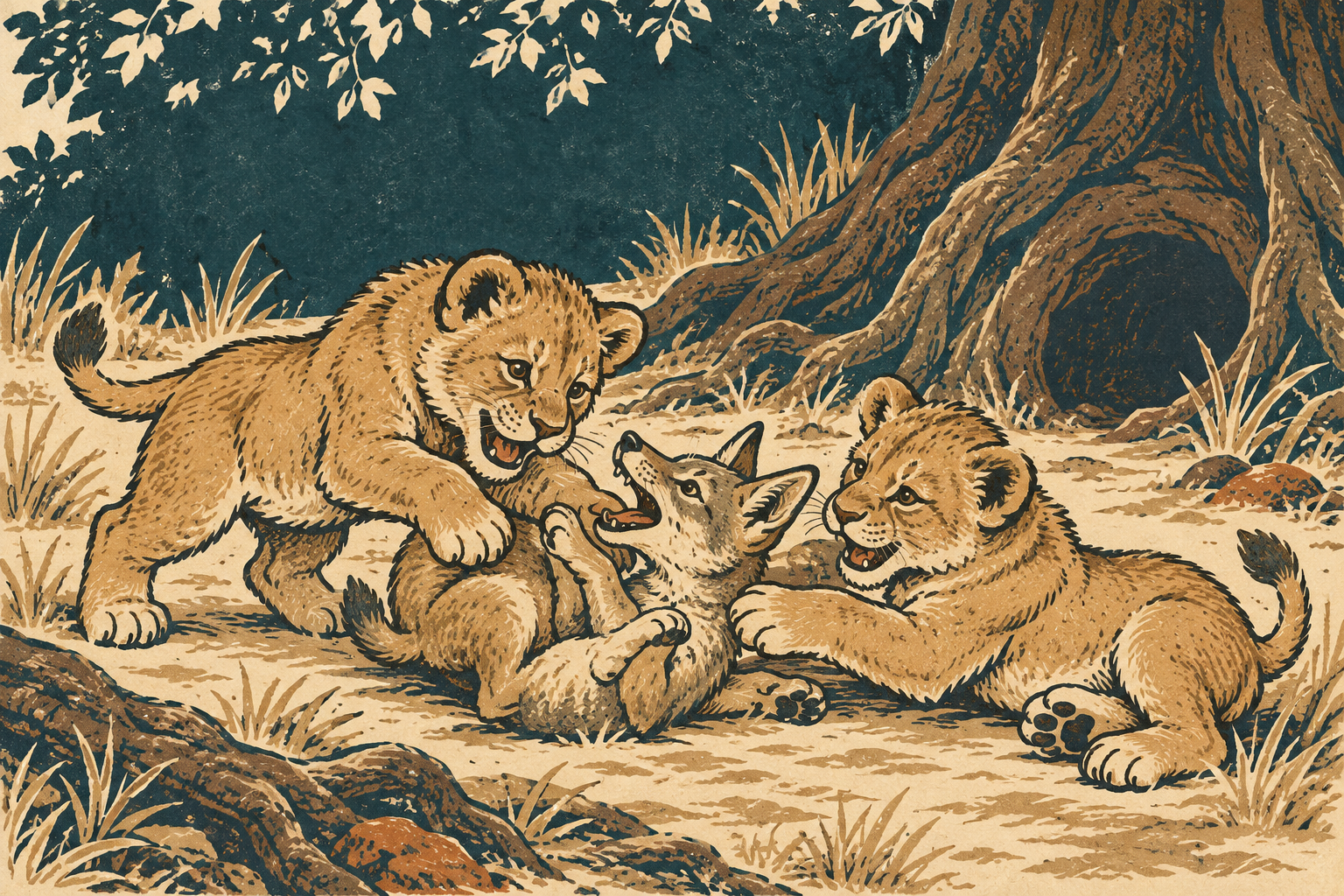
In a wide forest, a lion and his mate made their den, and when their cubs were born, there were two of them, strong and quick. Every day the lion went hunting so his family would eat.
One evening he came home with nothing — no deer, no game of any kind, only the last light going down behind the trees. But on the path he had found something small and shivering: a jackal cub, alone, too young to survive the night by itself. The lion couldn’t leave it. He carried it home gently in his jaws and set it down in front of his mate.
“I found no food,” he told her, “only this. I couldn’t bring myself to hurt something so small. Perhaps we should eat him instead, and I’ll bring more tomorrow.”
The lioness looked at the shivering cub for a long moment. “You wouldn’t harm him because he’s a baby,” she said. “So how could I? Whatever he is, he’s still a baby, and babies aren’t food.” And she made up her mind on the spot: he would be her third son.
So she fed him alongside her own two, and warmed him the same, and scolded him the same when he was naughty. The three of them grew up together, chasing each other through the grass, tumbling and wrestling and napping in the same patch of sun, and not one of them thought there was anything different about any of the others.
Then, one afternoon, an elephant strayed into their stretch of the forest, huge and grey, swinging its trunk with every slow step.
The two lion cubs saw it and went straight for it, teeth bared, ready to fight something ten times their size.
But the jackal cub had seen elephants before, from somewhere in him that the other two hadn’t. “Brothers, wait!” he called. “That’s an elephant. Your whole family has always kept away from them — please don’t go near it.” And with that, he turned and ran for home.
Seeing their brother bolt, the two lion cubs suddenly lost their own nerve too. All three of them ended up racing back to the den together, the elephant left plodding on, entirely unbothered, through the trees behind them.
That evening, when the twins told their parents about it, they left out the warning altogether. All they talked about was the running. “You should have seen him,” they said, laughing. “The second he spotted that elephant, he was gone before either of us could blink.”
The jackal cub heard every word of it, and something in him went hot and tight. His brothers hadn’t just teased him — they’d made him sound like a coward, when the truth was the opposite. He was so stung, and so angry, that he said things to them he didn’t mean — sharp, furious things, the kind that come out before a person has thought them through.
His mother pulled him aside. “You mustn’t speak to your brothers that way,” she said gently. “They’re family.”
But her gentleness only made him angrier, and he turned it on her too, demanding to know what right his brothers had to laugh at him — wasn’t he just as clever, just as brave, just as quick as either of them?
The lioness didn’t answer with anger. She looked at him for a long moment, this cub she had raised with her own milk, and she laughed instead — softly, sadly, not because anything was funny, but because she knew what she had to tell him, and she didn’t want him to fight his own brothers over it.
“You are clever,” she said. “And brave, and quick, and handsome besides. But there is one thing about your family that you don’t yet know.”
Then she told him. She told him where he had truly come from — the cold night his father had found him on the path, too small to live alone, and how she had chosen, right then, to raise him as her own out of nothing but pity. “Your brothers don’t know it,” she said. “Not yet. While they still think of you only as their kin, go quietly and find your own people. If they ever learn the truth and you’re still here, they will fight you. It could cost you your life.”
The jackal cub stood very still. Everything he had believed about himself — every game, every meal, every scolding, every night curled up between his brothers — was true and not true at the same time. He was frightened in a way he had never been frightened before, not even in front of the elephant.
Quietly, without waking the others, he slipped away into the dark to find the jackals he had never known.
Here, under our tree, nobody spoke for a moment.
Dev was still turning the puppy question over, but it had changed shape a little. “Maybe it just got raised by different dogs,” he said slowly. “Not that it isn’t really hers.”
“Maybe,” Nani said, and left it at that.
“I hope he found his own people,” Mira said quietly, “the ones who don’t laugh at him.”
Nobody under the banyan said anything more.
For the grown-up (not read aloud): the heart of it — however brave, clever, or loved you are, you are still what you were born, not only what you were raised to be. One thing was softened for this telling: in the old story, the jackal cub threatens to kill his brothers in his anger; here, he simply “said things to them he didn’t mean.”
Where it comes from: retold from the Panchatantra (the jackal cub raised as a lion’s son, Book 4).
More stories for ages 6–8
The Scar That Wasn’t a Sword · The Borrowed Stripes · The Dog Who Came Home · The Lion Who Called Out · Told Three Times · The Owl Who Almost Wore a Crown
 Banyan Story Studio