


Growing listeners · ages 6–8 · comfortable from 5 with a grown-up · Retold from the Panchatantra
Reading aloud? A note for you
In the old telling, the dogs of that foreign city actually set on him and hurt him as he leaves; we’ve kept only an unfriendly, unwelcoming pack, so there’s nothing frightening to walk your child through. The old telling also has him admiring how easy foreign women were to know, in his closing speech home — we’ve left that out entirely, since it has no place in a child’s story. What’s left is the plain, warm point the tale was always making: good food is not the same as a good home.
The smell of Nani’s dal was still hanging over the yard when the three of them came and settled by the banyan roots, plates barely rinsed. Mira arrived last, wiping her hands on her kurta, still arguing that she could have finished her rice faster if Leo hadn’t stolen the last papad. Leo only grinned and stretched out on his stomach. Dev sat down between them and pulled his knees up, quiet, the way he got once his stomach was full and the day was properly over.
Nani lowered herself onto her favourite root last of all. “Tonight’s is one the monkey told the crocodile,” she said, “up in his tree by the sea, near the end of all their talking, once some hard news had already come and gone between them. It’s a small story about a dog who wanted to see the world — and about how even a harder home is still home.”
Mira wrinkled her nose. “Better than papad?”
Nani looked round at all three of them. “Listen.”
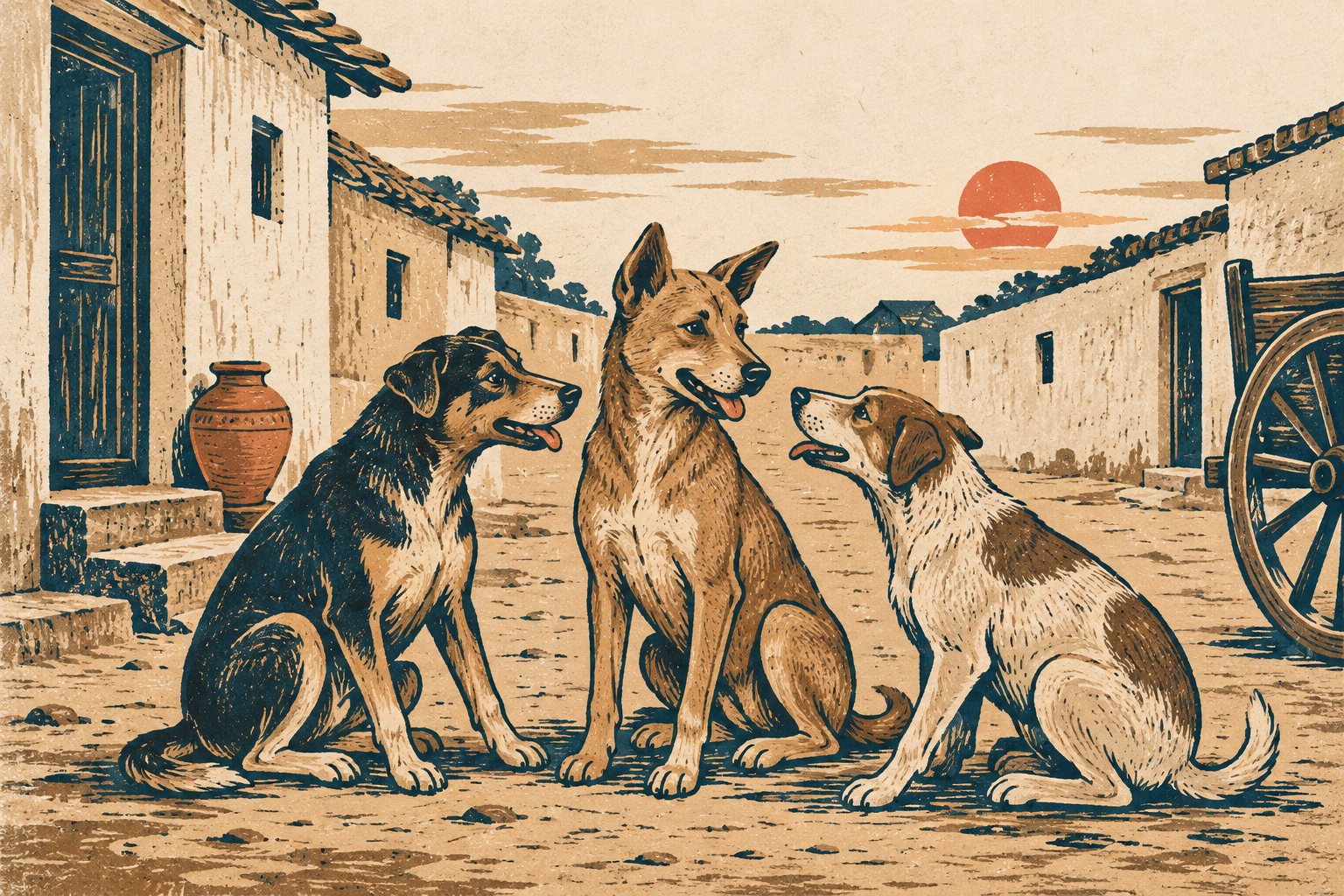
Long ago, in a town gripped by a long, hungry season, there lived a dog. Food grew scarce for everyone that year, people and animals alike, and one by one the town’s dogs began losing the yards and doorsteps they had always called their own. This dog felt his own hunger sharpen with every week that passed, until at last he made up his mind to go and try his luck somewhere far off.
He walked a long way, out past everything he knew, until he came to a city in another country entirely, one he had never laid eyes on before. There he found a house kept by a woman who was careless about latching her kitchen door and easy about what she left lying within reach. He slipped in after that, morning after morning, and made a fine, full meal of it — better, in truth, than anything he had ever managed back home. For a while it truly seemed he had stumbled onto the easiest, softest life a wandering dog could ever hope for, and he began to wonder why he had waited so long to leave.
But that city already had dogs of its own, and they did not care to share their bowls with a newcomer. One evening, as he came out from the house well fed and unhurried, the local dogs closed in around him from every side at once, growling low, and made it plain — with teeth bared and voices raised — that he was not wanted there, and never would be.
The dog got clear of them at last, shaken, and sat down somewhere quiet to think it over. “The food here is good,” he told himself, “better than I’ve ever had. But I have never once, in the worst of any famine, been made to feel so unwelcome among my own kind as I was made to feel just now, among strangers. Better a thin supper among dogs I know than a full one among dogs who’d sooner drive me off than share their street.” And with that settled in his mind, he turned around and made the long walk home.
His family and his old neighbors came crowding round the moment he arrived, the way anyone does for a traveler back from somewhere far. “Tell us everything,” they said. “What was the country like? How did the people treat you? What did you find to eat, all that time?”
The dog sat back on his haunches and took a moment, because both halves of the answer were true and he meant to give them both.
“The food there,” he said at last, “was the best I’ve ever eaten — more of it, and every kind, and at first no one seemed to mind a stranger helping himself. I won’t pretend otherwise. But the dogs of that place have no manners to speak of. They don’t wait to be properly introduced. They don’t share a street in peace. Turn your back on them for even a moment, and some squabble or shoving match has broken out before you’ve noticed. No amount of good food is worth neighbors like that.” He looked around at his own thin, familiar street, at faces he had known since he was barely old enough to walk it. “Whatever we’re short of here, at least we know one another. It turns out that counts for more than I gave it credit for, before I left.”
Here, under our tree, the last of the dal-smell had faded into ordinary night air.
“I’d still want to see the world,” said Leo, stretching both arms over his head. “I’d just bring my own snacks.”
Dev thought about it longer. “I think I’d rather stay,” he said quietly, “and share what we’ve already got.”
Mira only nodded, tearing a bit of leftover papad in half and handing one piece to Dev without being asked.
Nani said nothing more, and let that be the end of it.
For the grown-up (not read aloud): the heart of it — even a harder home is still home, because the people who already know you are worth more than a full table among strangers.
Where it comes from: retold from the Panchatantra (a dog’s journey to a foreign city and his return home, Book 4).
More stories for ages 6–8
The Jackal’s Warning · The Scar That Wasn’t a Sword · The Borrowed Stripes · The Lion Who Called Out · Told Three Times · The Owl Who Almost Wore a Crown
 Banyan Story Studio