


Growing listeners · ages 6–8 · comfortable from 5 with a grown-up · Retold from the Panchatantra
Reading aloud? A note for you
This one is a courtroom trick, told in two matched halves — a debt that vanishes, then a debt that is invented right back. Slow down for the merchant’s second excuse; that is the turn of the whole story, and a child often needs a beat to catch that he is doing on purpose what was just done to him. They may ask whether the boy was scared — he wasn’t; he is looked after the whole time, and you can say so plainly if it’s asked. Let the judges have their moment: this is a story about being caught out by your own logic, not about anyone getting away with anything. Naduk is said NAH-duk, Lakshman the familiar way.
The kitchen scale had come out earlier for dinner, and Mira had spent a happy ten minutes weighing whatever she could find — a mango, a shoe, her own fist — before Nani called them all outside. She came to the banyan still turning that over. “Everything has a weight, even things you wouldn’t guess,” she said, settling onto her root.
“That is exactly the story for tonight,” Nani said, lowering herself down with a small sigh. Leo arrived at a run and dropped cross-legged so fast he nearly toppled, catching himself on one hand. Dev was already there, having slipped out ahead of the others, and had claimed the spot with his shoulder against Nani’s before either of them sat down.
Off in the grass, Bupam was poking at something with great concentration — an ant, maybe, or a fallen fig — and paid the rest of them no attention at all.
“This is a story one jackal told his brother, to warn him: a man who has already ruined his own master will think nothing of ruining anyone else besides. It’s about this: believe that mice can eat away an iron balance, and you may as well believe a hawk could carry off a boy.”
“Listen.” And she began.
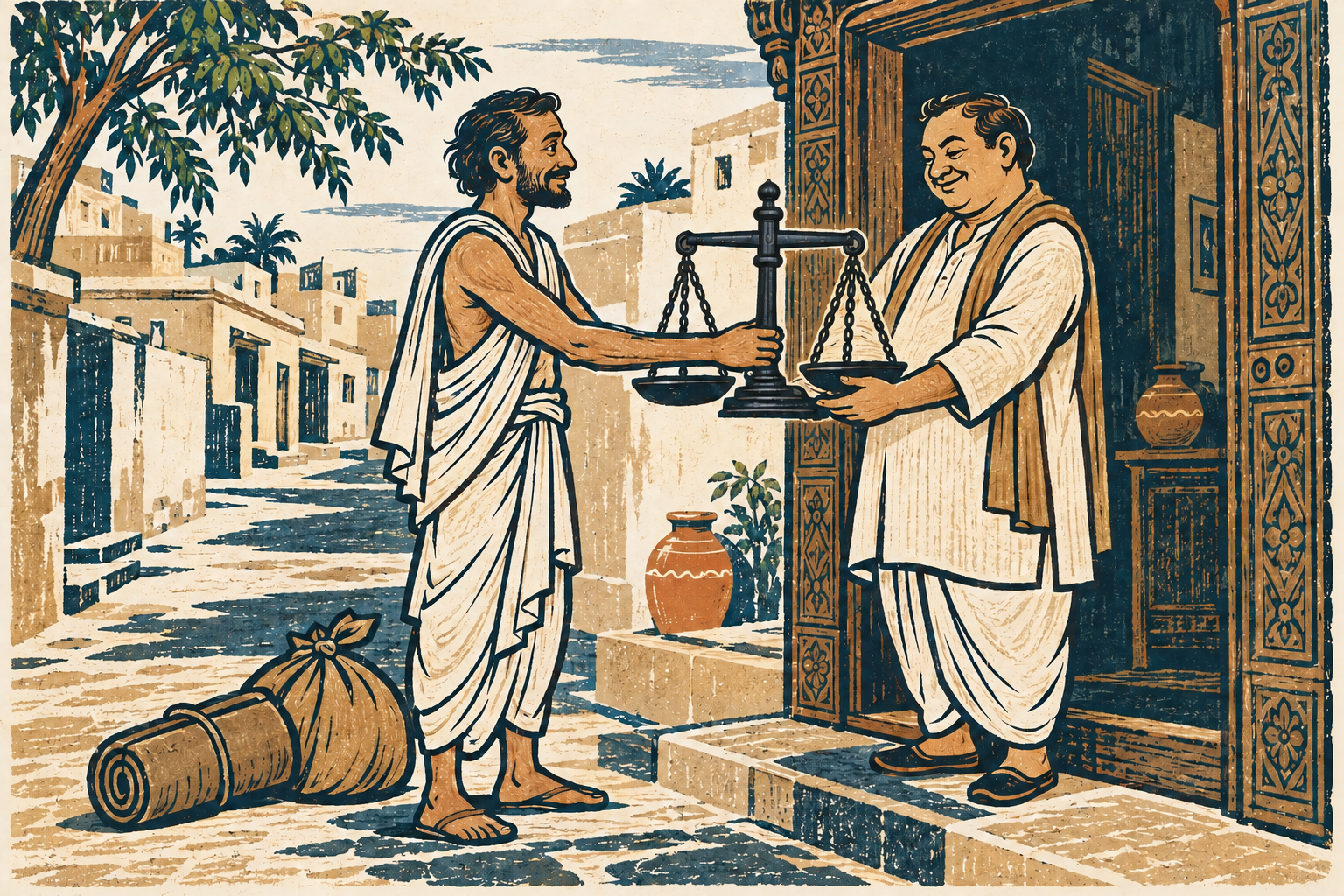
There was a town where a trader named Naduk had done well for years, until the year he did not, and his fortune ran out from under him the way water runs out of cupped hands. He decided to travel to build it back up. But in his house stood one thing too heavy and too precious to carry: an iron balance for weighing goods, passed down through his family, so large it took two men to lift it. Naduk did not want to leave it sitting empty in his own house while he was gone, so he carried it to a merchant he trusted, a man named Lakshman, and asked him to keep it safe until he returned.
Naduk was gone a long time. When he finally came home, dusty and glad to be back, he went straight to find Lakshman and asked for his balance back.
Lakshman spread his hands. “Friend Naduk,” he said, “I am sorry to tell you — the mice got in. They have eaten your iron balance clean away.”
Naduk looked at him for a long moment. Then he said, very evenly, “Well. If the mice have eaten it, the mice have eaten it. There is nothing to be done about mice.” And he said nothing more about the balance at all — which, if Lakshman had been listening closely, might have worried him more than an argument would have.
Instead Naduk said, “I’ve been travelling for weeks, and I am covered in road dust. I’m going down to bathe in the river. Would you send your boy along to carry my things for me?”
Lakshman, who was feeling the particular guilt of a man who has just told a lie, was glad of the chance to be helpful. He called his son and told him to go with Uncle Naduk and see that he had everything he needed.
So the boy went, cheerfully enough, carrying Naduk’s bathing things down to the river. Naduk bathed, and talked with him kindly along the way, and asked him about his lessons and his games, as an uncle might. And when they reached a certain house belonging to another friend of Naduk’s, well off the river path, Naduk asked the boy to wait inside for just a little while — and then did not come back for him. He left him there, comfortable and fed and entirely unafraid, with instructions to the friend to keep him a few days, and went home alone.
Lakshman was waiting on his doorstep. “Naduk,” he said, looking past him, “where is my son? Where is the boy who came with you?”
Naduk looked stricken. “Ah, Lakshman,” he said, shaking his head sadly, “it’s a terrible thing. We had barely reached the riverbank when a hawk came down out of the sky — a great hawk — and carried him off before I could so much as shout.”
Lakshman went very still. “A hawk,” he said, “carried off my son. A boy of fifteen years, taller than I am. You expect me to believe a hawk swept him away like a fish?”
“I only tell you what I saw,” said Naduk.
Lakshman was so angry and so frightened that he went straight to the town’s judges and set out his complaint at the top of his voice: that Naduk had taken his son to the river and come back without him, with nothing to show for it but a story about a hawk.
The judges sent for Naduk and asked him to explain himself.
“Honoured judges,” said Naduk, “I have told the truth exactly as it happened. A hawk carried the boy away. I saw it with my own eyes.”
“Naduk,” said the eldest judge, not unkindly, “a hawk cannot lift a boy of fifteen years. Everyone in this town knows that.”
“Is that so,” said Naduk. “Then may I ask the court something? In a town where mice can eat an iron balance weighing as much as two grown men — a balance passed down through three generations, that has never once been touched by a mouse in all that time — why should anyone be surprised that a hawk can carry off a boy? If the one thing is possible, honoured judges, so is the other. I am only matching my story to Lakshman’s.”
There was a silence in the courtroom. Then the eldest judge began, very slowly, to smile, and it spread from judge to judge down the whole bench, until they were all of them smiling at once, because they understood exactly what Naduk had done, and why.
“Lakshman,” said the eldest judge, “return the man his balance.”
“Naduk,” said the judge, “return the boy to his father.”
And that was the end of it. Lakshman went home and dug the iron balance out of the storeroom where it had been sitting untouched the whole time, and had it carried back to Naduk’s house. Naduk sent word to his friend, and the boy — who had spent a perfectly pleasant few days as a guest, and had rather enjoyed the mystery of it — walked home to his father that same evening. No one was punished. No one needed to be. The judges had seen through both stories at once, the way you can see two fish in clear water by looking for only a moment longer than the first glance takes.
Here, under our tree, the kitchen scale was probably still sitting out on the counter, Nani said, and someone would have to put it away before bed.
Mira thought about her mango and her shoe and her own fist on the scale. “I wonder how much a hawk weighs,” she said.
“Mice,” said Dev, half to himself, testing the word.
Leo laughed, short and surprised, and then went quiet again.
Nani got up to see about that scale, and left the three of them sitting a moment longer in the last of the light.
For the grown-up (not read aloud): the heart of it — believe one impossible excuse, and you have no ground left to reject the next one; a matched lie is the surest way to expose the first.
Where it comes from: retold from the Panchatantra (the iron balance eaten by mice, Book 1). In the old book, Karataka the jackal tells it to his brother Damanaka.
More stories for ages 6–8
The Skin Left Behind · Flying Up Together · What Two Parrots Said · The Howl He Couldn’t Hold · The Hare Who Came Late · The Wedge in the Log
 Banyan Story Studio