


Growing listeners · ages 6–8 · comfortable from 5 with a grown-up · Retold from the Panchatantra
Reading aloud? A note for you
This one turns on a promise kept and a change made permanent, so let both land without rushing them. Slow down at the moment the bride finds someone new in the dark room — she is startled, not endangered, and a beat of quiet there does the story’s work for you. A child may ask why burning the old snake skin matters; the story answers its own question, so you can let it. In the old telling this same night goes further, with an embrace the story doesn’t need for children, so this version stops at the proof that he is her husband and leaves it there. The old telling also nests this story inside a longer one about a monk; here it is told on its own, as its own story.
The puzzle had been nearly finished for two days running, four hundred pieces down to one, and that one piece was nowhere to be found — not under the cushions, not under the mat, not anywhere Mira had already looked twice. Leo arrived declaring he definitely hadn’t taken it, in the tone of someone who definitely had. Dev sat down quietly beside the unfinished puzzle and, without being asked, started checking under its corners for the hundredth time.
“Tonight,” said Nani, “is a story a counsellor once told his king, about how a change becomes real, truly and for good, once the one thing that seals it has been done.”
“Like finishing the puzzle?” Mira asked, still looking.
Nani smiled. “A little like the puzzle. Listen.” And she began.
In a certain town there lived a Brahman and his wife who had no children, and the wife wept whenever she saw the neighbours’ little ones at play. One day her husband told her to take heart — for at the sacrifice he had made, praying for a child, an unseen voice had promised him a son beyond all others in beauty and in character. Her heart lifted to hear it. And in time she did bear a child. But the child she bore was a snake.
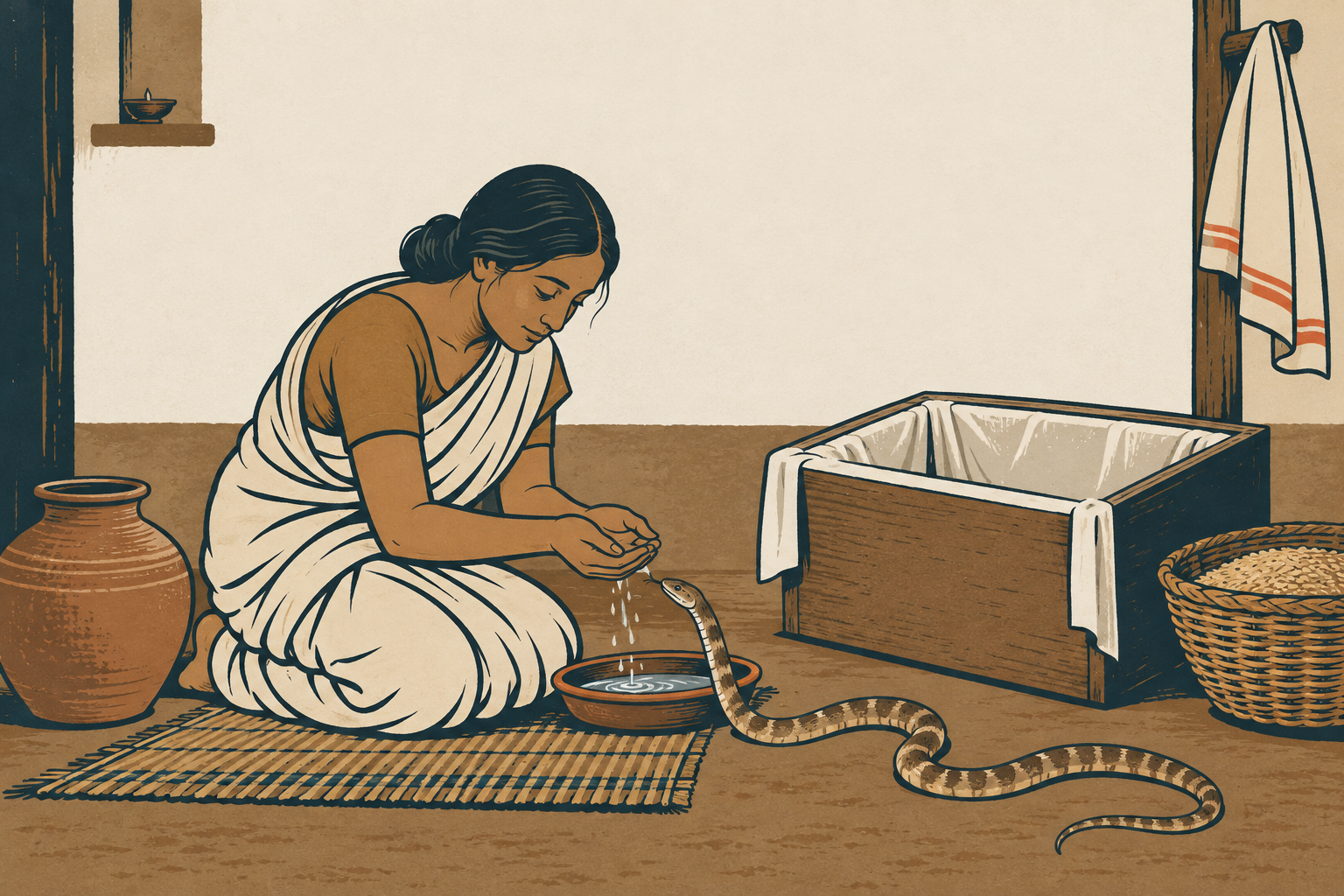
Everyone around her said the same thing: put him away, forget this happened. She would not. She bathed him with her own hands and settled him inside a big, clean box, feeding him milk and fresh butter until he reached his full length.
Years passed. One evening the wife watched a neighbour’s son married with music and flowers, and she wept again — this time because no one had ever come asking for her own son’s hand. Her husband could not bear her grief a second time. Who, he wondered aloud, would give a daughter to a snake? But he packed provisions and set out anyway, to look, because he loved her.
He travelled a long way, into a distant land, until he came to the house of an old family friend. That man had a daughter — clever, kind, and lovely — and when he heard why his friend had come so far, he offered her without a moment’s hesitation. So the Brahman brought the girl home with him, to be married to his son.
The town’s people couldn’t believe how lovely she was, and her own relatives begged her to leave before the wedding could take place. But the girl held firm. “A promise is made once,” she told them, “and it doesn’t come undone twice — not a king’s word, not a wise one’s word, and not a daughter once given in marriage. What is meant to happen will happen; even the gods cannot argue a thing back out of its fate. I know another story about fate keeping its word — that’s for another night. I won’t have my father shamed on my account.” And she married him.
She cared for him faithfully after that, bringing him milk each day and tending him as any wife tends a husband. And one night, out of the box in her room, came not a snake but a man.
She startled backward — a stranger, here, in the dark! — and was up and reaching for the door before he spoke. “Wait,” he said. “Don’t run. I am your husband.” And to prove it, he went back into the snake’s body lying in the box, and came out of it again, a man once more, right before her eyes. When she saw him clearly this time, she knew he had told her the truth.
In the morning, the Brahman rose early, as he always did, and found how matters stood. He took the empty snake skin from the box and put it to the fire, and watched it burn away to nothing. “He won’t need to go back into that again,” he said. And that day the Brahman and his wife told everyone in the town that they had a son — a fine, grown son — and it was entirely true.
And that is how a change becomes real: not in the wishing for it, and not even in the proving of it, but in the burning of what’s left behind — so there is nothing left to go back to, and the new shape simply is, from then on, for good.
Here, under our tree, the puzzle sat exactly as they’d left it, one gap still open in the corner.
“I really didn’t take it,” Leo muttered again, unprompted.
Mira looked at the gap a moment longer, then covered it with her hand and left it there.
Dev, already half-asleep against the root, didn’t stir.
For the grown-up (not read aloud): the heart of it — a promise kept without wavering, and a change that becomes permanent only once what came before it is truly let go.
Where it comes from: retold from the Panchatantra (a son born a snake, made a man for good, Book 1), freely reshaped.
More stories for ages 6–8
Flying Up Together · What Two Parrots Said · The Howl He Couldn’t Hold · The Hare Who Came Late · The Wedge in the Log · The Guest Who Couldn’t Wait
 Banyan Story Studio