


Growing listeners · ages 6–8 · comfortable from 5 with a grown-up · Retold from the Panchatantra
A heads-up: a hunter sets a snare and catches a whole flock of geese — nobody is hurt, and every one of them gets free.
Reading aloud? A note for you
This is a short tale about listening to good advice before trouble arrives, and then listening again once it has. Slow down at the vine’s first appearing — that quiet warning is easy to rush past, and it is the whole hinge of the story. Children often ask why the other geese did not simply cut the vine when he told them to; there is no need to answer for them, the story does. The moment of most tension is short — the geese are caught, and free again, within a page — so there is no need to soften it further than the story already does. All the birds in this one stay unnamed, as they do in the old telling.
The money-plant vine on the veranda pillar had grown so long over the summer that it now reached the eaves, and Leo had spent the whole walk over insisting someone should cut it back before it took over the roof. Mira wasn’t so sure. “It’s not hurting anything,” she said, dropping down cross-legged, chin already in her hands.
Dev arrived last, carrying the stick he always carried, turning it slowly between his fingers — not fidgeting, just listening the way he did.
“This one,” said Nani, once they’d all settled, “is a story one of the birds told all the others — about a vine nobody wanted to cut, a hunter’s snare, and a whole flock that only got free because they finally did what their oldest bird told them to do. It says: when someone who has lived long enough to have seen trouble coming warns you, listen — before it happens, and after.”
“Listen.” And she began.
In a part of the forest grew a fig tree so old that its branches reached further than anyone could see from the ground. A whole flock of wild geese made their home there, nest above nest among those branches, and had lived there for as long as any of them could remember.
One year a vine began to grow up from the roots of the tree — thin, green, and curling, feeling its way up the trunk the way vines do. Among the geese was a gander older than the rest, who had seen more seasons than anyone could count on their feathers. He looked at that vine a long while, and then he spoke.
“That vine means trouble for us,” he said. “While it is small, it is nothing — a scrap, easy to break with a wingtip. But leave it, and it will grow thick enough for a man to climb. Cut it now, before it climbs any higher.”
The other geese looked at the thin green thread winding round the bark, and they laughed, not unkindly. It hardly seemed worth troubling over. They went on with their foraging, and their flying, and their evenings in the tree, and none of them cut the vine.
Season followed season, and the vine grew thick and strong, climbing the trunk in loops all the way up to the nests.
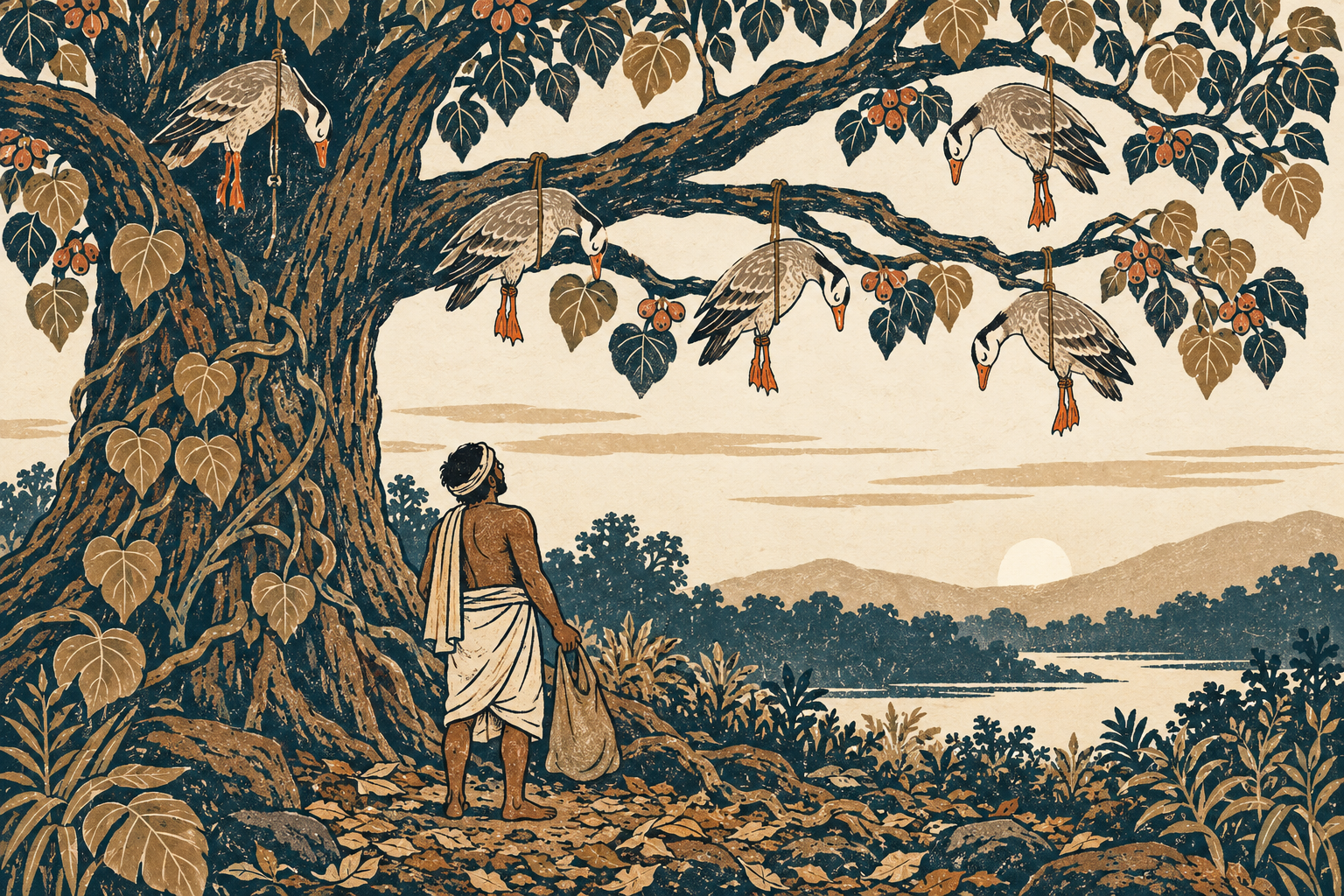
Then one day, while the whole flock was away in the fields, a hunter came walking through that part of the forest. He found the vine, tested it with his hand, and climbed it, hand over hand, all the way up into the fig tree. There, among the empty nests, he laid out his snares — loops of cord hidden among the leaves — and climbed back down and went on his way.
That evening the geese came home from the fields, tired and ready for sleep, the way birds are at the end of a long day. One by one, as each of them settled into the branches, a cord closed round its legs. By the time the last of them had folded her wings, every goose in the flock was caught fast.
“So,” said the old gander, once the flapping and the calling had died down enough for anyone to be heard. “It has happened. We are caught, and we brought it on ourselves by not listening. We are lost, every one of us — unless we can think our way out of it.”
“What can we do now, sir?” the others asked him. “The thing has already happened.”
The old gander thought a moment. “When the hunter comes,” he said, “every one of you must go still — as though the life had already left you. He will believe it, and when he throws the last of us down to the ground, that is our moment. Not before it. All of us, together, the instant the last one touches the ground.”
At first light the hunter came back to see what his snares had caught. He walked along the branch, and every goose lay as still and as limp as if the life had gone out of it already. Well pleased, he freed them from the cords one at a time and dropped each one to the ground, saving himself the trouble of carrying live, struggling birds.
He dropped the first. He dropped the next, and the next, until only the old gander was left in his hand.
And the moment the old gander’s feet touched the ground, the whole flock rose together, wings beating, up over the hunter’s head and away over the tops of the trees, before he had so much as understood what he was looking at.
He was left standing under the fig tree with an empty snare in his hand, and nothing else.
“That is the whole of it,” Nani said. “A flock of geese went free, in the end, because at the worst moment, they did exactly what their oldest bird told them to do. Listen to those who have lived long enough to have seen trouble before it comes — that is what this story was told to say.”
Here, under our tree, the evening had gone properly dark.
Leo looked over toward the veranda, just visible past the roots. “Maybe don’t cut the vine,” he said. “Maybe just watch it.”
Mira sat with that a moment. “Not one of them moved,” she said. “Not even one.”
Dev turned his stick once more in his hands and set it down at last, quietly. “I liked the gander,” he said.
Nani looked toward the veranda too, where the vine was only a dark shape now against the wall, and said no more.
For the grown-up (not read aloud): the heart of it — the flock went free because, in the end, they took the advice of the one among them who had lived long enough to have seen trouble coming.
Where it comes from: retold from the Panchatantra (the old gander and the creeping vine, Book 1).
More stories for ages 6–8
What Two Parrots Said · The Howl He Couldn’t Hold · The Hare Who Came Late · The Wedge in the Log · The Guest Who Couldn’t Wait · The Chain in the Hollow
 Banyan Story Studio