


Growing listeners · ages 6–8 · comfortable from 5 with a grown-up · Retold from the Panchatantra
A heads-up: a donkey gets caught making noise where he shouldn’t, and the farmers he wakes up are not gentle with him — he’s shaken and sore, but he trots off just fine.
Reading aloud? A note for you
This one is built for a grin, not a gasp — slow down for the donkey’s long, proud list of his own musical qualifications; the more seriously you say it, the funnier it lands. Your listener may want to argue that the donkey should just listen to his friend — let them; that’s exactly the point sinking in. The farmers’ arrival can go quick and light; we don’t linger on the blows, only on the fact that they came running and didn’t go easy on him. If your child asks whether the donkey is really okay, yes — sore and a little silly-looking, but fine, and still walking (loudly) by the end.
The crickets started up all at once that evening, a ragged chorus so loud and sudden that Leo clapped both hands over his ears and laughed. “They’re worse than you tonight, Nani,” he said, and she pretended to be wounded by the comparison. Mira had already claimed her usual spot in the roots, head tilted, plainly deciding whether any story could out-talk crickets. Dev sat a little apart, working a stubborn knot out of a bit of string he’d found, quiet and absorbed, only half-listening until Nani began to speak.
“A funny one tonight,” she told them, “though the fellow inside it wouldn’t call it that.” This was a story one traveler once told another, on a long walk they were making together — one of them called the wheel-bearer, the other the gold-finder, and it was the gold-finder’s turn to talk. His companion, he said, loved to show off, and never at the right moment. “It’s about knowing when to hold your tongue,” Nani said, “even when you’re sure you’re right.” She looked round at the three of them. “Listen.”
In a certain town there lived a donkey who spent his days hauling bundles of washing up and down the lanes, load after load, without complaint. But his nights were his own, and he liked to wander. One evening, roaming the open fields on his own, he crossed paths with a jackal out prowling the same ground, and the two got to talking, and by the end of the night they had decided they were friends.
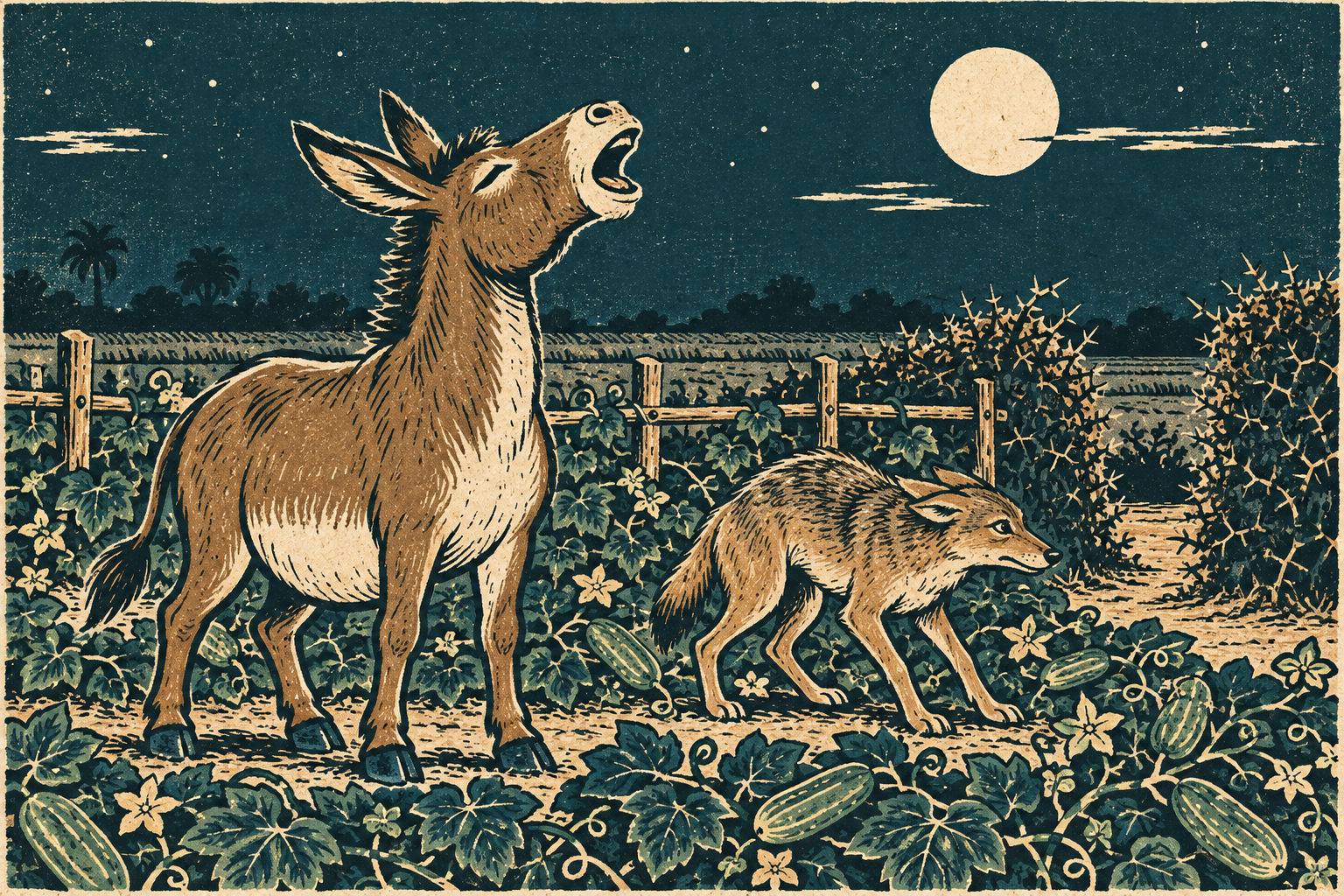
Being friends, they started keeping the same hours. There was a break in a nearby hedge that led straight into a farmer’s cucumber patch, and most nights the two of them would slip through the opening, eat as many cucumbers as they could hold, and be gone again before the sun came up. It suited them both very well.
Then one night, standing knee-deep in cucumber vines with a full belly and a clear sky overhead, the donkey felt a song coming on.
“Friend,” he said, lifting his head, “the night is much too fine to waste. I believe I’ll sing.”
The jackal’s ears went flat. “Please don’t,” he said. “We’re borrowing where we shouldn’t be, and borrowing is quiet work. Make noise now and you’ll bring the whole farm down on us both.”
“Nonsense,” said the donkey, drawing himself up. “You say that because you’ve never had an ear trained for music. I happen to know a great deal about it — the proper scales, the correct pauses, which notes belong where, how many kinds of song there are and what each is for, and which feelings go with which tune. On earth or in heaven, nothing is finer than a well-sung song, and I intend to give you one, whether you’re ready to appreciate it or not.”
“I don’t doubt you know your scales,” said the jackal carefully. “It’s only that your voice carries like a bell in a quiet valley, and it isn’t a voice that blends in. Tonight, of all nights, is not the night to be heard.”
“You wound me,” said the donkey. “Very well — if you’re so worried, go and keep watch by the gap. I’ll sing, and you’ll see that nothing comes of it.”
The jackal, seeing there was no talking him down, went and posted himself at that opening in the hedge to watch the dark fields, already bracing for what was coming.
The donkey planted his feet, lifted his head as high as it would go, and let loose.
It did not sound the way he thought it sounded. Across the fields, lamps began to flicker to life in farmhouse windows. Doors banged open. Within moments there were shapes running toward the cucumber patch, shouting to wake their neighbors, and they did not go easy on him when they arrived. The donkey went down hard, and by the time he’d scrambled back up, someone had tied a heavy stone collar round his neck to make sure he wouldn’t wander far before morning, and left him there while the whole farm settled back down to sleep.
But donkeys, as it happens, forget a scare faster than almost anyone. Before long this one had shaken off the fright entirely, put his head down, and simply barged straight through the hedge — stone collar, broken branches, and all — trotting off into the dark as if nothing at all had happened.
The jackal, watching safely from a distance, called after him, not unkindly, but not able to help himself either: “Beautifully sung, friend. That’s quite the necklace they’ve given you for an encore. Next time, maybe wait until I say it’s safe.”
Here, under our tree, Leo let out a snort of a laugh, clapping a hand over his own mouth as if he too might get caught making noise at the wrong moment. “He just had to sing,” he said, shaking his head.
Mira turned it over a moment. “I think the jackal was still his friend, though. He stayed and watched, even after.”
“I think so too,” said Nani.
Dev held up the string — the knot worked loose at last — and said nothing, just smiled, pleased with himself. Out past the branches, the crickets had finally gone quiet, as if they too had decided it was someone else’s turn to be heard.
For the grown-up (not read aloud): the heart of it — someone doing something they shouldn’t be doing can’t afford to show off in the middle of it; the joke, and the consequences, come home with him.
Where it comes from: retold from the Panchatantra (the donkey who sang once too often, Book 5).
More stories for ages 6–8
The Fiend’s One Rule · The Jar of Big Plans · The Frog Who Went That Night · The Jackal’s Warning · The Scar That Wasn’t a Sword · The Borrowed Stripes
 Banyan Story Studio