


Growing listeners · ages 6–8 · comfortable from 5 with a grown-up · Retold from the Panchatantra
A heads-up: there is a hunter and a snare in this story. Nobody is hurt, and every friend gets away.
Reading aloud? A note for you
This one carries real tension — a hunter with a bow, then a hunter with a club — but nobody is caught for long, and everyone gets home. Slow down at the tortoise’s cord being cut and the run through the reeds right after; that’s the release your listener has been waiting for. Chitranga is said chi-TRAN-ga. There’s no second moral at the end tonight — the tortoise says the whole of it once, inside the story, and that’s where it stays.
Leo arrived at a dead run, grinning and out of breath, one knee freshly scraped from a race down the lane he was fairly sure he’d won. Mira crouched to look the scrape over with real interest, more scientist than sympathizer. Dev trailed in behind them both, quieter than the other two, and sat down without needing to be asked twice.
“Do you remember the crow and the mouse?” Nani asked. “Laghu, who waited outside a door until he made a friend. Hira, who snipped a whole net of doves free. Those two found a lake to live by, and at that lake they found a third friend, an old tortoise named Mantu, slow as honey and twice as wise. Tonight I will tell you what happened when a fourth friend came crashing out of the grass — and what the four of them found out they could do together that none of them could do alone.”
Bupam, cross-legged in the grass nearby, picked a foxtail burr out of his own fur and flicked it away, listening anyway. “Listen.” And she began.
By that same lake, one evening while the three friends were still talking, something enormous by their standards — thin-legged, wild-eyed, and gasping for breath — burst out of the reeds. It was a young deer, and hunters had been chasing him since noon.
Mantu looked him over doubtfully. A deer was a large and important sort of animal to be friends with — what could a tortoise possibly offer someone so fast and so fine? But the deer, whose name was Chitranga for the pale dapples across his back, answered that very doubt with a story of his own: once, he said, a whole herd of elephants had been caught and bound by hunters, and it was mice — creatures smaller than anyone at this lake — who gnawed through every rope until the whole herd stood free. Size, Chitranga said, was never really the measure of a friend.
Mantu considered this, and was won over. And so there were four of them after that — crow, mouse, tortoise, and deer — meeting at the water’s edge every evening until the stars came out.
Then one evening Chitranga did not come.
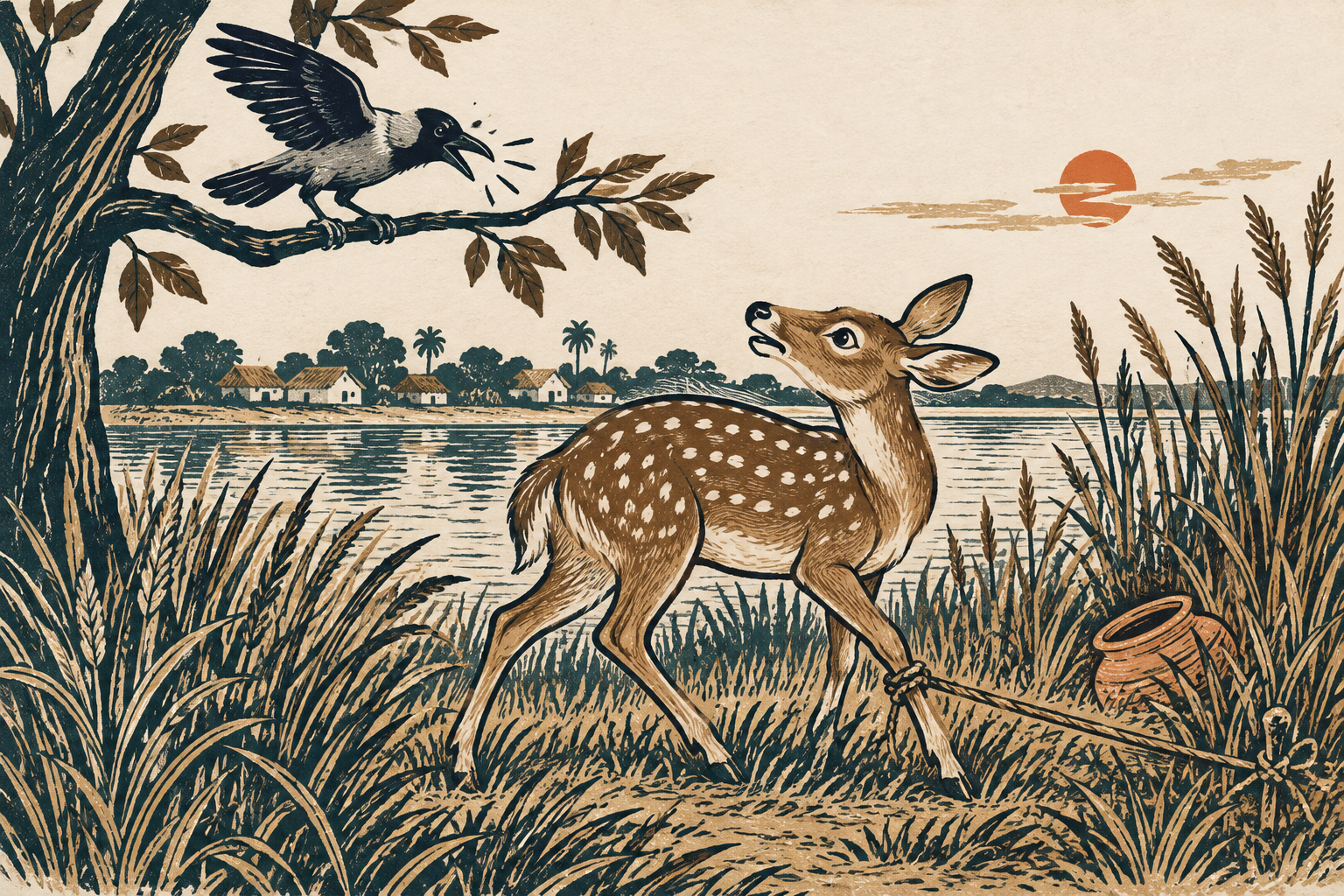
Mantu and Hira could not go far or fast enough to search, so they sent Laghu, who could fly faster than either of them could dream of going. He found Chitranga at last, caught in a hunter’s snare at the swamp’s edge, a cord drawn tight round one leg. Chitranga could only pant that there was no time — the hunter would be back soon. Laghu flew home for Hira, carried her back in his beak, and set her down beside their trapped friend.
While Hira worked at the knot with her teeth, Chitranga told them something else, quickly, because there was no time for a long story: this was not the first rope that had ever held him. Once, as a very young fawn, he had been caught and kept, and set free again, far from here. He did not tell it all — there wasn’t time, and it hardly mattered now. What mattered was that fate, it seemed, had a way of finding him twice.
Before Hira could finish, old Mantu arrived too — on foot, the whole distance, moving as fast as a tortoise has ever moved in the history of tortoises. Hira scolded him for it. “You cannot run from a hunter, Mantu. What good will you be, caught out here?” But Mantu only shook his head and kept walking, because a friend does not stay behind when a friend is in trouble, whatever the risk to himself.
Then, before anyone could argue further, footsteps came through the grass. The hunter, bow in hand.
Hira cut the last of the cord just as he arrived. Chitranga leapt clear and vanished into the trees; Laghu was already in the air; Hira melted into the grass. But the hunter, disappointed of his deer, looked down and found a tortoise instead, sitting right there in the open where Mantu had walked all that way to help. He bound Mantu’s feet with a length of cord and made to carry him off.
Watching from the trees, the others knew Mantu had no legs fast enough and no wings at all. So they made a plan, and it was Hira who thought of it.
Chitranga went back out into the open, in plain sight of the hunter, and lay down perfectly still — as still as a deer that cannot get up again. Laghu landed on his antlers and spread his claws there, pretending to peck at his eyes, as crows do to something already dead. The hunter, seeing what looked like a fresh kill worth far more than an old tortoise, set Mantu down on the grass and hurried off to fetch a club to finish the deer with.
The moment his back was turned, Hira darted to Mantu and cut his cord free. Mantu, loosed, did what no one watching would have guessed a tortoise could do — he shot toward the water like something poured downhill and was gone beneath the surface before the hunter had gone ten steps.
Chitranga felt the ground shake with the hunter’s returning tread and was up and running before the man was anywhere near close enough to swing anything at all. Laghu lifted off the antlers and away into a tree.
And that was the last the hunter saw of any of them. He turned one way, and then the other, in an empty clearing by a quiet lake — no deer, no tortoise, only a snare with every loop cut clean through, and a length of cord that had somehow ended up holding nothing at all. He went home with his club still in his hand and nothing else, because in the end, four friends had left him nothing to carry.
By the water, safe and together again, the four of them caught their breath. It was Mantu who spoke first, once he had drawn his head back into his shell far enough to feel steady again. “A crow who could fly found our lost one. A mouse who could bite set him free. A deer who could run led the hunter’s eye away from a tortoise who could only walk — and a tortoise who could swim got himself home in the end. None of us could have done all of it alone. All of us, together, did.”
Here, under our tree, Leo prodded his scraped knee. “Maybe I didn’t win after all,” he admitted, sheepish.
“Did the deer’s leg hurt worse than that?” Dev asked, quiet. Nobody quite had an answer for him. Mira sat very still, working out four different kinds of fast in her head and keeping the answer to herself.
Somewhere down the lane, another set of running feet went past in the dark — some other child racing to be somewhere — and for a moment all three of them just listened to it fade.
For the grown-up (not read aloud): the heart of it — four friends who are nothing alike can do, together, what none of them could do alone.
Where it comes from: retold from the Panchatantra (Mitra-samprapti frame story, Book 2).
More stories for ages 6–8
Two Heads, One Tummy · The Mouse’s Hidden Hoard · What the Weaver Chose · The Jackal’s Slow Supper · The Song That Scared a Prince · The Crow Who Wanted a Friend
 Banyan Story Studio