


Growing listeners · ages 6–8 · comfortable from 5 with a grown-up · Retold from the Panchatantra
A heads-up: one parrot shrieks for a stranger to be caught and hurt — it passes in a moment, and no one is harmed.
Reading aloud? A note for you
The shouted line is the one to watch for — slow down just before it, and let your voice drop back to ordinary once the king has ridden off, so your listener feels the danger pass. Your child may protest that it isn’t fair — the caged parrot never got to choose who raised him — and that feeling is exactly right; the story doesn’t argue it away, so it’s worth letting it sit rather than rushing to smooth it over. We’ve kept the tale close to its old shape: the one change is in how we describe the caged parrot’s keepers — the source names them by an old trade-group label that Banyan doesn’t repeat, so here they’re simply “rough, unkind keepers who caged and sold wild things,” described by what they did, not by who they were.
Two parrots were screeching at each other somewhere high in the tree above them, back and forth, back and forth, neither one willing to let the other have the last word. Mira tipped her head back trying to spot them in the dark leaves and gave up. Leo clapped his hands twice, hoping to startle them quiet, and they only screeched louder. Dev, sitting near Bupam, watched the noise rather than trying to stop it.
“Since we’ve got an argument going on right over our heads,” said Nani, nodding upward, “it seems the right evening for the story one jackal told his brother, on a night when the brother wouldn’t stop meddling in things that weren’t his business. He was trying to make him see something — that what raises a person shows in what that person says and does, for better or for worse.”
“Is it a happy one?” Leo asked.
“You’ll have to listen and find out,” Nani said. “Listen.” And she began.
High on a mountainside, a mother parrot raised two chicks in her nest. One day, while she was away searching for food, a man who caught wild creatures for a living found the nest and took both chicks.
One chick got away from him in the confusion and flew until his wings gave out, and by luck he came upon a wandering holy man, and that holy man brought him home to his hermitage and cared for him kindly there, the way he cared for every creature that came to him. The other chick was not so lucky. He was caged by the very man who had caught him, hung outside near the door, and taught, day after day, to speak the words that man wanted him to say.
Years passed, and both chicks grew into full-grown parrots. Far off, a king went riding, and his horse took fright at something in the road and bolted, carrying him away from his own guards before he could turn it, deep into wild country he did not know. On and on the horse ran, until it happened to bring the king close to the very place where the caged parrot was kept.
The moment the caged parrot saw a stranger on a horse, he began to shriek — calling for his keeper to come running, to catch the stranger, to make sure he did not get away. It was over in a breath. The king, startled by the ugly noise coming out of a cage, turned his horse sharply and rode on without looking back.
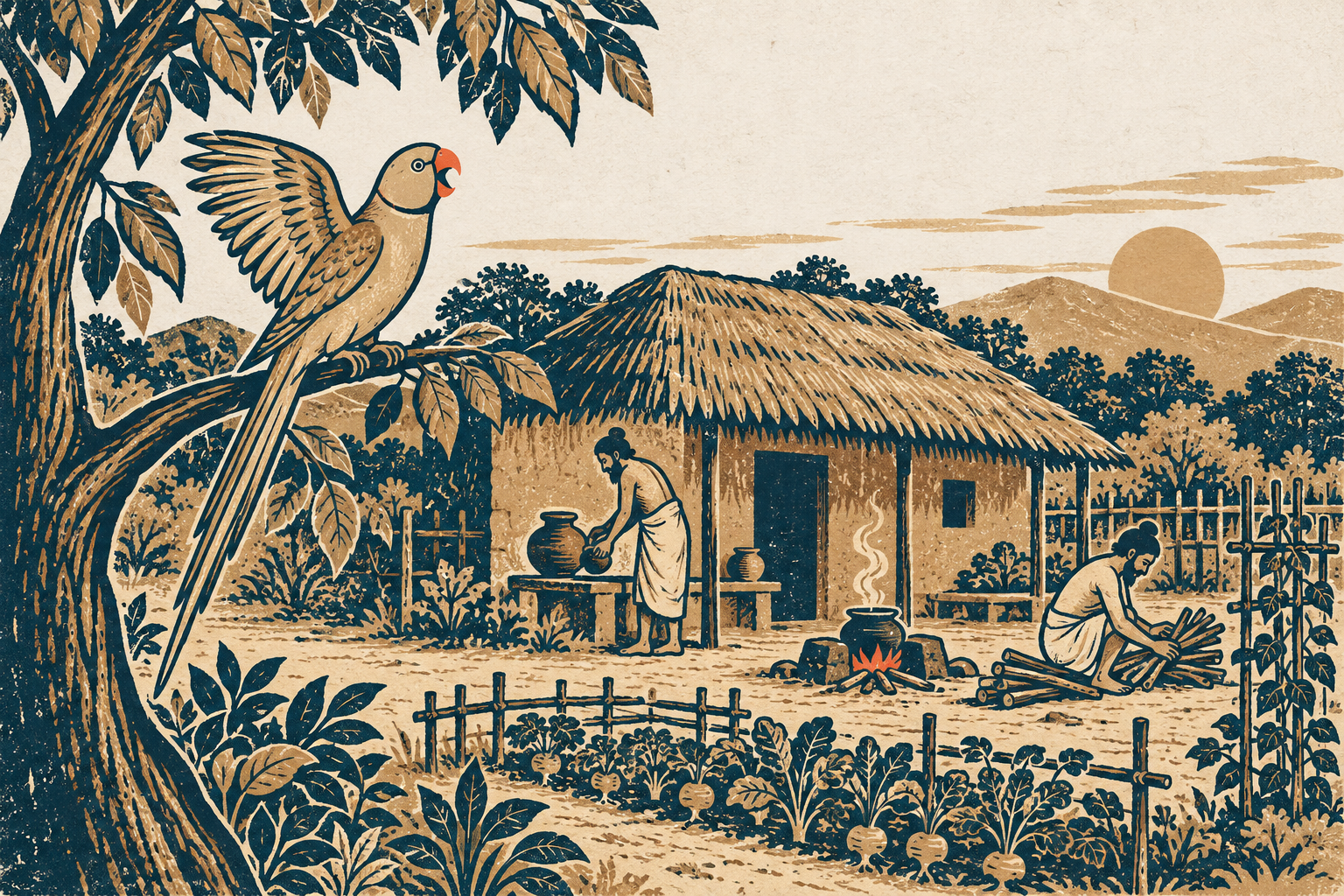
He rode a long while, his heart still pounding, until he came to a different part of the forest — a quiet hermitage, with holy men moving calmly among the trees, tending small fires and small gardens. And there, too, a parrot spoke to him from where he sat. But this parrot’s voice was warm, and there was no fear in it at all. “Come in, traveler, and rest here awhile,” he called. “Cool water, sweet fruit — whatever we have is yours.” And he called out to the hermits themselves to come and welcome their guest properly, to bring him water for his tired feet, to bring him into the shade and let him breathe.
The king sat down among the hermits, astonished, turning the whole strange day over in his mind. At last he turned to the parrot and said, “Not an hour ago, in another wood, I passed a parrot who looked just like you — and he screamed for me to be seized and hurt. Why would two birds, so alike, be so different?”
So the parrot told him. “That was my brother,” he said. “We were taken from the same nest, on the same day, by the same man. But he was kept and raised by rough, unkind keepers — people who caged wild things and sold them, and taught him only the harsh words they used themselves. I was carried here instead, and raised among hermits, who taught me nothing but gentleness, because gentleness was all they had to teach.”
The king sat with that a long while, watching the hermits move quietly among their small fires. It wasn’t, he understood at last, that one brother had been born good and the other born bad. Each one had simply grown into the shape of the hands that raised him — the fear and the roughness came out of one, because fear and roughness were all that had ever been poured into him; the welcome came out of the other, because welcome was all he had ever known. Two chicks, taken from the very same nest on the very same day — and two entirely different birds, grown from two entirely different mornings, afternoons, and evenings.
Here, under our tree, the two parrots overhead had finally gone quiet, worn out with screeching at each other.
“It wasn’t really about the parrots being different,” Mira said slowly. “It was about who raised them.”
Leo wasn’t satisfied. “But the mean one didn’t choose his keepers. That’s not fair.”
Nani let his words sit in the quiet rather than answering them.
Dev had been watching the dark branches where the real parrots had gone silent. “I’m glad the other one found the hermits,” he said, so quietly it was almost lost in the leaves.
For the grown-up (not read aloud): the heart of it — what raises us shows in what we say and do, for better or for worse.
Where it comes from: retold from the Panchatantra (two parrots raised in two different homes, Book 1). In the old book, Karataka the jackal tells it to his brother Damanaka.
More stories for ages 6–8
The Howl He Couldn’t Hold · The Hare Who Came Late · The Wedge in the Log · The Guest Who Couldn’t Wait · The Chain in the Hollow · The Carpenter’s Lunch
 Banyan Story Studio