


Growing listeners · ages 6–8 · comfortable from 5 with a grown-up · Retold from the Panchatantra
Reading aloud? A note for you
This one is a gentle joke on grown-up certainty, so let it land lightly — the fun is watching a sensible man talk himself out of trusting his own two eyes. Slow down at the third stranger’s warning, the point where the Brahman stops arguing and starts doubting; that’s the hinge the whole story turns on. A child may ask why he didn’t just look at the goat again, or why he believed three strangers over what he already knew — let that question sit rather than answering it for them, because it’s exactly the question the tale wants asked. There’s no unkind ending here: what becomes of the goat afterward isn’t part of this telling, and the three rascals get clean away with it, which is the story’s own quiet joke, not something left unfinished.
Nani had lost her reading glasses somewhere between the kitchen and the tree, and by the time the three of them arrived she was still patting the cushion beside her, checking the same spot twice. Leo found them almost at once, folded under the water jug, and held them up like a prize. Mira took them from him and set them properly in Nani’s hand instead of just passing them over. Dev sat down and watched the whole exchange without offering an opinion either way.
“Before the crows and owls came to war, a crow counsellor told his king these tales,” Nani said, glasses back on now. “Tonight’s is one of them. The point of it is this: the same claim, said by different voices, one after another, can talk a person out of trusting the plainest truth right in front of them.”
“Listen.” And she began.
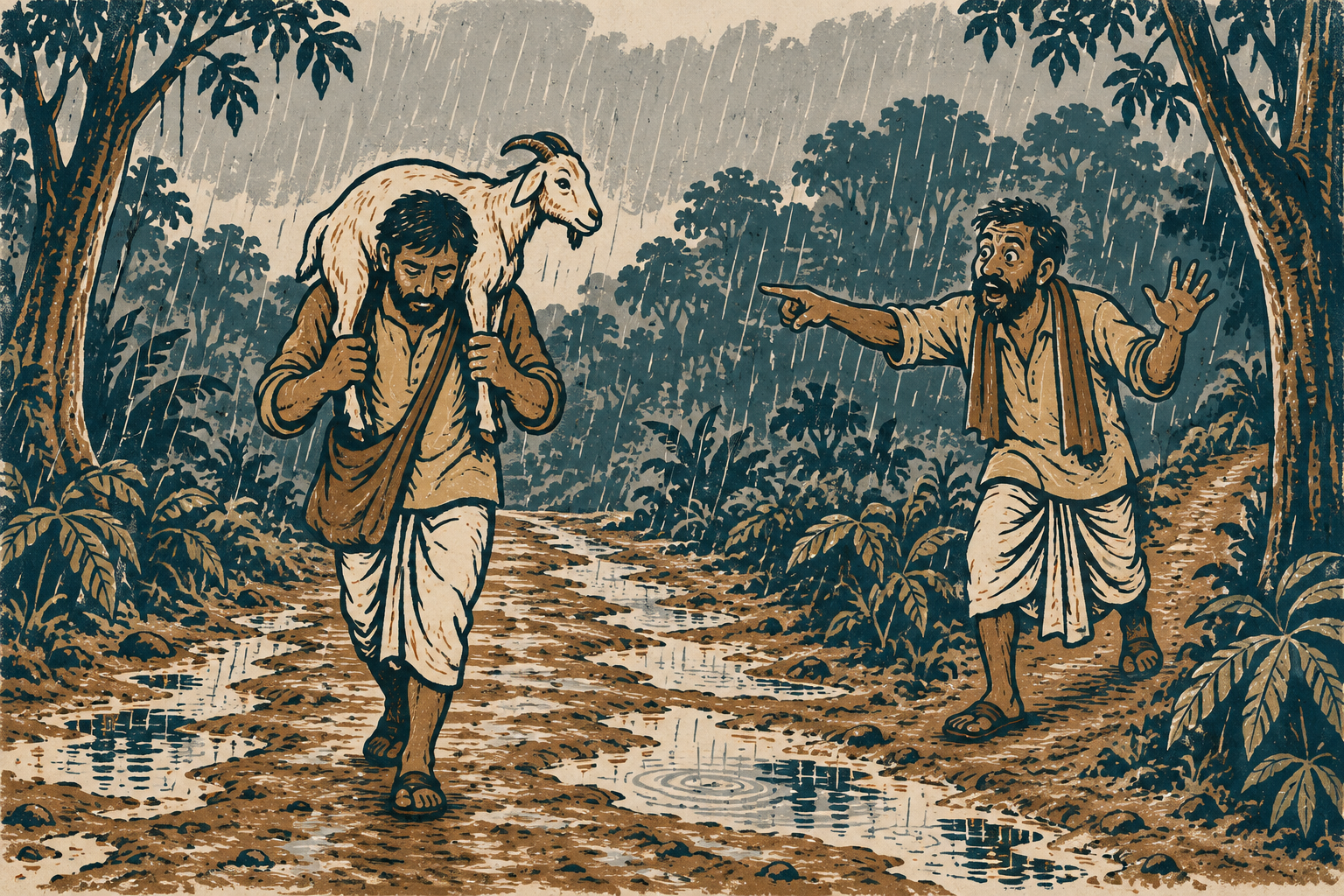
In a certain town there lived a Brahman who kept the sacred household fire burning and never once let it go out — that was his whole life’s work, and he took it seriously. One grey, drizzling day in the rainy season, he set off on foot for a village some distance off, to ask for a goat fit for the coming new-moon offering, as was proper for a man in his position. A man there gave him a fine, plump animal, exactly as custom required. The Brahman looked it over, found it sound, swung it up onto his shoulders, and started home along the forest road, hurrying to get out of the wet.
He hadn’t gone far before three hungry rascals, watching from the bushes, spotted him. The goat on his shoulders looked like a fine supper to men who had eaten nothing warm in days. But a Brahman does not simply hand over a sacrificial animal because he’s asked nicely — so instead of asking, the three of them put their heads together and settled on a trick, to be tried one after another, each rascal taking a different stretch of road.
The first slipped into a change of clothes, stepped out from a side path, and fell into step beside the Brahman, looking thoroughly scandalised. “Holy sir,” he said, “why in the world are you carrying an unclean creature across your shoulders like that? What you have there is no goat at all — it’s a dog.”
The Brahman stopped short. “Have your eyes failed you,” he said, “that you look at a goat and see a dog?” And he walked on, more annoyed than worried, muttering about fools who wandered the roads in bad weather.
He hadn’t gone much farther when the second rascal met him, dressed differently again, and just as horrified as the first had been. “Holy sir! That is no goat on your back — it’s a dead calf. And you know there are proper washings and fasts owed, for carrying a dead thing so carelessly.”
“Now you too?” the Brahman snapped. “First a dog, now a calf. It is a goat — I chose it myself, not an hour past.” The rascal only shrugged, said he’d spoken as he saw it, and let the Brahman go on his way.
But the Brahman’s steps had slowed, and his certainty along with them. Twice now, two different strangers had looked at the very same animal and seen something else entirely. He told himself it was nothing. Foolishness, both of them. And yet foolishness, repeated, has a way of growing heavier the farther you carry it.
He had not gone much farther still when the third rascal appeared, in a fresh disguise, and didn’t even trouble to hide his alarm. “Sir! Put that down at once — that’s a donkey you’ve got there, not a goat, and you know what it costs a man to go about carrying a donkey. Washing, bathing, the whole business, before you’re fit to be clean again. Drop it before anyone else sees you like this.”
That made three — three strangers, on three separate stretches of the very same road, each one certain the Brahman was carrying something he oughtn’t. He looked down at the animal on his shoulders, and for the first time, truly looked — and where a goat had been an hour ago, he could no longer say for certain what he saw. A dog. A calf. A donkey. Or perhaps, he thought, with his heart going cold, none of those at all — perhaps some shifting, unclean spirit of the forest, wearing a goat’s shape only to catch a careless man off his guard.
He didn’t wait to find out which. He threw the animal down into the road and ran the rest of the way home without once looking back, glad only to be free of it.
Behind him, once the road was empty, the three rascals came out from hiding, gathered up the goat between them, and made off with it exactly as they’d planned from the start — three hungry men who had never once needed to fight the Brahman for his goat. All it had taken was the same untrue claim, told three times, in three different voices, on three different bends of one road.
Here, under our tree, Nani folded her glasses closed and set them carefully in her lap this time, not on the ground beside her.
Leo opened his mouth, thought better of it, and closed it again.
“You should keep them on a string,” Mira said, watching her do it.
Dev, half-asleep, had already slumped sideways into the crook of the root.
For the grown-up (not read aloud): the heart of it — three untrue claims, said one after another by three different voices, can talk a person out of trusting what’s plainly right in front of them.
Where it comes from: retold from the Panchatantra (a Brahman tricked out of his goat, Book 3).
More stories for ages 6–8
The Owl Who Almost Wore a Crown · The Argument That Saved Him · The Lake They Wouldn’t Share · The Secret Two Snakes Told · The Lion Who Called Out · The Girl Who Chose a Mouse
 Banyan Story Studio