


Growing listeners · ages 6–8 · comfortable from 5 with a grown-up · Retold from the Panchatantra
A heads-up: a stranger says plainly, once, that he means to eat the Brahman that night — it passes quickly, and no one is hurt.
Reading aloud? A note for you
The frightening part is short by design: the stranger’s plan is said once, plainly, and the story moves straight on into the squabble — don’t linger there, and your listener’s attention will follow you. Some children ask why the two wrongdoers didn’t simply work together properly; a fair answer is that two people (or a person and a ghost) who are each only looking out for themselves rarely trust one another enough to share. The chase at the end plays best light and quick, almost comic — the Brahman is startled, not in real danger, by the time he picks up his stick. If your child asks what a Brahman is, a simple answer is: someone whose family’s traditional work was prayer and teaching, often poor despite it.
Beyond the wall, one dog started up — a single sharp bark — and a second answered it from three houses down, and then the two of them went back and forth at each other into the dark until somebody’s gate slammed and both gave up at once.
Leo laughed at the sudden quiet. Bupam had tucked himself into the crook of Nani’s elbow, one ear turned toward the wall, listening for more barking that never came. Mira sat down already turning over a riddle in her head, the way she did most evenings. By the time Dev reached his spot the barking outside had finally stopped, and he sat down beside Nani in the new quiet, saying nothing.
“In the owls’ court,” Nani said, “the counsellors argued back and forth, and told these tales as they argued. Tonight’s is about two wrongdoers who wanted the very same thing, on the very same night — and what happens to a plan when the two people making it cannot agree with each other. Sometimes your rescue comes from your enemies, if you can only get them quarrelling among themselves.” She glanced toward the wall, where the dogs had gone quiet. “Listen.” And she began.
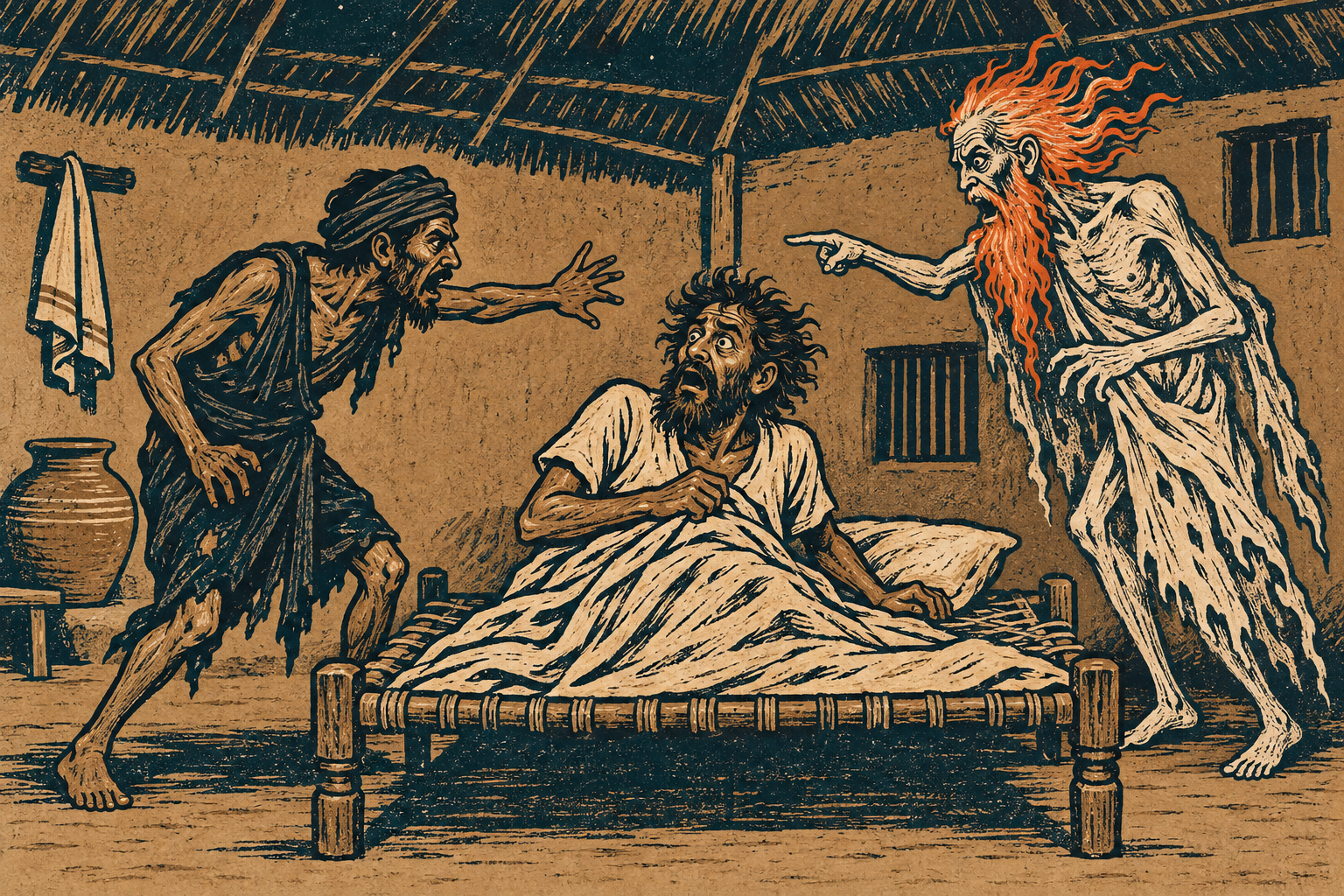
In a certain village there lived a Brahman who owned almost nothing. He lived on whatever people gave him, and never troubled himself over how he looked — his hair and beard had grown long and wild, and years of weather had turned his skin to leather. One day a neighbor took pity on him and handed over two young calves.
The Brahman raised them with real care, feeding them butter and oil and whatever fodder he could beg, until the calves grew into two strong, glossy cows — the kind any farmer would envy.
A thief noticed them and made up his mind on the spot: he would come back that very night and lead both cows away.
So after dark he took a length of rope and set out toward the Brahman’s hut. On the path he came upon someone he had never laid eyes on before — a gaunt, ragged figure with teeth spaced too far apart, a crooked nose, eyes that didn’t quite match, wiry cords of muscle under loose skin, hollow cheeks, and a beard the color of a flame fed too much oil.
The thief’s stomach dropped. “Who — who are you?” he managed.
“A ghost,” the stranger said simply. “And now you can explain yourself, wandering about at this hour.”
“I’m a thief,” the man admitted, seeing no use lying to a ghost. “Headed for that hut over there, to lead off a poor Brahman’s two cows.”
At this the ghost brightened. “What luck,” he said. “I only get to eat every few days, and tonight was going to be my night besides — and it happens I’d already chosen that very Brahman. We’re bound for the same door.”
So the two of them walked on together, and settled in near the hut to wait until the household had gone quiet.
When the Brahman was at last asleep, the ghost moved to go in and finish his business — but the thief caught his arm. “Not yet,” he hissed. “Wait until I’ve got the cows out, or the noise will wake him, and I’ll lose them.”
“And if I wait,” the ghost shot back, “and my meal goes wrong because of your fumbling, whose fault is that?”
“The other way round is worse,” the thief insisted. “If you go first and he wakes screaming, I get nothing either. Let me finish, then eat all you like.”
Neither one would give an inch. Their whispers turned to arguing, and the arguing grew loud enough that — of course — it woke the Brahman.
Startled out of sleep, the Brahman sat bolt upright. The thief spoke first: “Wake up! There’s a ghost here who means to eat you!” And in the very same breath the ghost said: “Wake up! There’s a thief here who means to steal your cows!”
The Brahman took one look at the pair of them, arguing over him in the dark, and understood exactly what kind of night he was having. He murmured a quick prayer under his breath, which was enough to send the ghost backing away into the shadows, and then he snatched up a stout stick and chased the thief clean off his land before the man could lay a hand on either cow.
By morning the Brahman had both his cows still tied at their post, and his own two feet still under him — kept safe, in the end, by the very two who had meant him harm, because they could not agree on which of them should have him first.
Here, under our tree, nobody spoke for a moment. Even the dogs beyond the wall stayed quiet.
Then Leo grinned into the dark, the way he did when a story had gone exactly the way he liked, and that was all — nobody added a word to it.
For the grown-up (not read aloud): the heart of it — an enemy’s discord can be a gift: when two wrongdoers cannot agree, their quarrel can save the very person they meant to harm.
Where it comes from: retold from the Panchatantra (the Brahman saved by a quarrel between a thief and a ghost, Book 3).
More stories for ages 6–8
The Lake They Wouldn’t Share · The Secret Two Snakes Told · The Lion Who Called Out · The Girl Who Chose a Mouse · Told Three Times · The Owl Who Almost Wore a Crown
 Banyan Story Studio