


Growing listeners · ages 6–8 · comfortable from 5 with a grown-up · Retold from the Panchatantra
A heads-up: a king orders his soldiers to hunt down a whole flock of birds with clubs, and nobody is caught — they get away together.
Reading aloud? A note for you
This one moves fast at the end, so slow yourself down on purpose when the soldiers appear — let the old bird’s plan land before you turn the page. A child may ask why the lake-birds wouldn’t just share; it helps to say plainly that their choice is the reason everything else happens, without scolding them for asking. We tell this story on its own tonight — in its old home it sits inside a longer, sadder story a father once told, but it stands up perfectly well by itself, so that is how the children hear it. The king’s name, Chitraratha, is said chit-RA-ra-tha.
Someone up the lane was lighting the first diyas of the week early, little points of flame appearing one by one along a windowsill, and the smell of the oil drifted down to the roots long before the light itself did.
Leo noticed it first. “Is it already Diwali?” he asked, dropping down without waiting for an answer. Mira arrived next, settling herself neatly, eyes still on the distant flames. Dev arrived somewhere between the two of them, unnoticed until he was already seated, watching the lamps instead of Nani.
“Not yet,” said Nani, “but soon enough. In the owls’ court, the counsellors argued back and forth, and told these tales as they argued. This one’s about a lake, and who got to live there, and what happens when the ones who have plenty won’t make room for the one who has none.”
“Listen.”
And she began.
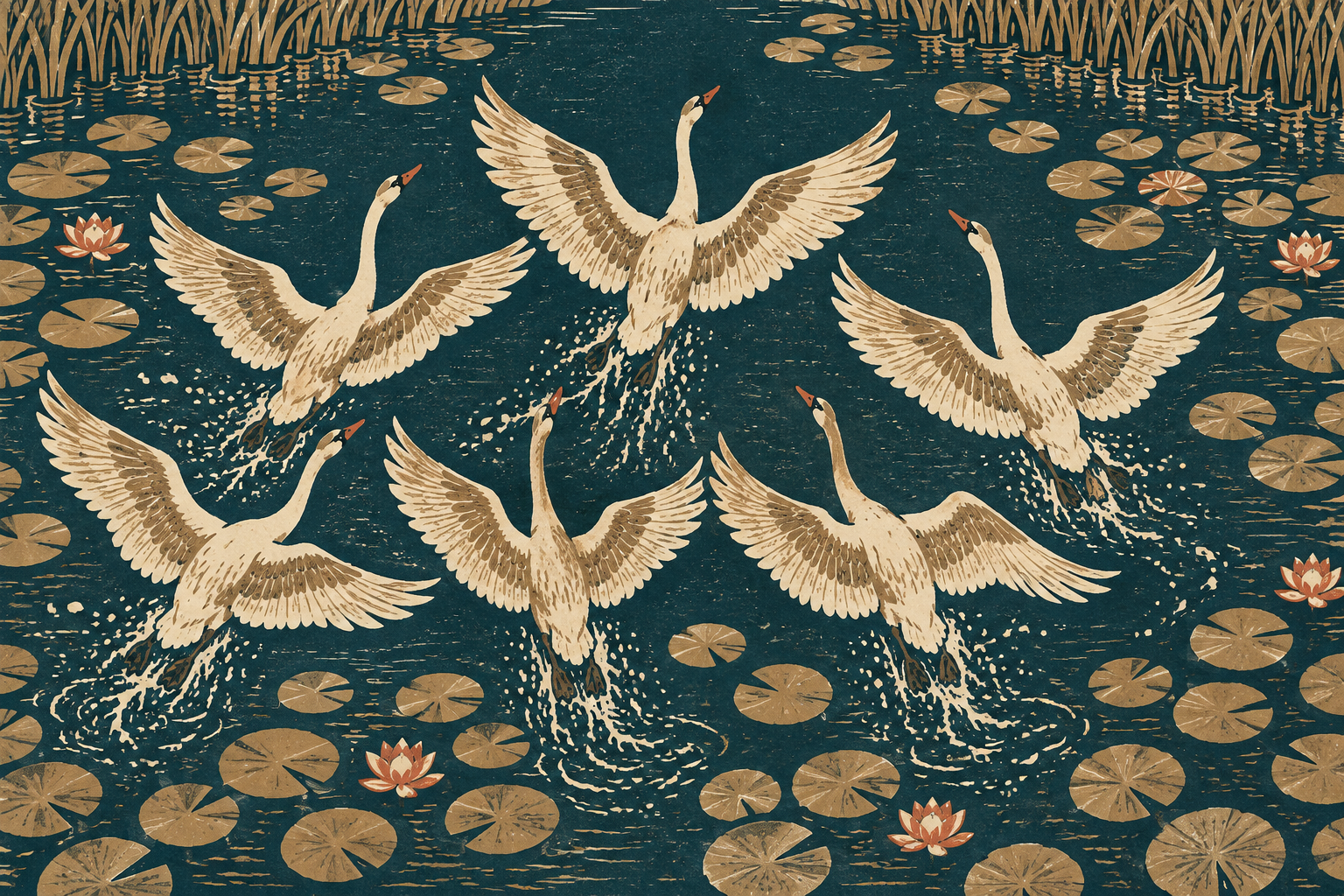
A king called Chitraratha once owned a wide, still lake thick with water-lilies. A great many golden swans made their home on it, and because the king’s soldiers kept the lake safe and well guarded, the swans paid their rent the only way swans can: twice a year, each one gave up a single tail feather, soft and shining, for the king’s treasury.
It was a fair arrangement, and it had worked a long time.
Then one evening a stranger came gliding down onto the water — a bird larger than any of them, with feathers so bright he seemed to carry his own small sunset wherever he went. He folded his wings and looked around at the lily pads and the quiet water and thought: this is a fine place to live.
But when he asked to stay, the swans drew together, wingtip to wingtip, and would not have it.
“You can’t live here with us,” they told him. “We pay for this water, feather by feather, twice a year. You haven’t paid anything. There’s no room.”
The golden bird pointed out that the lake was plenty big for one more. The swans said that wasn’t the point — the point was the arrangement, and the arrangement didn’t include him. Back and forth it went, neither side giving an inch, until it wasn’t a disagreement anymore. It was a full argument, loud enough that the reeds themselves seemed to lean in and listen.
At last the golden bird gave up trying to reason with them and flew straight to the king.
“Your Majesty,” he said, “I only wanted somewhere to land. But your swans say they’ve rented the whole lake and there’s no room for a guest — not even for one night. I thought you should know how your birds treat a stranger who comes to them with nothing but a question.”
Now, the king was proud of his lake, and prouder still of being known as a fair and generous ruler. To hear that his own swans had turned away a guest at the water’s edge — and argued about it, rudely, in front of everyone — put him in a black temper.
He called for his men. “Go to the lake,” he said, “and kill every last one of those swans. If they can’t be generous while they’re guests on my water, they won’t be swans on it at all.”
The soldiers set out at once, clubs in hand, moving quickly and quietly through the reeds toward the water.
One old swan — the eldest of the whole flock, who had outlived three other lakes and knew the look of trouble when it was still far off — happened to be watching the shoreline. He saw the men coming long before the others did: the glint of the clubs, the careful way they moved, trying not to be seen.
He didn’t waste a single moment arguing about whose fault it was.
“Kinsmen,” he called out to the whole flock, “this has gone further than any of us meant it to. Whatever was said, whatever was fair or wasn’t — none of that matters now. What matters is this: we rise together, or none of us rises at all. Up. All of us, now.”
And with one great sound of wings, the entire flock lifted off the water at once — a hundred golden birds climbing together into the darkening sky, wingtip to wingtip, gone before the soldiers ever reached the shore.
All because a lake full of guests forgot how to make room for one.
Here, under our tree, the diyas up the lane had multiplied while they weren’t looking — a whole row of small flames now, steady in the still air.
“They just left the whole lake,” Dev said at last, half to himself. “All of it. Just like that.”
“They did,” Nani said, and left it there.
Leo yawned enormously and leaned his head against Nani’s arm. Mira didn’t say anything at all — she was still watching the little lamps up the lane, as if counting them.
For the grown-up (not read aloud): the heart of it — shut a guest out at your own door, and you may end up losing far more than the room you wouldn’t share.
Where it comes from: retold from the Panchatantra (a lake, a stranger, and a king’s anger, Book 3).
More stories for ages 6–8
The Secret Two Snakes Told · The Lion Who Called Out · The Girl Who Chose a Mouse · Told Three Times · The Owl Who Almost Wore a Crown · The Argument That Saved Him
 Banyan Story Studio