


Growing listeners · ages 6–8 · comfortable from 5 with a grown-up · Retold from the Panchatantra
Reading aloud? A note for you
This is a story about a father trying to find the very best match for his daughter — and about how a creature’s own nature, in the end, decides what fits. A child may ask why the sun, the cloud, the wind and the mountain each turn out to have a flaw; let them enjoy working out the chain before you say the next step. We’ve left out the old telling’s long verse debate about exactly the right age to marry, and we never give the girl’s age as a number — here she is simply “old enough to be married,” which is the studio’s own generalising, not the source’s. Nothing sad happens in this one; read it at the pace of a small joke building toward its punchline.
A smell of onions frying in ghee kept drifting out from the kitchen window every time the evening breeze shifted, and it was making Leo hungrier by the minute, even though dinner wasn’t so very long past.
Leo got there first, sniffing the air instead of sitting properly. “That smells like Amma’s parathas,” he announced, dropping down anyway. Mira arrived a moment later, already turning a question over before she’d even folded herself into the roots. The smell pulled Dev over too, eventually, and he eased down quietly beside Nani, glancing toward the kitchen window just once before he settled.
“Tonight,” said Nani, “is one from Run B. In the owls’ court, the counsellors argued back and forth, and told these tales as they argued, and this is one of them — about a mouse who was raised as a girl, and about what happened the day she had to choose a husband. Whatever fine home raises you, what you’re born is what you stay.”
“Listen.” And she began.
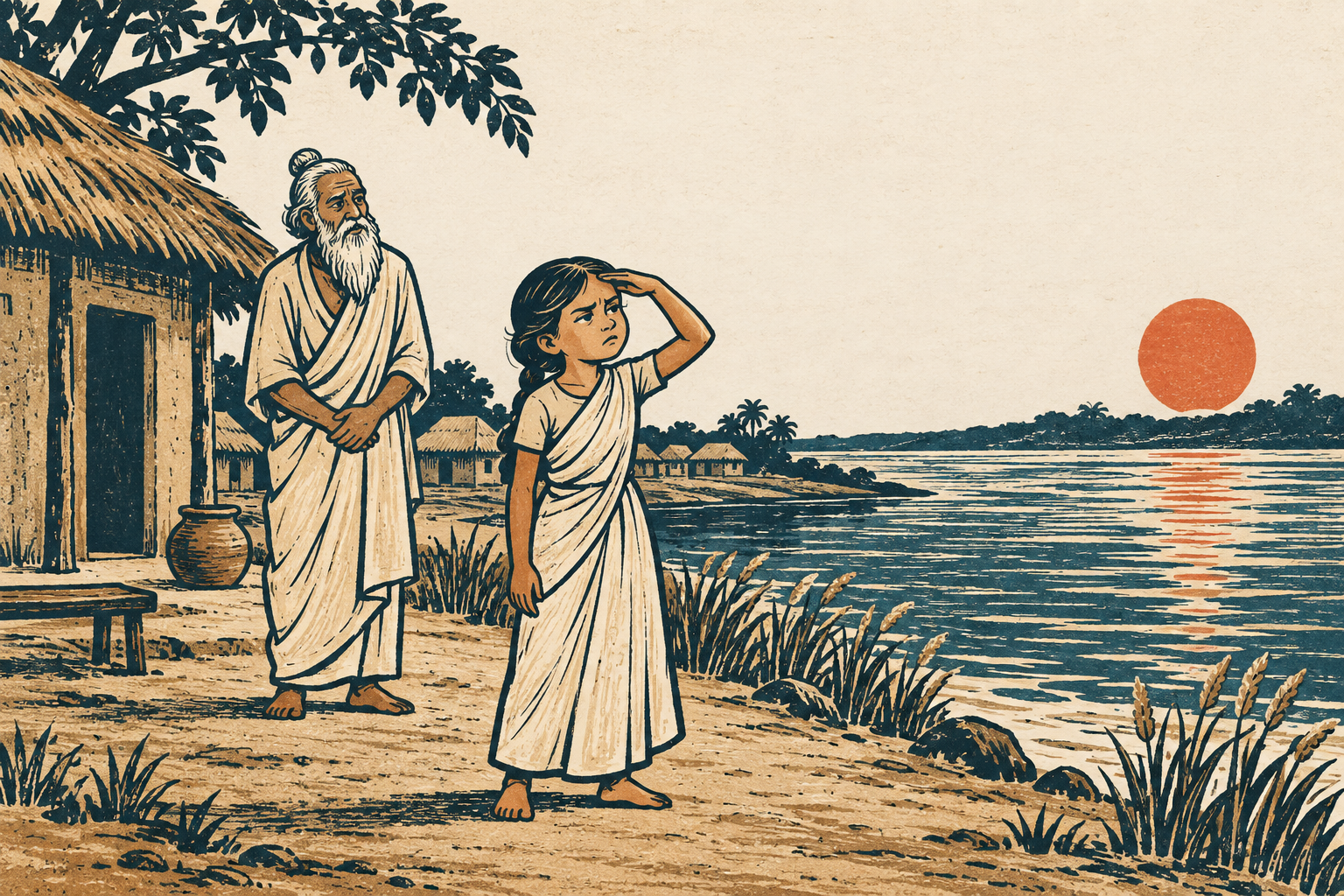
On the bank of a great river lived a hermitage full of holy men, and the eldest among them, its father and teacher, was named Yajnavalkya. One morning, as he knelt at the water to wash, a hawk passing overhead let a little female mouse slip from its beak, and she landed, trembling, right in his open hand.
Yajnavalkya looked at the small creature a long moment. Then, through the power of his own holiness, he turned that tiny mouse into a baby girl, and carried her home to his wife.
“Here,” he said. “Raise her as our own daughter.” And his wife, who had no child of her own, took the girl gladly, and loved her, and spoiled her a little, the way parents do.
Years passed, and the girl grew, until one day the wife came to her husband and said, “Husband, have you noticed? Our daughter is old enough to be married now. It’s time we found her someone.”
Yajnavalkya agreed. “I want the very best for her,” he said. “Someone above the ordinary. Let us ask the sun himself.”
So he called on the sun, and the great burning light came down and stood before them. “Little one,” Yajnavalkya asked his daughter, “what do you make of him? The brightest thing in all three worlds.”
The girl shook her head. “He’s much too hot, Father. I couldn’t bear him. Isn’t there anyone better than the sun?”
Yajnavalkya turned to the sun himself. “Is there anyone greater than you?”
“Oh, yes,” said the sun. “The cloud is greater than I am. The moment he covers me, I vanish completely.”
So the cloud was called next, and stood before the girl. “And this fellow?” asked her father.
“No,” she said. “He’s black, and cold, and gloomy. Someone finer than this, please.”
“Is there anyone greater than you?” Yajnavalkya asked the cloud.
“The wind,” said the cloud. “He blows me wherever he pleases.”
The wind arrived, restless even standing still. “Him?” asked the father.
“He can’t hold still for a second,” said the girl. “Too fidgety by far. Someone steadier, please.”
“Is anyone greater than you?” Yajnavalkya asked the wind.
“The mountain,” said the wind. “However hard I blow, he never moves an inch.”
So the great mountain was brought, tall and unshaking. “This one, then?” said her father.
The girl looked him over and made a face. “He’s all rock and bristle, hard and unbending. There must be someone else.”
“Is there anyone greater than you, O mountain?” asked Yajnavalkya.
And the mountain, of all things, laughed. “There is. The mouse is greater than I am. A mouse can hollow me out from the inside before I even feel it.”
So, half in wonder, Yajnavalkya called for a mouse. A small, whiskered, ordinary mouse came and sat before the girl, and Yajnavalkya asked, one more time, “And this small fellow — what do you say?”
The instant she saw the mouse, something in the girl turned over and settled. My own kind, she thought, and her whole body seemed to know it before her mind caught up. “Father,” she said, “please make me a mouse again, and let me marry him. Then I can be a proper mouse-wife, and keep a proper mouse’s house, the way my own kind ought to.”
And Yajnavalkya, seeing how sure she was, used his holy power once more, and turned his daughter back into a small brown mouse. She went to the mouse gladly, as her own true self, and that was the end of the search — because you can dress a creature up as sun, cloud, wind or mountain, you can raise it with all the love in the world, but underneath, what it was born is what it stays, and sooner or later, it finds its own way home.
Here, under our tree, the smell of frying had faded into the plain smell of night jasmine, and nobody said anything for a moment. Then Leo burst out laughing. “She turned down the sun! For a mouse!”
“She knew what she was,” said Nani, smiling. “There’s no shame in a mouse loving a mouse.”
Mira was quiet, working something out. “So it didn’t matter how grand the husband was. Only what fit.”
“Only what fit,” Nani agreed, and left it at that. Dev, already half-asleep against her side, only smiled.
For the grown-up (not read aloud): the heart of it — however grandly a creature is raised, its own true nature will out in the end.
Where it comes from: retold from the Panchatantra (the mouse who was raised as a girl and chose a mouse, Book 3).
More stories for ages 6–8
Told Three Times · The Owl Who Almost Wore a Crown · The Argument That Saved Him · The Lake They Wouldn’t Share · The Secret Two Snakes Told · The Lion Who Called Out
 Banyan Story Studio