


Older listeners · ages 9–12 · comfortable from 8 with a grown-up · Retold from the Panchatantra
A heads-up: young birds are lost to a snake before this story even starts, and the telling stops on purpose right as a new danger is climbing toward the nest — without saying what it finds there.
Reading aloud? A note for you
This is the shortest, plainest story in the collection, and it earns that plainness — there’s nowhere to add warmth without blunting the point, so let the pauses do the work instead of your voice. Slow down at the crab’s advice; that’s the hinge the whole story turns on, and it’s worth letting your listener sit with how easily it’s given, with no reason attached. Your child will very likely ask what happens to the herons’ new chicks once the mongooses reach the nest — the honest answer is that the story doesn’t say, on purpose, because the not-knowing is the warning. In the old telling, the tale goes on to say plainly that the mongooses eat the young too; here it stops just before that, with the mongooses still climbing toward the nest, so the point lands without the studio spelling out a second loss the source states outright.
A long line of ants had found their way across the biggest root that evening, marching single file from a crack in the bark down toward the grass, and Leo had been crouched watching them for a good five minutes before anyone else arrived, fascinated by how faithfully each one followed the one ahead. Mira arrived and stepped carefully around the line instead of through it. Dev crouched down next to Leo without a word, watching the same line of ants for a moment, before he was the last of the three to settle in beside Nani.
“There was a man once,” Nani said, “who had a son with a clever plan. Too clever — the kind of plan that gets you exactly what you want, and something else besides that you never asked for and didn’t see coming. Before his son could try it, the father sat him down and told him this story, to make him stop and think it all the way through first, and not after, when it’s too late to matter. It’s about a plan that gets rid of one trouble and opens the door, without meaning to, to a worse one — because nobody stopped to ask what else it might do.”
Leo glanced once more at the ants, still marching, before looking up.
“Listen.” And Nani began.
In a tall fig tree at the edge of a forest pool, a pair of herons had kept their nest for as long as anyone could say, the branches worn smooth in the same two or three places where they always landed. Low down in the trunk, in a hollow all his own, lived a black snake, and the snake had a habit he never broke: whenever the herons’ eggs hatched, before the chicks had grown feathers enough to fly, he climbed up out of that hollow in the dark and ate them, one nest at a time.
It happened once. It happened again the next season, and the season after that. Every year the herons built the same nest a little higher, wove it a little thicker, told themselves this time might be different — and every year, once the eggs had hatched and the chicks had begun to call for food, the snake came up out of the dark all the same. It kept happening, brood after brood, until the herons no longer let themselves hope for anything different — until a new clutch of eggs felt less like a beginning and more like something already halfway lost, a debt already owed to the hollow below.
After the snake had taken the newest chicks, one heron could not carry it any further in silence. He left the tree and flew down to the water’s edge, and there he stood in the shallows with his head bowed low over his own reflection, and wept — quietly, the unwitnessed kind of weeping, the kind that doesn’t ask anyone to see it, though someone did.
A crab, feeding nearby among the reeds, noticed him standing there so long and so still, and came closer across the mud. “Uncle,” he said, “why such a heavy heart tonight?”
“What choice do I have?” said the heron, not lifting his head. “A snake lives in our own tree, in the very trunk that holds our nest, and every single time we raise young, he climbs up in the dark and eats them — mine, and my kin’s besides, so that none of us has ever once watched a whole brood learn to fly. I grieve for them, and I do not know how to stop it. Is there any way at all — any device, any trick — to be rid of him?”
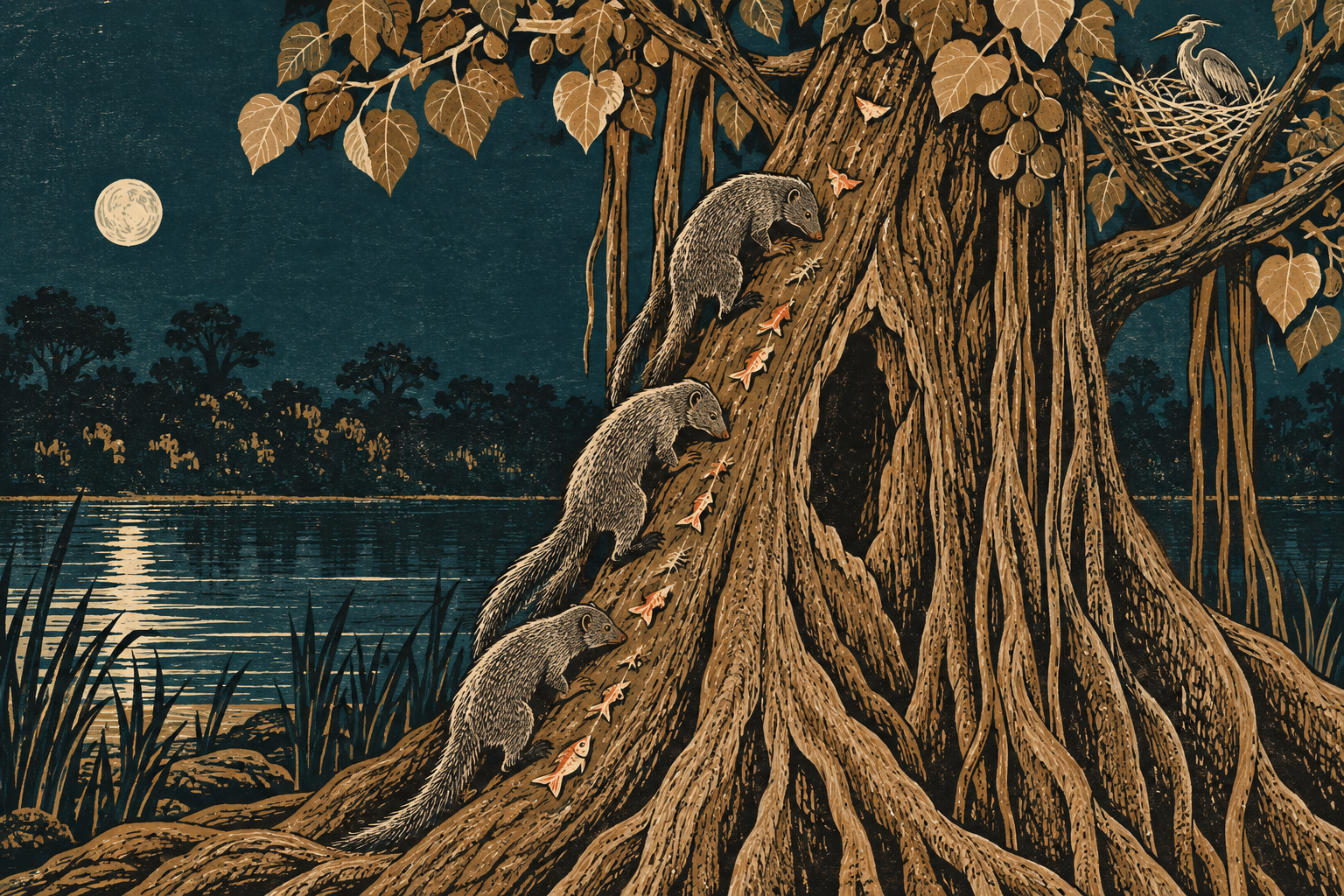
The crab was quiet for a moment, turning the question over the way a crab turns over a stone, looking at it from every side, in no hurry at all to answer. Then he said, “Here is what you should do. Cut fish into small pieces, and lay them out in a line, one after another — start the line at the very mouth of the mongooses’ burrow, and let it run the whole distance from there to the snake’s hollow. You need do nothing else. Their own noses will carry them the rest of the way.”
The heron did exactly as he had said, working through the last of the daylight, laying the pieces of fish out one by one from the burrow to the hollow, a scent-trail with only one honest way to follow it. It was simple work, simpler than anything else he had tried in all those grieving years, and that simplicity itself felt like a kind of relief. Then he drew back into the reeds with his mate, and the two of them waited together to see what would come of it, not speaking, watching the dark line of fish scraps disappear one by one as the evening deepened.
It happened just as the crab had said it would. Before the night was old, the mongooses caught the smell of fish at their own doorstep and came out to follow it, nose down, piece by piece, unhurried and certain, all the way to the snake’s hollow at the foot of the fig tree — and there, in the sudden violent fight that followed in the dark, they killed him. For the first time in longer than the herons could remember, the hollow at the foot of their tree held nothing that meant them harm.
But the mongooses did not turn back once the snake lay dead. The trail of fish had never stopped at the hollow; it had gone on the whole time, the same as it had begun, climbing up past the hollow and into the lower branches of the fig tree, on toward the nest the herons kept high above.
And the mongooses, who had followed the trail faithfully this far already and had no reason yet to stop, kept following it — up the trunk, higher, branch by branch, toward the nest, the way any creature keeps doing the thing that has worked for it every single time so far.
It is a good thing to be rid of one trouble. It is a better thing, before you ever lay the trail, to ask where else it might lead — because a trail, once it is laid, does not know to stop just because you have gotten from it the one thing you wanted.
Here, under our tree, nobody spoke for a moment. Leo looked back down at the root, but the ants had already finished crossing and gone.
Mira opened her mouth for a question, then, after a moment, closed it again, unasked — as though she’d already worked out the story wasn’t going to answer it.
Dev pulled his sleeves a little further over his hands and said nothing either, but he leaned in closer against Nani, and she rested a hand lightly on his head without looking down.
“He warned his son well,” Nani said at last, more to herself than to any of them. She let the quiet settle over all of them.
For the grown-up (not read aloud): the heart of it — think through what a plan may bring, not only what it is meant to bring.
Where it comes from: retold from the Panchatantra (herons, a snake, and mongooses, Book 1), freely reshaped.
More stories for ages 9–12
The Servant’s Two Mutterings · The Jackal’s Two Lies · The Treasure He Would Not Set Down · The Crab Who Looked Down · Three Warnings · The Light That Wasn’t Fire
 Banyan Story Studio