


Growing listeners · ages 6–8 · comfortable from 5 with a grown-up · Retold from the Panchatantra
A heads-up: a frightened crowd closes in on a young deer meaning to hurt him, but a holy man stops them before anyone is touched.
Reading aloud? A note for you
This is a story inside a story — Chitranga is telling Hira something that happened to him long before tonight, in another story, just after she and a friend had found him caught, before anyone had worked out what to do next. You don’t need that other story to read this one; it stands on its own. Slow down at the part where the prince becomes afraid of his own deer — that fear, not the deer’s homesickness, is what frightens the court into moving against him. A child may ask why the crowd wanted to hurt a deer who’d done nothing wrong; the honest answer is that frightened people sometimes act before they understand. Take a breath before the holy man speaks — his one sentence is what stops everything. Chitranga is said chi-TRAN-ga.
The lights had flickered twice already that evening — the whole street’s, not just their own — and just as Nani sat down they went out completely for a moment, throwing the garden into pure dark before stuttering back on.
Dev grabbed for Nani’s arm without quite meaning to. “I knew that was just a power cut,” he said, though his hand didn’t let go right away.
Leo laughed, delighted rather than scared. “You jumped, though.”
Mira had gone quiet the moment the lights flickered, watching the dark corners of the garden as if checking they’d come back right.
“Funny thing about the dark,” said Nani. “People get frightened of it faster than they get frightened of almost anything real. Tonight I want to tell you something Chitranga once told Hira — about the first time he was ever caught, long before you knew him, when a whole palace got so afraid of something they didn’t understand that they very nearly did something terrible over it.”
“Afraid of what?” Leo asked.
“That’s the story,” Nani said. “Listen.”
Long ago, when Chitranga was barely six months old, he was the fastest and silliest of all the fawns in his herd, always dashing out ahead just to feel the wind, then circling back to find everyone again. Now, deer know two ways of running — a straight, flat gallop, and a special leaping bound that carries them clean over anything hidden in the grass. Chitranga had learned the straight gallop. He had not yet learned the leap.
One afternoon, tearing ahead in his usual game, he lost sight of the herd entirely. He turned in circles, searching the horizon, until at last he spotted them — far off, all standing together, all looking back at him. They had used the leaping bound to clear a hidden snare in the grass. Chitranga, not knowing the leap, ran straight into it, and the cord closed tight around his leg. He fell. And when he looked up, the herd was gone — they could see no way to help him, and so, with heavy hearts, they had gone on without him.
When the hunter came, he did not harm the little deer. Something about the fawn, struggling there in the grass, softened him. “He is only fit to be somebody’s pet,” the hunter thought, and instead of any worse thing, he carried Chitranga home and gave him to a prince, who was delighted with his gift.
The prince, it turned out, was kind. He saw that Chitranga was fed well and cared for gently. But a palace is a noisy, curious place, and everyone who lived there wanted a turn at touching the young deer — poked and stroked and admired from every side until his ears and his hooves ached from so much attention, and his heart ached worse, for his herd.
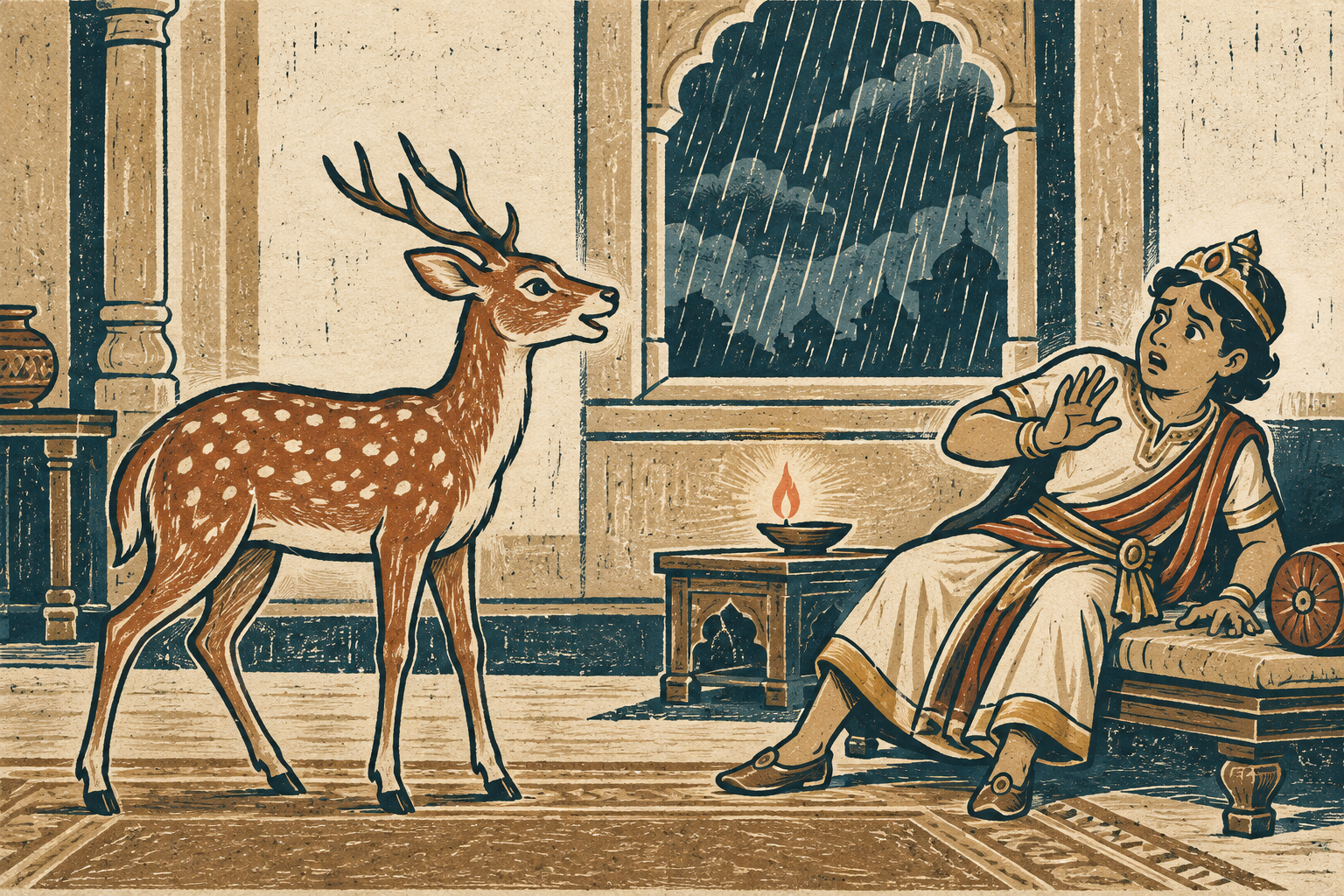
Then came the rainy season. One evening, as the prince rested and the thunder rolled somewhere beyond the palace walls, Chitranga’s homesickness rose up in him so strongly that he found himself speaking it aloud, in the old rhyming way deer have of saying a true thing:
When will I run with my own again,
lean into the wind and rain,
and feel the herd close round me
the way it used to, before?
The prince sat bolt upright. “Who said that?” he cried, looking wildly about the room — and when he understood that no person had spoken, that it had been the deer, he was seized with terror. He did not think Chitranga was any ordinary talking creature. He thought a spirit had entered him, the prince himself, and that his own mind was no longer to be trusted. Pale and shaking, he stumbled from the room, calling for anyone who could free him of whatever had taken hold of him.
Word raced through the palace that the prince was cursed, and fear does not wait to check its facts before it acts. A crowd gathered around Chitranga, certain that harming the strange deer would somehow lift the curse from their prince, and they closed in on him meaning to hurt him badly.
It was a holy man, passing near the palace that evening, who stopped them. “Why would you hurt this poor creature?” he called out, pushing through to stand between the crowd and the trembling deer — and something in his voice made them pause before a single blow could land.
The holy man knelt by Chitranga a moment, then rose and spoke gently to the prince. “There is no curse here,” he said. “It is monsoon, and this young deer misses his herd, the way any creature misses its own kind in the season that reminds it most. He was only saying so, in the way his kind knows how.”
Hearing this, the fear went out of the prince all at once, like air out of a held breath. Ashamed, and moved, he gave an order at once: “Wash him clean at the river, and carry him home to his own woods — let him go.”
And so they did. Chitranga ran home to his own kind, unharmed, his heart lighter than it had been in all his months at the palace.
“And that,” Chitranga told Hira, all that time later, sitting together with no plan yet made, “is how it happened. I was caught once before, and let go. And here I am — caught again, as if a thing that has happened to you once has a way of finding you a second time.”
Here, under our tree, the lights were holding steady now, and Dev had finally let go of Nani’s arm.
“That’s a bit scary,” he said. “Being scared of your own deer.”
“It is,” Nani agreed.
Leo was already looking for a hole to poke in the story. “But how did the deer even talk in the first place?” He didn’t get much of an answer beyond Nani’s laugh.
Mira leaned back against the root and watched the street lamp glow steady again through the leaves, and didn’t say anything more at all.
For the grown-up (not read aloud): the heart of it — a thing that has already happened to you once can find its way back to you again; what matters is who happens to be nearby when it does.
Where it comes from: retold from the Panchatantra (the deer’s own earlier captivity, an inset told within the frame story of the crow, the mouse, the tortoise and the deer, Book 2).
More stories for ages 6–8
The Crow Who Wanted a Friend · A Thousand Tiny Teeth · The Reason Nobody Knew · What Four Friends Can Do · Two Heads, One Tummy · The Mouse’s Hidden Hoard
 Banyan Story Studio