


Growing listeners · ages 6–8 · comfortable from 5 with a grown-up · Retold from the Panchatantra
Reading aloud? A note for you
The turn to slow down for is the middle: two snakes, each unaware they are overheard, trading the one thing that could kill them. Read it almost like two people arguing at a fence — quick, prickly, a little smug. A child may ask why the princess was sent off to marry a stranger at all; the honest answer is simply that her father decided it, the way kings in these old tales often decide things without asking anyone. They may also ask whether the snakes ever find out she was listening — the story doesn’t say, and that’s fine to leave open. Nothing here needs softening further; just keep the two snake-voices distinct so the two secrets don’t blur together. The old telling adds a sneer that she got what she deserved; here we leave that sneer out and tell the marriage as the king’s plain decision.
Somewhere past the wall, a neighbor’s radio was playing a cricket match too low to properly follow — just a rise in the commentator’s voice now and then, a snatch of “…and that’s out!,” gone again before anyone could catch the score. Bupam had gone quiet too, one paw resting over his own ear as if he were straining to hear the score as well.
Mira tipped her head toward the sound and asked, “Who’s winning?” Nobody could say. Leo settled down anyway, more interested in the story than the score. Dev took the longest getting there, pausing once at the gate to listen to the radio crackle fade, before folding himself in beside Nani.
“In the owls’ court,” Nani said, “the counsellors argued back and forth, and told these tales as they argued. This one’s about two creatures who each knew the other’s worst secret, and what they did with what they knew — help each other, or ruin each other. It only takes one person listening closely enough.” She looked toward the wall, where the radio had gone quiet at last. “Listen.” And she began.
In a certain kingdom there lived a king, and the king had a son. The prince was not well. Little by little he was wasting away, because a snake had made its home inside him, curled in his belly as though it were an anthill in a field. No physician in that country could put it right, and at last, worn thin and unhappy, the prince left his father’s house and travelled to another land. There he lived as a beggar at the edge of a great temple.
Now the king of that country had two daughters, and every morning each one came to bow at his feet. The first always said, “Victory to you, my king.” The second said something else — “You get what you deserve, my king” — plain words, not meant unkindly, but not what a king likes to hear at breakfast. Her father decided that this daughter should be married off to whatever stranger could be found, and so it was arranged: she was given to the prince who begged at the temple gate, with only a few servants for her dowry.
She did not seem to mind at all. She took her new husband gladly, the way you’d take a gift you hadn’t expected, and the two of them set off together for his own country, with her small household following behind.
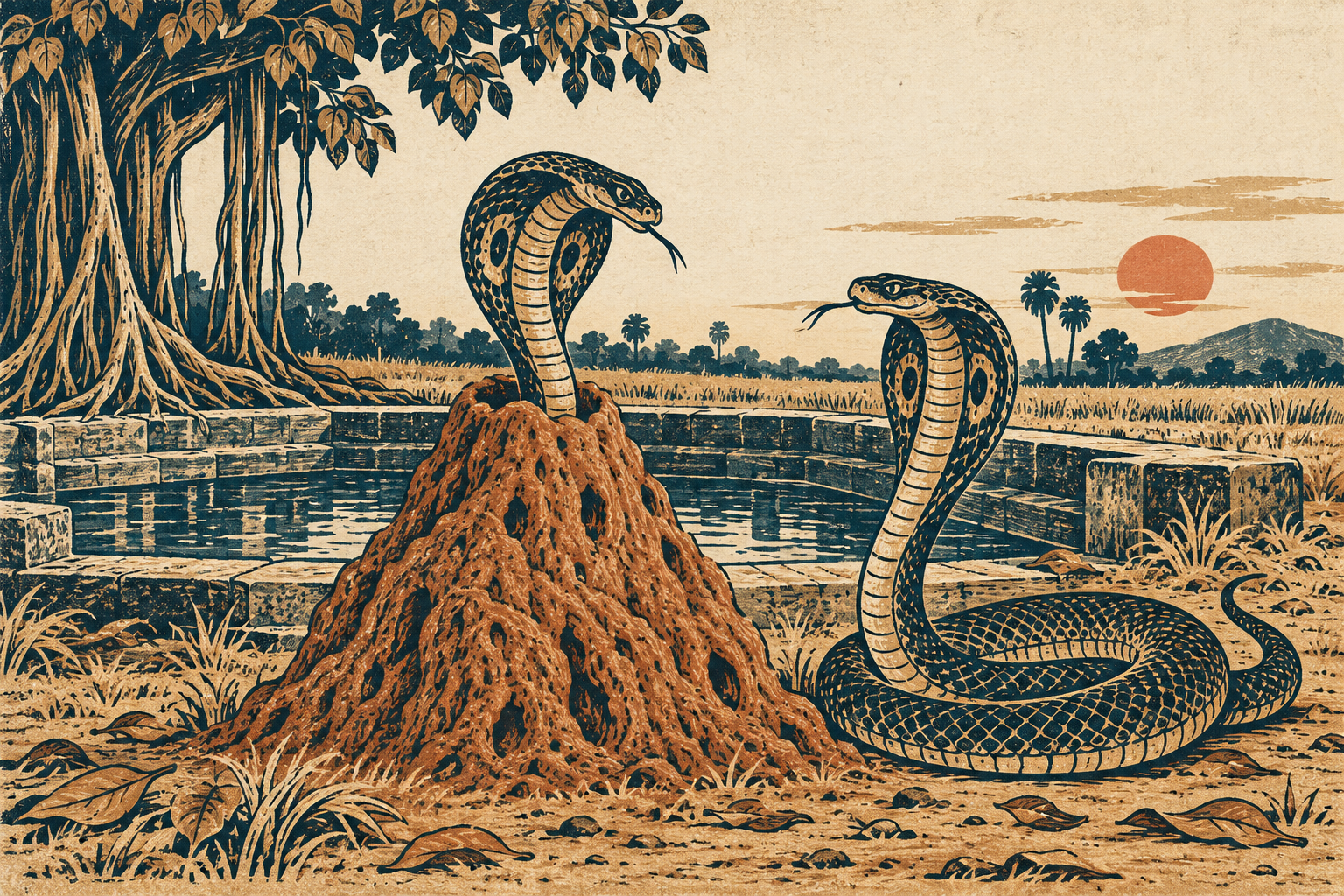
On the road, they stopped in a city by a wide tank of water. The prince stayed behind to keep their few belongings while his wife took her maids off to market for oil, rice, and salt. When she came back, laden with baskets, she found her husband asleep with his head against an anthill at the edge of the water — and from his open mouth, a hooded snake’s head had come out to breathe the evening air. At the very same moment, another snake was easing its own head up out of the anthill, for the very same reason.
The two of them caught sight of each other, and neither one was pleased.
“You,” said the anthill snake, “living off a young man like that — tormenting someone who never did you harm.”
“Look who’s talking,” said the belly snake. “You’re guarding two whole pots of gold under that anthill, and never let anyone near them.”
And having given away each other’s secrets once, neither could stop. “Besides,” sneered the anthill snake, “everyone knows black mustard, ground and swallowed, is the end of a creature like you.” “Is that so,” said the belly snake. “Well, everyone knows hot water poured straight down a hole finishes off a creature like you.”
Neither snake noticed the princess, standing very still behind a branch, hearing every word.
She said nothing to anyone. She only remembered.
That night, she gave her husband a cup mixed with black mustard, and in the morning he was able, for the first time in months, to stand without pain — the snake inside him was gone for good. Then she led her maids to the anthill and had them pour in water they had set boiling over the fire, and by evening the gold that the anthill snake had been hoarding was theirs to carry home.
Well and strong, and considerably richer, the prince and his princess turned back toward her father’s country, and when she came to his door, her father and mother welcomed her home with great honour, and she lived there happily from that day on.
Here, under our tree, the radio outside had gone silent too, the match perhaps over, or perhaps only out of range.
“I would have told someone,” Mira said. “Right away.”
Nani only smiled and said nothing back. Dev, already drowsy, leaned his head against her shoulder without a word.
For the grown-up (not read aloud): the heart of it — two creatures who each know the other’s hidden weakness can help each other, or destroy each other, depending on who is listening and what they do with it.
Where it comes from: retold from the Panchatantra (the prince with a snake inside him, Book 3).
More stories for ages 6–8
The Lion Who Called Out · The Girl Who Chose a Mouse · Told Three Times · The Owl Who Almost Wore a Crown · The Argument That Saved Him · The Lake They Wouldn’t Share
 Banyan Story Studio