


Growing listeners · ages 6–8 · comfortable from 5 with a grown-up · Retold from the Panchatantra
Reading aloud? A note for you
This telling leaves out a punishment the old story includes: after the potter confesses, the king in the original has him beaten before sending him away. Here, the king’s anger stays anger — sharp words and an urgent warning, nothing more. Slow down at the moment the king asks the potter directly for his story; children often want to know why the potter doesn’t just lie, since it would clearly be easier for him. The short story the king tells in reply — about a jackal raised among lions — is told here only as what it is, a quick explanation, not a whole second tale; if your child wants that story in full, it lives on its own elsewhere on this site. A child may also ask why the king was ever angry at all, since the potter never claimed anything for himself — that’s worth sitting with rather than answering quickly.
Leo rolled up his sleeve to show off a fresh bruise on his arm, purple already going yellow at the edges. “Got this blocking a shot at cricket,” he announced, “practically diving for it.” Mira looked at it, unimpressed. “You tripped over the water can. I was there.” Leo didn’t argue the point so much as ignore it, turning his arm this way and that so the light caught the bruise better. Dev slipped into his usual spot without announcing himself and said nothing about the bruise at all.
“Tonight’s story is about a mark like that too, Leo — and about a man who wore one that wasn’t quite what people believed it to be,” said Nani. “It’s a tale the monkey once told the crocodile, back in the evenings when the two of them still sat and talked before either had any news from home. And it’s about this: pretending to be more than you are will catch up with you, even when the pretending was never really your idea.”
“Listen.” And she began.
In a certain town there lived a potter, a maker of jars and water-pots, who one day stumbled and fell hard among a heap of broken clay. A sharp edge caught him across the brow, and though he got back on his feet and went on with his work, the cut healed badly into a long, raised mark that never smoothed away.
Some seasons after that the town went hungry in a poor harvest, and the potter, needing work badly, travelled far from home and joined the guards who stood watch at a distant king’s palace.
That king noticed the mark riding high on the new guard’s brow and thought at once: here stands a man who has faced real danger — a wound worn like that is earned looking forward, not running from anything. So he began giving the potter honours above the other guards — a better place at the front of every parade, gifts no ordinary soldier received. The rest of the guards noticed too, and burned quietly with envy, though none of them dared speak against a man the king favoured so plainly.
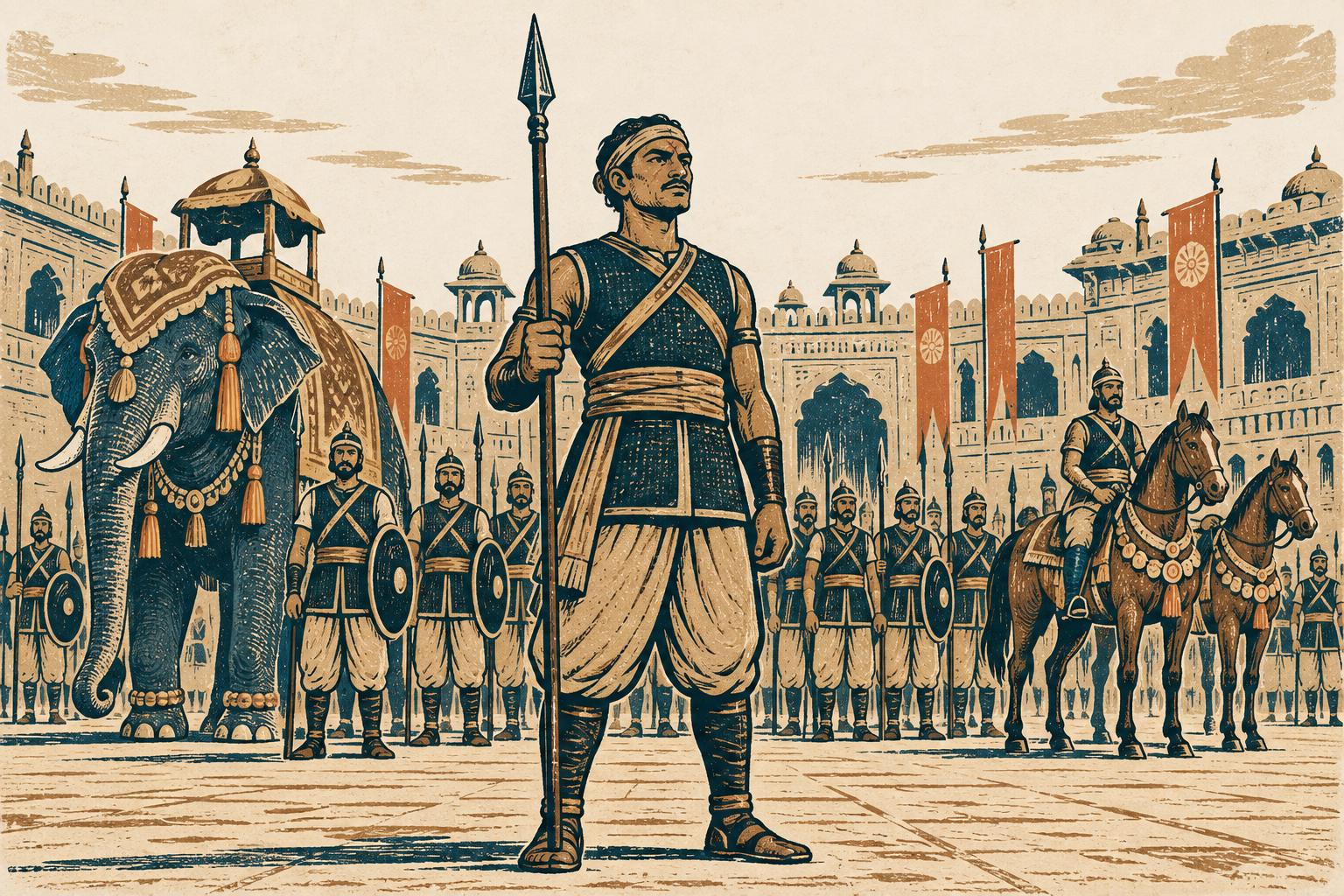
One day, at a grand review of the whole household guard — elephants dressed in their finest, horses in their trappings, every soldier standing straight at attention — the king finally turned to him and asked outright: what was his family, and in which battle had he earned that mark on his brow?
The potter did not lie, though a lie would have been easy, and safe. “Your Majesty, I claim no soldier’s blood. I am a potter by trade, and this mark is no sword-cut at all. I earned it falling, unsteady with drink, through a yard littered with broken clay.”
The king’s face changed. All at once he understood that he had mistaken a stranger’s clumsy misfortune for a warrior’s courage, and that he had spent his favour on a man who had never once claimed to deserve it, only never troubled to correct the mistake either. His anger was quick, and plain, and did not need to be acted on to be felt.
“Then let me earn what I have been given,” the potter said. “Give me a place in the line, and let my spear-arm speak for me.”
But the king shook his head. “You may carry every other gift under heaven — a steady hand, an honest tongue, a good heart — and still be no soldier at the end of it, no more than a creature raised far from its own kind ever quite becomes what raised it.” And to explain what he meant, the king told him, in a few words, a much older story: of a young jackal once raised tenderly among a family of lions, brave and loyal and dearly loved by them, who was still, underneath all that raising, only ever a jackal.
“Go now, before the men who stood beside you learn the truth of that mark for themselves,” the king said, low and urgent, “for I cannot answer for what soldiers do to a man they believe has made fools of them.” And the potter, hearing everything the warning meant, did not wait to be told a second time. He gathered the little he owned, and before morning he was already on the road home, back toward his wheel and his clay, in a town where no one would ever ask a stranger where his marks had come from.
Here, under our tree, Leo let his sleeve fall back over the bruise, quieter about it now than he’d been an hour ago.
Mira wrinkled her nose. “But he didn’t even lie! He told the truth the second the king asked him.”
“He did,” said Nani. “That is the part worth keeping. He could have stayed silent and let the mistake carry on a little longer. Instead he told the plain truth, even knowing what it might cost him.”
Leo frowned, still working it over. “I don’t know if I’d have told him. Not with the king already so angry.”
Dev didn’t say anything for a moment, and then he said, quietly, “I think I would still rather be the potter than the one who never got found out.”
Nani only nodded, and let the quiet sit.
For the grown-up (not read aloud): the heart of it — pretending to be more than you are, even by accident, catches up with you; but telling the truth when it’s finally asked of you is still the right call, whatever it costs.
Where it comes from: retold from the Panchatantra (the potter mistaken for a soldier, Book 4), freely reshaped.
More stories for ages 6–8
The Borrowed Stripes · The Dog Who Came Home · The Jackal’s Warning · The Lion Who Called Out · Told Three Times · The Owl Who Almost Wore a Crown
 Banyan Story Studio