


Growing listeners · ages 6–8 · comfortable from 5 with a grown-up · Retold from the Panchatantra
Reading aloud? A note for you
This is a talking story more than an action story — a crowd deciding something together, and one bird speaking up. The part to slow down for is the crow’s argument: give each of his reasons its own breath, because a six-year-old will want to agree or disagree with him in real time. Near the end, the owl and the crow never actually meet again — the owl’s disappointment lands on his own mate, not on the crow — so there’s no confrontation to brace for, only two characters quietly regretting the same afternoon in two different places. Let that quiet sit for a moment before you close the tale.
Mira and Leo reached the flat root at the same moment and both dropped onto it together, elbowing for space, until Mira said, “Fine, you have it,” and moved over before Leo could even argue back.
“That’s more patience than some kings manage,” Nani said, settling herself between them. Dev, last as always, tucked in on her other side and said nothing, just watched the two of them make peace.
“Before the crows and owls came to war, a crow counsellor told his king these tales,” Nani said. “Tonight’s is the first one he told. It’s about a bird who spoke his mind too sharply and made himself an enemy he never meant to make — and about the trouble that comes from choosing, or speaking, before you’ve thought a thing all the way through.” She looked at Leo especially. “Listen.” And she began.
In a wide clearing where every kind of bird made its home, word went round one morning that a meeting had been called. Swans came, and cranes, and doves. Peacocks came, and plovers, and pigeons, and owls, and partridges, and skylarks, and more birds than could be counted arrived and settled on every branch and along the ground beneath.
They had gathered to grumble. Their king, a great bird named Garuda, spent all his days serving the god he loved and none of his attention on them. When a hunter’s net closed around a careless wingtip, or a hawk came diving out of the sun, Garuda was nowhere near, and nobody could say he had ever once come to help. A king in name only, the birds agreed, was worth nothing at all. So they decided, together, to choose somebody else — a second king, to watch over them properly while Garuda kept to his prayers.
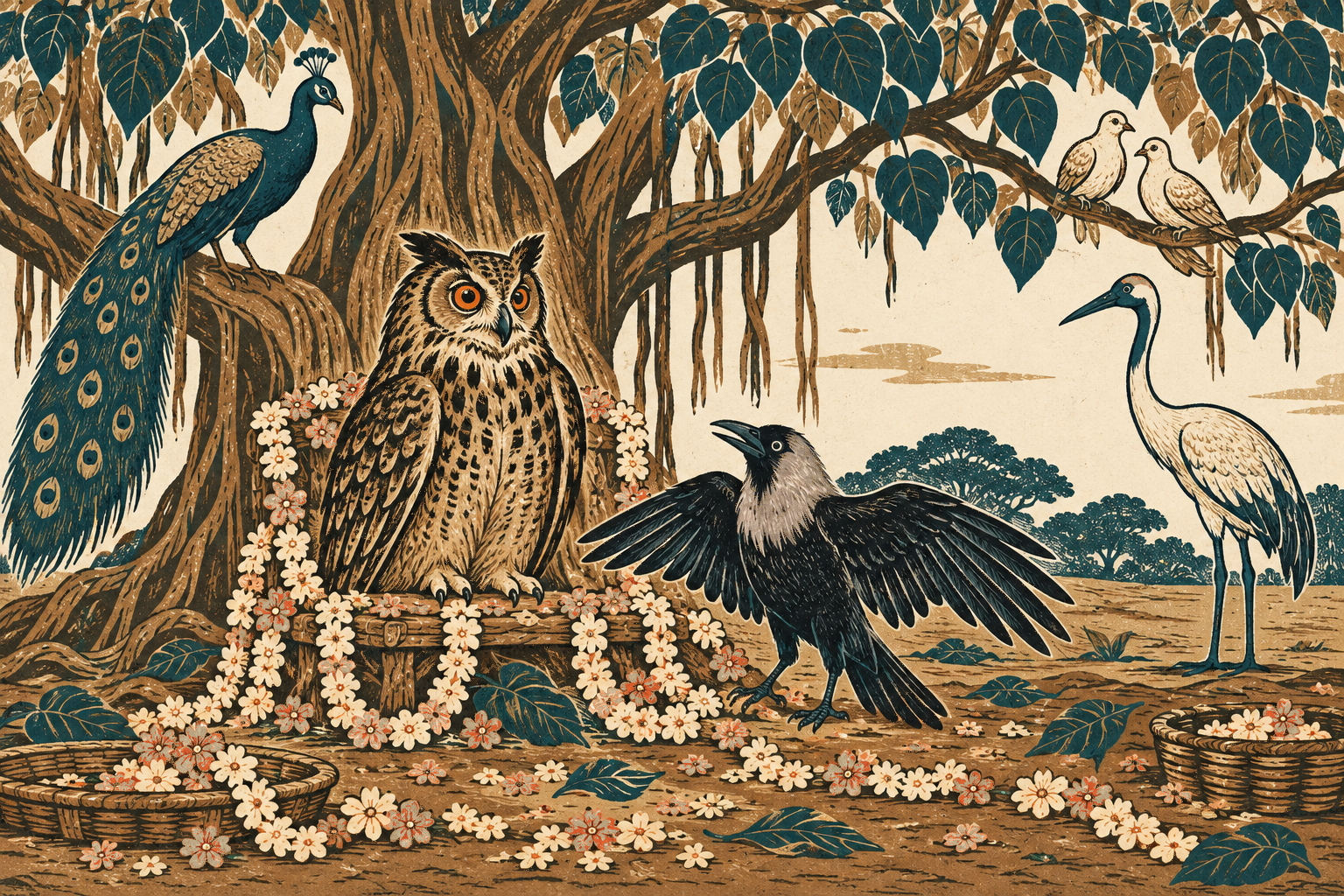
Looking around at each other, they settled on the owl. He had a grave, solemn face and unblinking eyes, and solemn faces make people think of wisdom. “Let it be the owl,” the birds agreed, and at once the whole clearing became a festival. Water was fetched from faraway streams for the anointing. Flowers were gathered and woven. A throne was set beneath the widest tree, and singers began to practice their songs, and the owl himself sat up on that throne, waiting, trying to look every bit as dignified as a king ought to look.
It was right in the middle of all this bustle that a crow came flapping down out of nowhere, landed with a rough, ordinary caw, and looked around at the decorations with open surprise.
The birds knew him at once — everyone agreed the crow was the cleverest bird in the forest, quick with an answer for anything — so they called him over. “We’re making the owl our king,” they told him. “You’ve arrived just in time. Tell us what you think.”
The crow laughed before he’d even sat down. “You have swans here,” he said, “and peacocks, and nightingales with the sweetest voices in the world — and out of all of them, you’ve chosen the one face in this whole clearing that looks like it’s about to bite someone? He can’t even see past his own beak once the sun comes up. And besides — why crown a second king at all, while Garuda still sits on his throne? Two kings at once is trouble twice over, however grand the new one looks.”
A few birds shifted uneasily, but the crow wasn’t finished. “You think a strong-looking face is what protects you,” he went on. “It isn’t. Cleverness protects you — I’ve seen it work when nothing else would. There was once a herd of elephants trampling a whole warren of rabbits flat every time they came down to drink, until one small rabbit stood up on a rock at night and convinced the elephant king that the Moon itself was furious with him — and that was the end of the trampling, without a single elephant ever being fought.”
He let that settle, then went further still. “And a grand, solemn face can be the most dangerous thing of all, if you trust it blindly. I heard once of a bird and a rabbit who couldn’t settle whose nest was whose, so they carried their quarrel to a cat — a cat with a reputation for holiness, who listened so kindly and agreed to judge so fairly that both of them came right up close to hear his verdict. Neither one of them ever got to hear it. That is what waits at the end of trusting the wrong judge, however wise he looks sitting still.”
The birds looked at each other, and then at the owl on his half-finished throne, and one by one they began to murmur that the crow had a point. Better to go home and think it over properly than to crown a king in a hurry. So the whole gathering rose into the air together and scattered back to their nests, agreeing to meet again another day and decide properly.
Only the owl was left behind, still perched on the throne, blind as noon to him as it always was, waiting for footsteps that never came. “What’s keeping everyone?” he finally called out. “Why hasn’t the ceremony started?”
It was his mate who answered, since she alone had stayed at his side. “The crow spoke against you,” she told him gently, “and everyone flew home to think it over. There’s no one left here but us. Come — let me take you home.”
The owl’s face fell, and something harder than disappointment settled into it. “So that is what he thinks of me,” he said to her, low and bitter. “I will not forgive it, not ever. That crow has made himself my enemy, starting today, and nothing will undo it.” And he let her lead him home in the dark, brooding the whole way on a grudge the crow himself would never even hear spoken.
The crow, meanwhile, flying home alone under the first stars, wasn’t feeling nearly as pleased with himself as he had in the clearing. The more he turned the afternoon over, the more he wished he’d said less of it, or said it more gently. He hadn’t meant to make an enemy — he’d only meant to keep a bad choice from being made in haste. But sharp words, once loosed into the air, don’t come back just because you’d like them to.
“A clever answer isn’t worth much,” he told himself, “if it costs you a friend you never needed to lose. Next time, I’ll turn a thing over with someone I trust, and then turn it over again by myself, and only then will I open my beak.” And with that resolve tucked under his wing like a second set of feathers, he flew on home.
Here, under our tree, Mira and Leo reached for the water cup at the same moment again — and this time, without a word, Leo let her go first.
“I think I would have thought about it twice,” Mira said.
Dev only nodded, already half asleep. Nani said nothing at all, only smiled into the dark and let the quiet close back over them.
For the grown-up (not read aloud): the heart of it — harsh, unreflective speech makes needless enemies; think a thing all the way through, more than once, before you speak.
Where it comes from: retold from the Panchatantra (the crow who spoke against a king, Book 3).
More stories for ages 6–8
The Argument That Saved Him · The Lake They Wouldn’t Share · The Secret Two Snakes Told · The Lion Who Called Out · The Girl Who Chose a Mouse · Told Three Times
 Banyan Story Studio