


Growing listeners · ages 6–8 · comfortable from 5 with a grown-up · Retold from the Panchatantra
A heads-up: a hungry lion hides in a cave hoping to catch whoever answers a greeting — nobody is caught, and the story ends with a clean escape.
Reading aloud? A note for you
The tension here is all in the waiting — a hidden animal, a silence where a greeting should be. Slow down at the point where the jackal notices something is wrong; that pause is the whole trick of the tale. Your listener may ask why the lion doesn’t just come out and look — the answer is that he thinks staying hidden and quiet is how he’ll catch his dinner, which is exactly the mistake that gives him away. Nobody is hurt in this one, so you can let the big echo land as funny as well as frightening.
Nani’s stool had wobbled through two whole evenings before she folded a playing card thick enough to wedge under the short leg, testing her weight on it twice before she trusted it. Leo bounced once on the seat just to see if it would hold, and got his hand swatted away for it. Mira sat a little apart, laying a row of small flat stones out in order, largest to smallest, starting over each time one didn’t sit right. Dev came last and settled without a word, close enough to watch the stool.
Bupam nosed along the edge of the plate at Nani’s side, and by the time anyone thought to look, a whole biscuit had gone missing with him into the dark past the roots.
“In the owls’ court, the counsellors argued back and forth, and told these tales as they argued,” Nani said, once the stool held steady under her. “This one got told out of pure spite, by a counsellor nobody else would listen to. It’s about a creature who mistakes a loud noise for something worth being afraid of.”
Nani smiled. “Listen.”
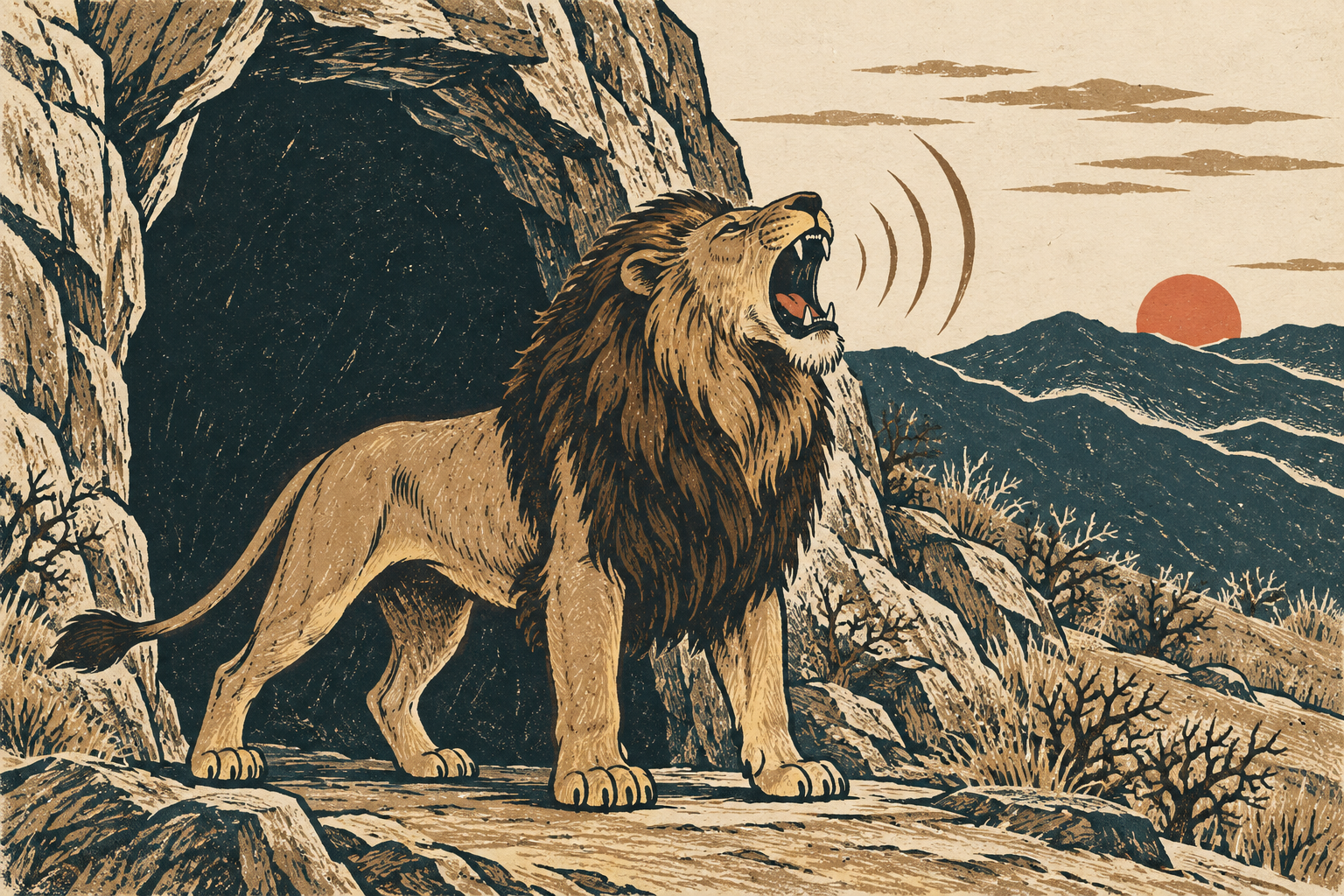
In a stretch of mountain forest there lived a lion named Kharanakhara, who had gone a long while without finding anything to eat. He had hunted since morning through dry grass and thorn scrub, and by the time the sun began to drop behind the hills, his hunger had worn him thin and made him careless and grim. As the light failed, he came upon a wide cave set into the mountainside, its mouth dark and cool, and he slipped inside it without a sound. He thought to himself that sooner or later some creature would wander in for the night, the way animals do when they’ve walked far and want only a safe corner to sleep in, and that he need only stay out of sight and wait for one to come close enough.
He crouched in the deepest shadow of the cave and made himself still.
Before long, footsteps came padding up to the entrance — Dadhipuchchha, a jackal who had lived there for longer than he could easily remember. Every evening when he returned, he called into the dark the same way, out of habit as much as anything: “Cave, ho! Cave, are you there?” And every evening, something in the cave’s own shape sent his call rolling back to him, deep and doubled, like a second voice answering.
Tonight, nothing came back.
Dadhipuchchha called again, puzzled now. Still nothing. He turned this over for a moment, then raised his voice toward the entrance. “Well,” he said, loudly enough for the dark inside to hear, “if you’ve lost your manners, I know another cave down the ridge that still remembers how to greet a friend. I’ll go there instead.”
Inside, the lion listened to this and believed he understood it completely. He decided that the cave must always answer whoever lived there, and that tonight it was staying silent purely out of fear of him. That fear, he thought, was proof enough that dinner was standing right outside. Here, at last, was his dinner, waiting to walk right up to him. So he resolved to answer the greeting himself, in the cave’s place, and let the jackal come looking for the voice that had called him — straight into his jaws.
He opened his jaws and let out the loudest roar he had in him.
But a cave is a strange, hollow thing, full of rock walls that catch a sound and throw it back bigger than it started. This one had a voice far bigger than the lion’s own. His roar rolled off the stone and doubled, then doubled again, and went rushing out across the whole mountainside at once — so huge and sudden that creatures far off down in the valley lifted their heads in fright, with no notion at all of where such a sound could have come from, or what kind of animal could make it.
Dadhipuchchha, still standing at the mouth of the cave, understood in that one instant exactly what he had nearly walked into. No ordinary cave answered a greeting like that — nothing he knew of did. He did not stop to reason it out further, and he did not wait to see what shape might come out of the dark after that roar. He turned and ran, fast and low through the grass, back the way he had come, leaving the lion alone in his cave with nothing to show for the loudest sound he’d ever made — no dinner, no visitor, only his own enormous echo still rolling away over the hills.
Nani let the tale settle a moment before she spoke again, in her own voice now, not the story’s. “The counsellor finished it with a little rhyme of his own,” she said, “and it says something like this: knowing what to be careful of is its own kind of gladness, and carelessness is what trips a fool up — for he had walked these hills his whole life, he said, and never once, before that night, had he heard a cave with a voice of its own.”
Here, under our tree, Nani shifted her weight again on the mended stool, and it held without a creak.
Leo checked the plate, found it empty, and rounded on Bupam. “That was you.”
Mira finished her row of stones and left it exactly as it stood, not sweeping it away.
Dev sat listening to the dark past the roots a moment longer. “Something’s still out there,” he said, not moving to look.
For the grown-up (not read aloud): the heart of it — a loud noise is not the same as real danger, and a real danger usually gives itself away if you’re paying attention.
Where it comes from: retold from the Panchatantra (the lion who hid in a talking cave, Book 3).
More stories for ages 6–8
The Girl Who Chose a Mouse · Told Three Times · The Owl Who Almost Wore a Crown · The Argument That Saved Him · The Lake They Wouldn’t Share · The Secret Two Snakes Told
 Banyan Story Studio