


Growing listeners · ages 6–8 · comfortable from 5 with a grown-up · Retold from the Panchatantra
Reading aloud? A note for you
This one comes to us secondhand — a traveling holy man once told it to his host, and a small mouse from a different story of ours happened to overhear and pass it along, so don’t be surprised if the frame feels a step removed; that’s faithful to the original, not an accident. Shandilee is said shan-dih-LEE and Kamandaki is said kuh-MAN-duh-kee — both take a light hand on the first go, and children pick them up fast on the second. The ending never says what Shandilee’s reason actually was, and that’s on purpose. It isn’t a loose thread to tie off for your child — it’s the whole point, and it’s worth letting them sit with the not-knowing for a minute before you talk about it.
Leo got there first for once, a fistful of marbles rattling in his pocket, and spent the whole walk trying to talk Mira into swapping her one lucky agate for his whole handful of plain ones. “That’s not a fair trade and you know it,” Mira said, and kept the agate shut tight in her fist the rest of the way to the roots. By the time Dev wandered over, saying nothing about marbles at all, the argument was already in full swing, and he simply sat down beside Nani to listen to the two of them work it out.
“Tonight’s story came to us the long way round,” Nani said, once they’d quieted. “A mouse who once lived by a certain lake used to tell it — about a night he lay very still and listened to a holy man tell his own host a story, about a trade that looked very strange from the outside. It’s about trusting that a clever person has a reason, even when nobody else can see what it is.” “Listen.” And she began.
In a certain town, once, a poor Brahman opened his door to a traveling holy man who needed shelter through the rains, and took him in gladly.
Early one morning, before either household was properly awake, the holy man woke to the sound of the Brahman and his wife talking through the wall. Tomorrow, the Brahman was saying, was the winter solstice — the best day in the year for a poor priest to go begging in the next village. While I’m gone, he said, will you set something aside, in the sun’s honor, to feed a hungry Brahman?
His wife was in no mood for it. Feed a guest, she said, on what? Since the day she’d married him she hadn’t tasted a good meal or worn one pretty thing, and she was tired of being asked to give away what they didn’t have.
Now the Brahman was not a man who could let a complaint like that pass without answering it — not with temper, but with a lecture. Even the poorest hand can spare a mouthful for someone hungrier, he told her, and it counts for more than the rich man’s mountain of gold, given at the wrong time to the wrong person. Wanting more than you need, he said, is trouble looking for a place to happen — and “trouble” put him in mind of a story he knew, about a man so busy planning for riches he hadn’t even earned yet that he lost the good luck sitting right in front of him. He told her that story too, start to finish, then finished his lecture the way people do when they want it to stick, saying the whole thing over again, word for word.
By the end of it, his wife had softened. Very well, she said — there was a little sesame in the house; she’d grind it fine and see their guest fed properly. Content, the Brahman set off for the next village at first light.
So the wife set to work. She soaked the sesame seeds, hulled them clean, and spread them in the sun to dry, then went back to her chores. While her back was turned, a stray dog wandered through the yard and fouled the whole dish.
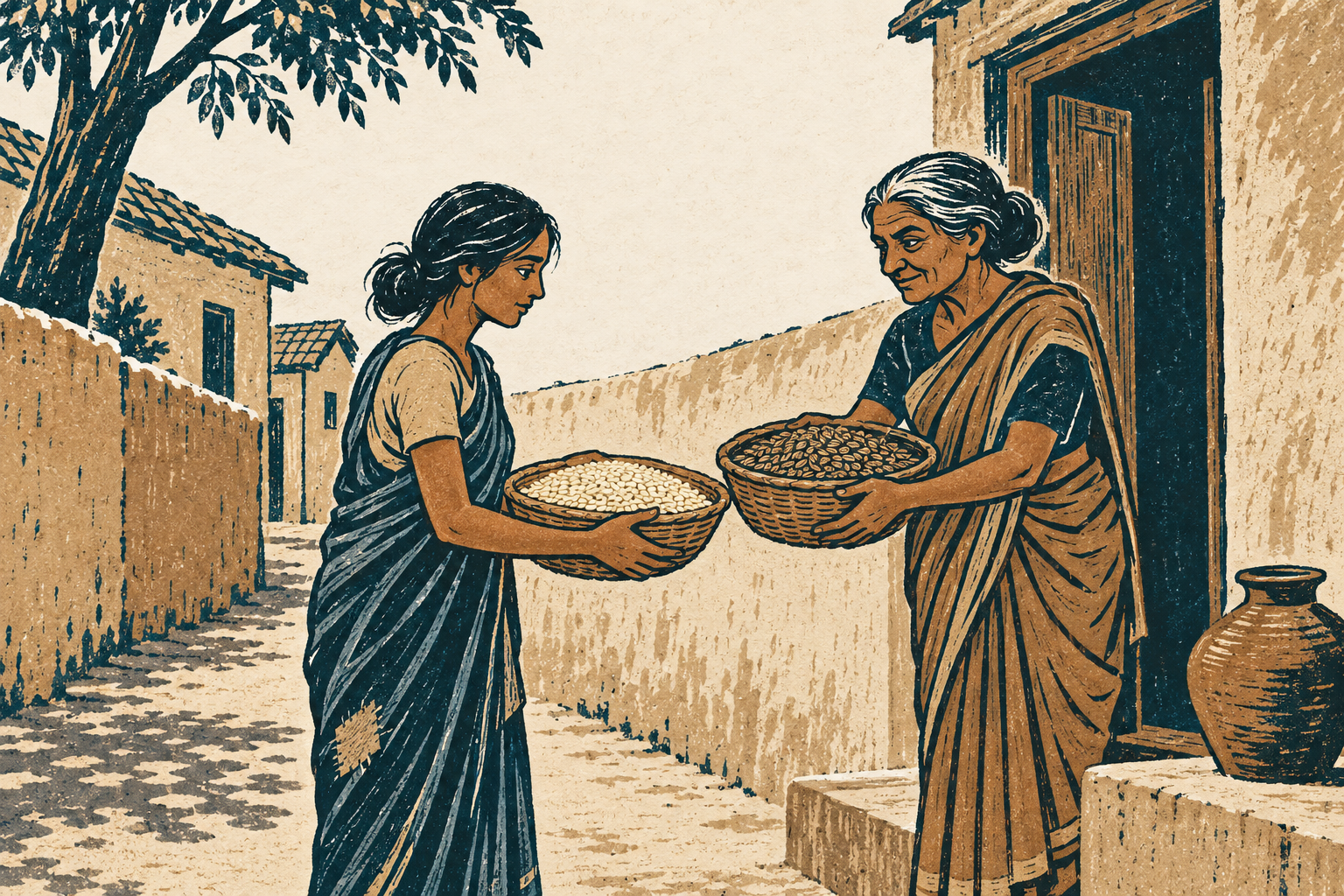
She came back to find her morning’s work ruined. There was no serving a guest tainted grain, and she couldn’t bear to simply throw good sesame in the dirt. So she filled a basket with it and carried it from doorway to doorway down the lane, calling out that she’d trade her hulled sesame, cup for cup, for anyone’s plain unhulled sesame.
At one house — the very house where the holy man himself had once stopped to beg alms and been given a kind welcome — a woman named Shandilee heard the offer and was glad of it. Hulled sesame was worth the trouble of hulling it yourself, and here it was, ready-made, for the price of her own rough grain. She made the trade on the spot, and the Brahman’s wife went home with a basket of plain sesame and no more thought for the matter.
That evening the Brahman came home from his travels and asked how the day’s giving had gone. His wife told him the whole of it — the spoiled sesame, the trade she’d struck instead. Who was it you traded with? he asked. Before she could answer, their son Kamandaki spoke up. “Mother Shandilee,” he said.
At the name, the Brahman went quiet and turned the matter over in his mind. Shandilee hadn’t gotten the better end of that bargain, he said slowly — she’d taken spoiled grain and handed over good grain for it — and everyone in the town knew her for a sharp trader who did nothing without a reason. If a woman like that took the worse side of a deal without blinking, she must have seen something in it that the rest of them couldn’t.
He never did work out what that something was. But he never once doubted that it was there — that a woman so shrewd with a bargain doesn’t make a bad one by accident, whatever it looks like from the outside looking in.
Here, under our tree, Nani let the story settle.
Dev frowned into the lamplight. “But what was the reason?” he asked.
“Nobody in the story ever finds out,” said Nani. “Not even the Brahman. He only trusted that there was one.”
Leo turned his marbles over in his pocket and didn’t offer the trade again. “Maybe there was a reason she said no, too,” he admitted, grudging. Mira only smiled, agate still in her fist, and said nothing back.
For the grown-up (not read aloud): the heart of it — a bargain that looks strange from the outside may still make very good sense; a shrewd person’s odd choice deserves curiosity before it gets an assumption.
Where it comes from: retold from the Panchatantra (the tale of the sesame bargain, told by a traveling holy man to his host, Book 2).
More stories for ages 6–8
What Four Friends Can Do · Two Heads, One Tummy · The Mouse’s Hidden Hoard · What the Weaver Chose · The Jackal’s Slow Supper · The Song That Scared a Prince
 Banyan Story Studio