


Older listeners · ages 9–12 · comfortable from 8 with a grown-up · Retold from the Panchatantra
A heads-up: this story ends mid-fight, with danger still closing in, and doesn’t say aloud how it comes out.
Reading aloud? A note for you
This one is short and sharp, so don’t rush it — let the quiet after “he could not fight off a crowd” do its work before you turn the page. Your child may ask what happened to the snake in the end; the honest answer is that the old telling says he doesn’t survive it, and we’ve chosen to stop the story just before that, at the moment the ants close in from every side, rather than say so. They may also ask why the ants attacked at all — it helps to say plainly that he wounded himself trying to force his way through a gap built for something smaller, and the smell of blood is what drew them. There’s no cruelty to soften here, only a crowd doing what a crowd does once it’s been provoked.
Leo had been snapping at everyone since dinner, overtired from an afternoon spent racing the length of the lane over and over, and by the time he dropped onto his usual root he was picking a fight with the grass itself. Mira, wisely, sat a little farther off than usual. Dev arrived last and said nothing, which was its own kind of comment on Leo’s mood.
“Before the crows and owls came to war, a crow counsellor told his king these tales,” said Nani. “Tonight’s is short, and it isn’t really about a snake underneath — it’s about what a crowd can do once it’s been stirred up and turned loose on somebody. Even somebody strong.”
“Listen.” And she began.
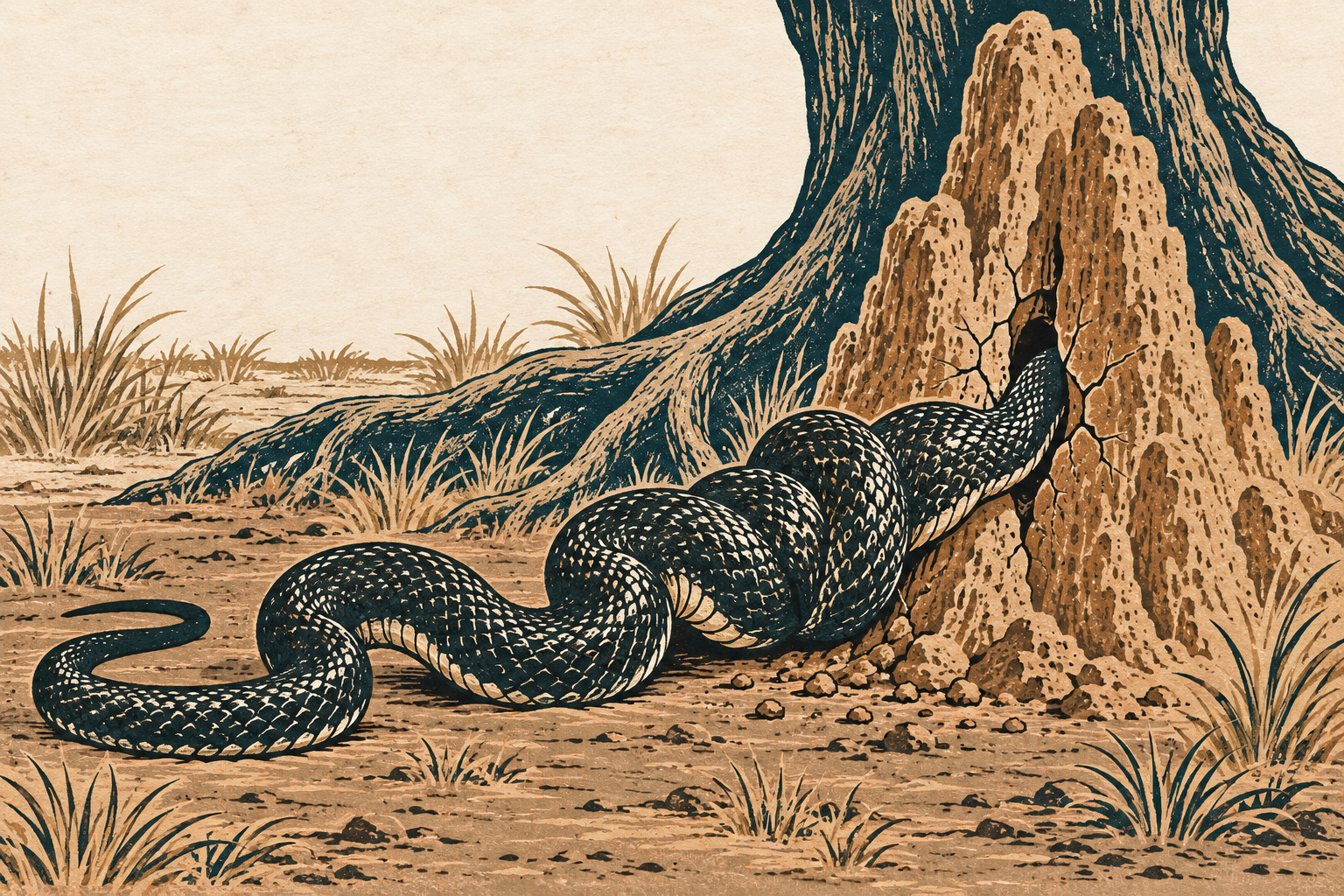
In an anthill at the roots of an old tree lived a black snake, bigger by far than anything that had ever made its home there before. The mound itself had been raised over long years by countless small builders, tunnel by tunnel and grain by grain, and it was riddled through with passages meant for creatures a fraction of his size — yet somewhere along its main gallery, wide and worn smooth by generations of traffic, there was room enough even for him. He had grown up inside that anthill, coil by coil, until its tunnels fit him the way a favourite coat fits a boy who has stopped noticing he’s outgrown it, and he had never once, in all that time, needed to think hard about getting in or out. There was that one wide, worn path through the mound that the ants themselves kept clear as a matter of course, simply by using it every day, and the snake used it too, without a second thought, the way you use a door you’ve walked through a thousand times and stopped seeing at all.
One day, though, the snake left by a narrower gap in the side of the mound instead of the wide path he always used. It was barely more than a crack, a seam in the hard-packed earth that something the size of a beetle might have slipped through without noticing it was there at all. The snake, easily ten times the width of that crack, began to force his way through anyway.
He was strong enough to try it. He was not thin enough to manage it cleanly. For a moment he was properly stuck, wedged fast with the hard-packed earth gripping him on every side, and he had to shove and strain and force himself the rest of the way through, scales dragging against the unyielding walls of the crack. The earth held fast where his body did not, and the crevice tore a long, stinging wound down his side before he came free of it at all. By the time he lay stretched out in the grass beyond the mound, he was bleeding freely.
The ants noticed first.
They came the way ants always come to the smell of blood — not all at once, but quickly, a scattering of scouts at first, drawn along the wounded scent of him, and then more behind them, and then more behind those, until what had begun as a handful become a crowd, and the crowd became a swarm, and the swarm became something with no edges the snake could find and strike at.
He struck all the same. He was fast, and strong, and furious at the sting of the first bites, and he lashed and snapped and crushed a great many of them under his coils before the fight had gone on very long at all — more ants than any one creature ought reasonably to be able to kill in a single afternoon, if you had asked anyone watching to guess beforehand. Each strike found its mark. Each strike also cost him a moment he didn’t have, a moment in which three more ants closed the gap that one had just been cleared from.
But there is a difference between beating back a crowd and beating a crowd, and the snake was learning it the hard way. Every ant he crushed left a dozen more still coming, from every direction at once, up out of the grass and down out of the broken mound and in along the very seam he’d torn open to get free. They covered his wound first, then the ground around it, then whole stretches of him he hadn’t known were undefended, until there was no single place left on his long body that wasn’t answering to some small, burning bite. He was still the strongest thing in that clearing, by far, and it no longer mattered in the slightest. A crowd angry enough does not need any one member of it to be strong — only enough of them, together, refusing to stop.
The snake fought on, because there was nothing else left to do, as the ants kept coming from every side and did not thin, no matter how many of their number he had already put down. There was no gap left to strike into that another ten didn’t fill before his coil had even finished its swing, and no part of him left unmarked that a fresh line of them wasn’t already climbing toward. What had begun as a single torn wound was fast becoming a hundred smaller ones, then more than could easily be counted, each one small on its own and none of them, together, small at all.
That was the whole of what the counsellor told his king that night: that no matter how mighty a creature is on his own, he cannot fight off a crowd once its blood is up — and the bigger and prouder he is, the harder that lesson lands when it finally comes for him.
Here, under our tree, nobody spoke right away. Leo, worn out at last, had gone quiet without anyone telling him to.
“That’s it?” he said eventually, but with less fight in it than before. “You can’t just stop there.”
“The story stops there,” Nani said. “Some stories tell you everything. This one only tells you enough.”
Mira didn’t say anything else, just watching the dark past the wall. Dev had already stretched out flat on his back, looking up through the leaves.
For the grown-up (not read aloud): the heart of it — even the strongest can be undone by a crowd, once it’s been roused and won’t stop coming.
Where it comes from: retold from the Panchatantra (the snake who fought a swarm of ants, Book 3), freely reshaped.
More stories for ages 9–12
Milk for the Anthill · The Judge Who Could Not Hear · The Monkey’s High Branch · The Frog King’s Bargain · Called Back Twice · The Friend Who Climbed the Tree
 Banyan Story Studio