


Older listeners · ages 9–12 · comfortable from 8 with a grown-up · Retold from the Panchatantra
A heads-up: this story’s judge cannot be trusted, and we stop the telling at the exact moment trust runs out — before anything happens.
Reading aloud? A note for you
This telling stops earlier than the old one did. In the source telling, the cat is not merely dishonest — he seizes them both the moment they draw near, and the old closing rhyme says so outright. Here, we stop the story at the very instant both of them step in close to him, trusting his kindness, and we let the closing line carry the cost without describing what follows. A listener at this age may ask, “but what happens to them?” — you can say only that the story stops there on purpose, because trusting the wrong judge is already the whole lesson, and not every ending needs to be spelled out. Slow down through the cat’s long, holy-sounding speech — that slowness is the trap itself, and the more sincerely you read it, the better the warning lands. There is no rescue in this one; let the quiet at the end sit rather than resolving it for them.
Leo and Mira arrived already arguing, both certain they’d won the race up from the gate. “I touched the root first,” Leo said. “You did not,” said Mira, “I was ahead by two whole steps.” Neither would give an inch, and at last they turned to Nani together. “You judge it,” Leo said. “You saw us come in.”
Nani held up both hands. “I saw nothing of the sort — I was watching Dev, who came in slowest of anybody and doesn’t seem to mind at all.” Dev, settling close by her side, shrugged and said nothing. Bupam, curled low in the roots by her feet, didn’t stir.
“Before the crows and owls came to war, a crow counsellor told his king these tales,” said Nani. “This is one of them — about judges. About what happens when you hand your quarrel to someone who’s only pretending to care how it turns out.” “Listen.” And she began.
In a tall tree at the edge of a wood lived a bird, and in a hollow at the foot of that same tree lived a partridge. Neighbors so close for so long become something more than neighbors, and the two of them spent their evenings together once the day’s foraging was done — trading stories, guessing riddles, simply sitting near each other in the particular comfort of a friend who is always there.
Then, one afternoon, the partridge left with a group of other birds to glean a ripening rice field, and did not come home that evening. Nor the next. The bird waited at the mouth of the hollow each dusk and imagined the worst — a snare, a hawk, some quick ending that had left no trace — and many days passed that way, in a grief with no news to end it.
One evening, while the hollow still stood empty, a rabbit came wandering by, found the space dry and roomy, and moved in without a second thought. Why would he think twice? As far as he knew, nobody was coming back for it.
But somebody did. The partridge returned at last, plump and glossy from a season of easy rice, having simply grown too fond of good foraging to hurry home. When he found a rabbit curled where his own nest had been, his surprise turned quickly to indignation. “This hollow is mine,” he said. “You’ll have to find another.”
“Is it,” said the rabbit, unbothered. “A place belongs to whoever is living in it — that’s the whole of the law, as I understand it. You left. I stayed. Ask anyone you like.”
Neither would give way, and both of them, in fact, believed they were right — the partridge because he remembered the nest as his own, the rabbit because he had never once been taught to doubt a rule so convenient. So they agreed, the way reasonable disputants do, to let someone else settle it, and off they went together to find a judge, the bird trailing behind out of pure curiosity, wanting to see how it would all end.
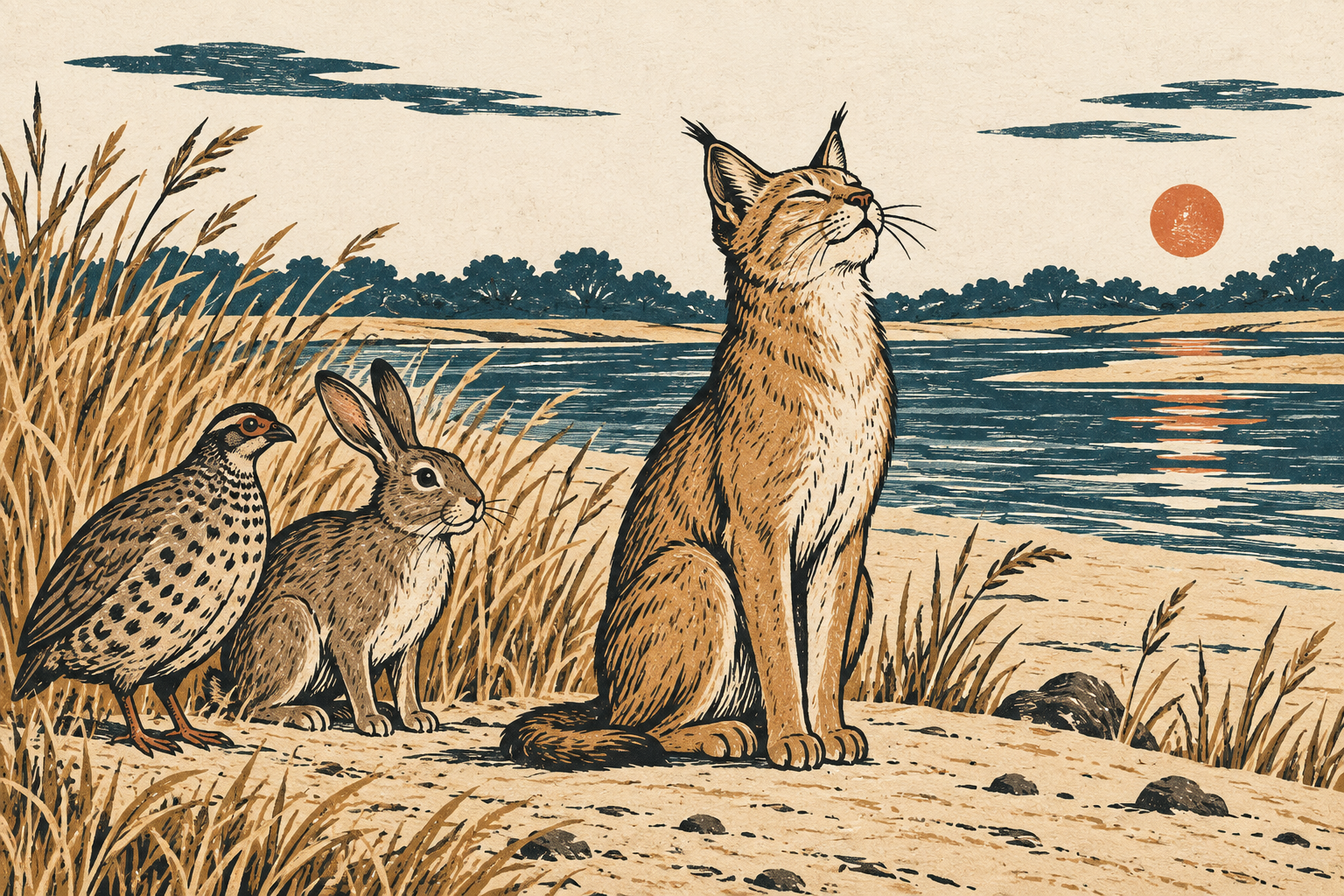
The partridge knew of one: a cat who lived alone on a sandbank down by the river, said to have given up hunting years before, said to spend his days now fasting and at prayer, admired the length of the riverbank for a holiness that asked nothing of anyone. “He’ll hear us out fairly,” said the partridge. “A holy creature has no stake in who wins.”
The rabbit balked the moment he caught sight of the cat. “Not him,” he said. “A pious face proves nothing. I’ve heard of holy sorts who keep right on being hungry underneath the prayers.” But the partridge had already made up his mind, and in the end the rabbit agreed only to state the case from a safe distance, rather than turn back altogether.
The cat, for his part, had built his whole quiet life on exactly this kind of moment — a reputation costs nothing to wear and pays for itself the day someone believes it. He sat back on his haunches, tilted his face upward as if lost in contemplation, and when the two of them called out their dispute from where they stood, he answered with a long, unhurried speech about mercy — how even the smallest creature deserved gentleness, how a judge who ruled unjustly, out of pride or fear or hunger, earned himself a reckoning far worse than the quarrel he had been asked to settle. He spoke of sacred duty and the wrongness of cruelty with such evident feeling that by the end of it, neither of them doubted his sincerity.
“I would never harm either of you,” the cat finished. “You have my word on that, sworn before every power I hold sacred. But I am old now, and my hearing has gone thin with age — I catch only half of what is said to me from this distance. Come nearer, both of you, and lay the whole matter out close to my ear, and I promise you an honest judgment.”
The partridge looked at the rabbit. The rabbit looked at the partridge. Whatever doubts either of them had carried down to the riverbank, that long speech on mercy had worn them smooth, the way running water wears a stone, until trusting him felt like the only reasonable thing left to do.
So, step by careful step, weighing every word of that gentle speech and finding no fault anywhere in it, the partridge and the rabbit went nearer to the cat, closing the little distance that alone still stood between themselves and him — nearer, and nearer, until at last they had come close enough that neither one of them stood beyond his reach.
That is as far as this story goes, and it goes no further on purpose. The crow counsellor who told it wanted his king to carry away one thing only: trust badly placed is trust betrayed.
Here, under our tree, Leo and Mira’s race was still unsettled, and neither of them brought it up again.
Dev didn’t say anything for a while. Then he shifted a little closer to Nani’s side.
Mira looked off toward the dark path down to the river and didn’t look away for a long moment.
Leo picked at a bit of bark, frowning at nothing in particular. “I don’t like that we don’t know what happened,” he said at last.
“No,” Nani agreed. “Neither do I.”
For the grown-up (not read aloud): the heart of it — a kind voice is not the same thing as a fair judge, especially when winning your trust is the whole of that judge’s plan.
Where it comes from: retold from the Panchatantra (the cat who judged the rabbit and the partridge, Book 3), freely reshaped.
More stories for ages 9–12
The Narrow Way Out · Milk for the Anthill · The Monkey’s High Branch · The Frog King’s Bargain · Called Back Twice · The Friend Who Climbed the Tree
 Banyan Story Studio