


Older listeners · ages 9–12 · comfortable from 8 with a grown-up · Retold from the Panchatantra
A heads-up: one character makes a real, frightening plan to hurt a trusting friend — it is never carried out — and the story ends in a fight, told plainly rather than shown blow by blow.
Reading aloud? A note for you
This is the long one — the frame story that carries Book Four of the Panchatantra, told here whole, in one sitting. Slow down at the middle of the water, when the plan is said out loud; a listener this age will want a beat of quiet there before the monkey starts thinking his way out. Along the way, the two of them kept trading tale after tale back and forth across the water — we have kept only the shape of that habit, a line here and there, since the frame itself is the story we are telling tonight and eight more tales inside it would swamp it. In the old telling, the crocodile’s wife’s fate is spelled out; here the story simply moves on to the empty house, since what matters for this tale is what the crocodile does next, not what became of her. Your listener may ask why the crocodile still trusted the wife who asked such a thing of him — that is worth sitting with, not rushing past.
Somewhere past the garden wall, an oar dipped and pulled, dipped and pulled — their neighbor rowing the little tank boat out and back, out and back, the same short crossing over and over in the dusk. Mira cocked her head at the sound. “He goes to the same spot every time,” she said, “and comes straight back.”
“Some people do,” said Nani, settling herself among the roots. Leo flopped down beside her, already restless for the story to start. Dev stood a moment at the wall’s edge, listening for the oar, before finally settling close and quiet.
“Tonight’s story is a big one,” Nani said. “A whole book’s worth — not a tale inside a tale, but the frame that holds a great many of them. It comes from the part of the old book called Loss of Gains, and Vishnusharman himself told it to two young princes long ago, to teach them something about trust. It’s about a friendship that should have lasted, and about how far someone will go once they’ve let themselves be talked into something they know is wrong. Listen.”
And she began.
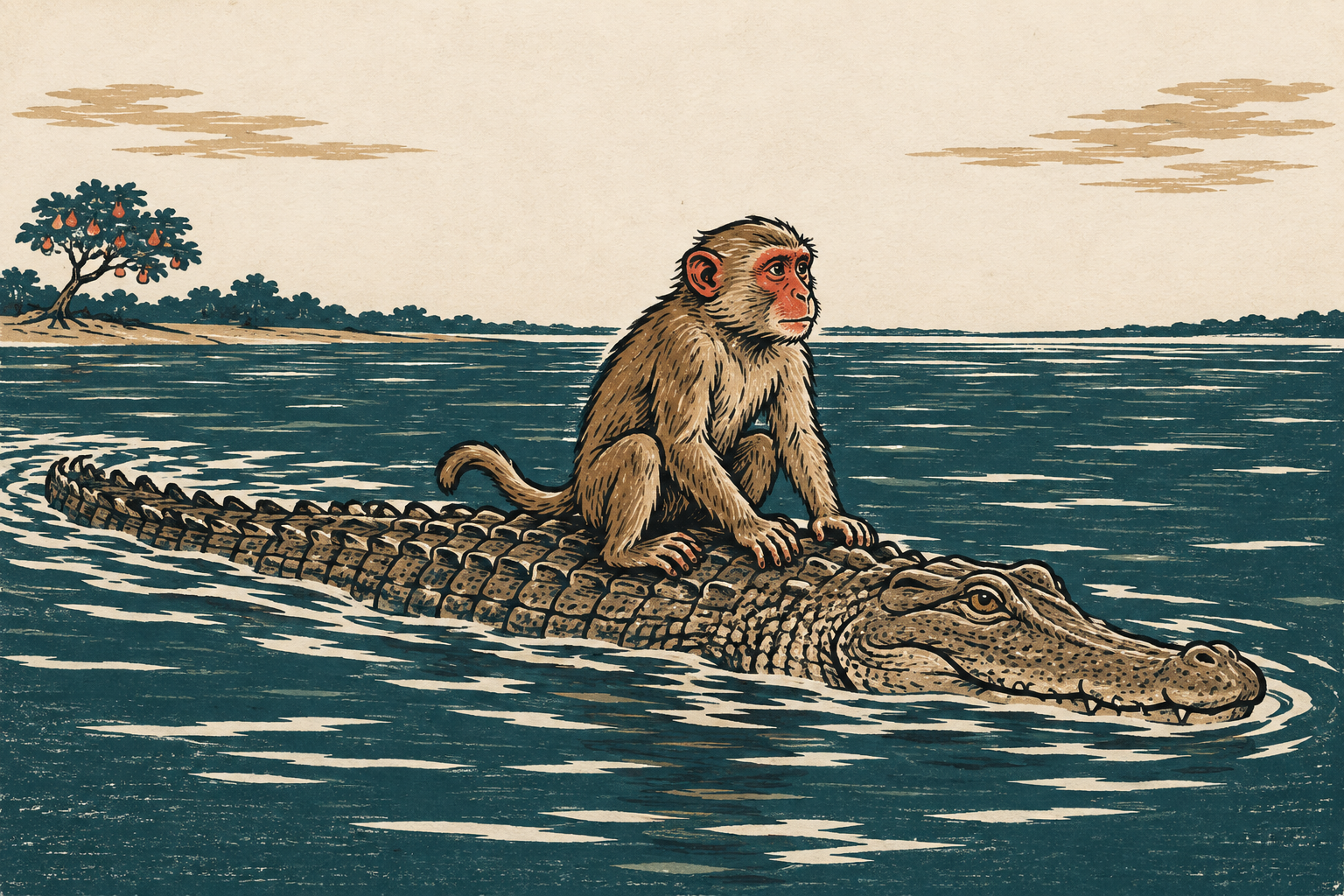
Where the tide reached almost to its roots stood a rose-apple tree that bore fruit the whole year round, and a monkey named Raktamukha made his home high in its branches. One day a crocodile called Karalamukha climbed up out of the waves and dug himself a cool hollow in the sand beneath the tree to rest. The monkey, seeing a stranger below, called down a welcome and threw him rose-apples, sweet as anything the crocodile had ever tasted. They talked the whole afternoon away, and by evening they were friends — the monkey in the branches, the crocodile in the sand — and it became their habit to meet there every day and talk until the light went.
Every night the crocodile carried a few rose-apples home to his wife, and one evening she asked him where such fruit came from. “From a monkey I’ve grown fond of,” he told her. “He gives me more than I can eat.” And his wife, tasting the sweetness of them, got an idea into her head and would not let it go: if fruit like this could make a monkey so sweet-hearted, she reasoned, then his heart itself must be sweeter still — and she wanted it for herself.
The crocodile refused her outright, the first time and the second. The monkey was his true friend, he said, almost a brother; he would not harm him for anything. But his wife would not be put off. She turned cold toward him, then accused him of loving someone else — how else could he refuse her so small a thing? — and needled at him night after night until he could no longer eat or sleep for the arguing. He was, in the end, a devoted husband and not a brave one, and between her jealousy and her demanding, his resolve wore through like cloth.
So, sick with what he meant to do, he went to visit his friend, and could barely raise his eyes to him. “You’ve been unwell,” said the monkey, worried, seeing him so grey and silent. “Tell me what’s wrong.” The crocodile, ashamed, put together a story instead of the truth — that his wife had scolded him for never once repaying his friend’s kindness, that she had set out a welcome at their home and was waiting to receive him properly. “Come and meet her,” he said. “Ride on my back, and I’ll bring you there and back before dark.”
The monkey, touched and flattered, agreed at once, and climbed onto the crocodile’s back as he slid into the water and struck out from shore.
They had not gone far before the sea grew deep and dark beneath them, and the monkey, gripping tight, felt something change in the way his friend swam — hesitant, then grimly steady, like someone carrying out a decision rather than doing a kindness. And in the middle of that deep water, Karalamukha stopped pretending. He told him the truth: that his wife had set her heart on eating the monkey’s heart, believing it would keep her forever young, and that he, torn between his wife and his friend, had chosen his wife. He was sorry for it, he said — and he meant it — but there it was.
The monkey felt the whole world tip beneath him, out there with no shore in reach and a friend turned enemy beneath his very feet. But he did not let his fear show in his voice. “If only you’d told me back on land,” he said, thinking fast, “I’d have brought it with me. We monkeys, you know, keep our hearts separate from our bodies for safekeeping — mine sits safe in a hollow of that same rose-apple tree, this very moment. Turn back, and I’ll fetch it for your wife myself.”
It was nonsense, of course — no creature keeps its heart in a tree — but the crocodile, wanting badly to believe there was a way through this without losing either his wife or his friend, turned and swam for shore.
The instant his feet touched dry sand beneath that rose-apple tree, Raktamukha was up its trunk faster than the crocodile could speak, and did not come down again. “Now give me the heart,” called Karalamukha from the sand, still hoping. The monkey looked down at him from a high branch and laughed, though there was no real gladness in it. “No creature carries two hearts,” he said. “You have shown me exactly what you are. Go home, and don’t come back under this tree.”
The crocodile tried everything after that to win him down again — apology, flattery, the excuse that it had all been a joke to test his friend’s nerve — and the monkey refused every time, telling him, in place of a plain no, one short story after another about foolish trust and its cost, each one ending the same way: he would not be caught the same way twice. The crocodile, for his part, pressed and pleaded and told a story or two of his own back, unwilling to let the friendship go even now, but the monkey stayed where he was and would not be moved.
Time passed this way, the two of them trading tales across the water without either quite giving up the argument, until one day another creature of the sea came by with news: Karalamukha’s house, on his own side of the water, had been seized while he was away — taken over by a bigger, bolder crocodile who now held it as if it were his own.
Stripped now of home as well as friend, the crocodile did not know which way to turn, and at last swam back to that same shoreline tree to ask the only creature he still trusted for advice, ashamed as he was to ask it. “I know I have no right,” he said. “But you were always the wiser of us. Tell me what to do.”
The monkey was silent a long moment, weighing whether to answer at all. But he was not, in the end, the kind of creature who would leave even an unworthy friend without help when it was asked for honestly. “Go home,” he said at last, “and fight for what is yours. A stranger sitting in your house today will have roots sunk too deep to move tomorrow. This is not a moment for soft words or bribes — this is a moment to stand and fight.”
So Karalamukha thanked him, said his goodbyes, and swam home resolved to win back what was his, whatever it cost him. And there, at his own doorway, he fought the intruder who had taken his house — a hard fight, and a real one — and won it, and lived there afterward in peace for a long time.
And that is the story as the old book tells it, of blind folly always paying its price when something precious is given away for flattery’s sake — and of how a good, plain, contented life is worth more than reaching for someone else’s fine house through tricks and guile. Fate provides enough, the old verse says, the way the forest provides enough for the deer that lives in it. It is a lesson the crocodile learned the hard way, and the monkey, watching safe from his branch, never had to learn at all.
Here, under our tree, the oar sound had stopped; whoever it was had tied up for the night.
“He never came down again,” said Dev softly. “Even after. Even when the crocodile fought and won and everything was all right.”
“No,” Nani agreed. “Some doors, once you’ve seen what’s on the other side of them, don’t open the same way twice.” She reached over and closed the lid of her basket, the small sound final in the quiet.
Mira looked toward the dark water and said nothing at all.
For the grown-up (not read aloud): the heart of it — a good, contented life is worth more than what you might gain by giving away something precious through flattery and guile, and trust, once truly broken, is not easily rebuilt.
Where it comes from: retold from the Panchatantra (the monkey’s friendship with the crocodile, Book 4), freely reshaped.
More stories for ages 9–12
The Frog King’s Bargain · Called Back Twice · The Judge Who Could Not Hear · The Narrow Way Out · Milk for the Anthill · The Friend Who Climbed the Tree
 Banyan Story Studio