


Older listeners · ages 9–12 · comfortable from 8 with a grown-up · Retold from the Panchatantra
A heads-up: there’s a sudden death in this one, caused by a fast, frightened decision — it happens quickly, and the whole story turns on it.
Reading aloud? A note for you
This is one of the studio’s more clear-eyed leaves — a real death happens quickly and is not softened away, because the whole lesson depends on it landing. Slow right down at “before she looked, before she thought, she struck,” and let a full breath pass before you go on; that line is doing the story’s real work, and a listener may want to sit with it rather than move past it. Older children often ask why the mother didn’t look first, or whether the mongoose could somehow have shown her what had happened — there’s no tidy answer beyond what the story already gives: fear moves faster than thought, and that is exactly the point being made. Devasharman is said dev-uh-SHAR-mun. This is a straightforward retelling, not a reshaped one — nothing has been changed about who did what, only how plainly the hardest moment is shown.
The power went out for a few seconds just as they were settling in — the porch light guttering, dying, flickering back on — and Leo yelped and grabbed for the nearest arm, which happened to be Mira’s. She shook him off, unbothered. Dev didn’t move at all, just watched the light steady itself.
“Just the old wiring,” Nani said, once it was clear the light meant to stay. “Nothing to worry about.” She looked round at the three of them, settling.
“Tonight’s story is an old one,” she said, “and I want to tell you before we begin: it isn’t gentle all the way through. I could soften it, and it would still be the same story wearing a nicer coat. I’d rather you heard it as it actually happened.”
Mira’s eyes sharpened with interest, the way they always did at a warning. “What happens?” she asked.
“You’ll hear,” said Nani. “This is a story the judges told a merchant, called to witness a trial, to explain the sentence about to be given. It’s about a choice made too fast to really be a choice — reaching for more than was asked, thinking it costs nothing, when it costs everything.”
Dev looked up at her. “Reach for more, how?”
“Watch, and you’ll see,” Nani said. “Listen.”
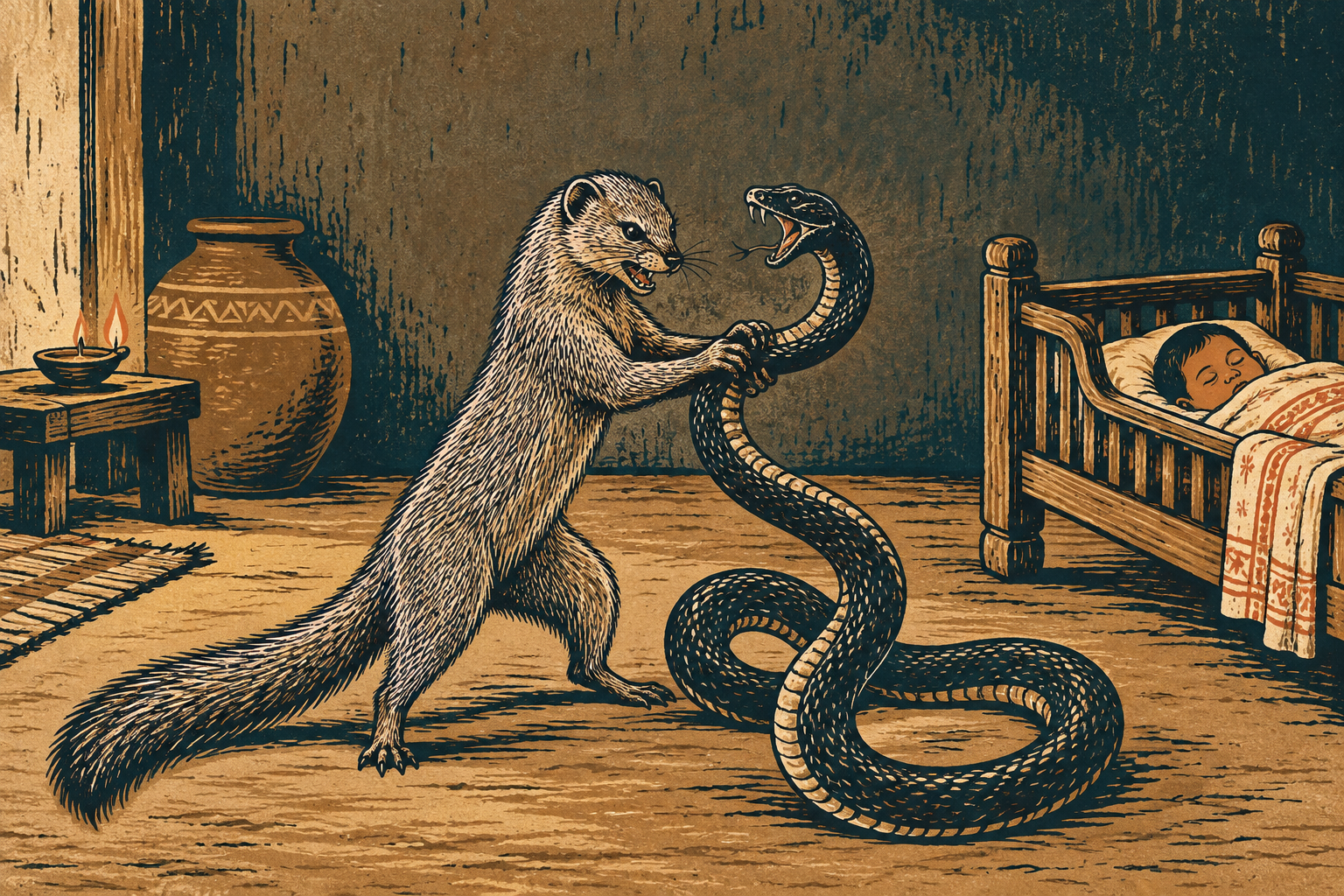
In a certain town there lived a Brahman named Devasharman, and his wife, and their infant son. Into that same house had come a mongoose — not sought out, but taken in, because the wife could not turn away a small creature that needed feeding. She raised it at her own breast alongside her son, fed it and washed it and carried it about on her hip the way she carried the baby, and cared for it in every practical way as though it were a second child. And yet she never once trusted it fully, not underneath. A mongoose is a quick, sharp-toothed thing, she told herself, even while she was bathing it and salving its small scrapes — and a mother’s fear does not always listen to a mother’s affection, even when the two of them live in the same house, in the same day, in the same pair of hands. So she kept half an eye on it always, the way a person keeps half an eye on a stove left burning in another room: not because anything has gone wrong yet, but because something might.
One morning she had water to fetch and a house to leave behind her. She settled the baby into his cradle, checked that he was sleeping soundly, and turned to her husband where he sat. “Watch him,” she said, “and watch the mongoose too, until I am back. I won’t be long.” Then she took her jar and went, and the door stood open behind her for a moment before it swung shut.
A house, though, is a hard thing to sit still in, and Devasharman had his own excuse ready before the door had even settled — some errand, some small hunger, something that felt urgent enough in the moment, though it plainly was not urgent at all, only convenient. He told himself it would take only a little time, and he told himself the mongoose could be trusted with that little time, and both of those things were the kind of thing a person tells himself precisely when he already suspects they are not quite true. So he went out, into the ordinary business of the town, and did not hurry back. The house stood empty but for a sleeping child and a mongoose curled near the cradle, keeping the watch that had actually been asked of a person, not an animal.
It did not stay empty. A black snake, drawn by whatever draws a snake toward warmth and stillness, slid in through some gap low in the wall and made straight for the cradle, moving the unhurried, certain way snakes move when nothing is stopping them. The mongoose caught the movement first — the weight of it, the wrongness of it, some instinct older than any lesson it had been taught — and did not wait to think about whether this was its fight to take. It threw itself at the snake, fought the length of the room with it, taking hold and losing hold and taking hold again, and did not stop until the snake was in pieces and no longer a danger to anyone. The baby, astonishingly, slept through most of it. Then, marked with the snake’s blood, breathing hard, and thrilled in the simple, uncomplicated way an animal is thrilled after doing something brave, the young guardian bounded out of the house to find the one person who would understand what it had done: the mother, now coming up the path with her water jar balanced on her hip.
She saw it while it was still some way off — small, fast, its mouth dark and wet, running straight toward her with an urgency she had no way to read correctly. She did not see any snake, because there was no snake to see; it was back in the house, in pieces, where the danger had already ended. She did not stop to ask what had happened, and there was no one there to ask. In the space of one breath, with her son alone somewhere behind her and this creature she had never fully trusted racing toward her with blood already on it, she decided the worst thing a mother can decide, and before she looked, before she thought, she struck — brought the heavy jar down where the mongoose ran — and it was over before she understood what she had done.
She left it where it fell and hurried inside, the water jar forgotten in the doorway, calling her son’s name before she had even crossed the threshold. And there he was: awake now, unharmed, blinking up at her from his cradle, with a torn black snake lying dead on the floor a hand’s width from where he lay. Only then, standing in that room with the evidence laid out plainly in front of her, did she understand what the mongoose had actually done for her son, and what she had done to answer it.
Her grief broke out first as noise — she struck her own hands together and would not be comforted, would not stop saying, over and over, that she had killed the one who had saved her son. Devasharman came home in the middle of it, a bowl of gathered food still in his hands, and found his wife undone on the floor of their own house, mourning a mongoose he did not yet understand she had killed with her own hand.
She did not soften it for him, and she did not wait for him to ask what had happened. She turned on him where he stood in the doorway, food still in hand, and told him plainly, in her grief and in her anger both at once, that this was his doing — that he had left his post for the sake of an easy errand that was never actually his to run, and that the cost of that small reach past his duty had come home to their own cradle, in the shape of a death that need never have happened at all. It was not the snake she named as the cause of what she had done, and it was not, in the end, even her own quick hand. It was a husband who had wandered from the one small task he had been asked to hold, on the one morning it happened to matter.
That is the shape the judges wanted their listener to carry out of the room that day, and it is worth carrying out of this one too: indulge no excessive reaching past what is actually yours to do — a little, held carefully, is enough for the moment it is needed.
Here, under our tree, nobody spoke for a moment. Leo picked at a loose thread on his sleeve and didn’t look up. Mira’s chin, always tipped forward and ready with a question, stayed down.
It was Dev who broke the quiet. “The mongoose didn’t do anything wrong,” he said, very low, as if it still needed defending.
“No,” Nani agreed. “It didn’t.”
The porch light held steady now, warm and unflickering, and for a while nobody wanted to talk about anything else.
For the grown-up (not read aloud): the heart of it — a decision made in fear, before looking, cannot be undone, and its real cause traces back to a small reach past what one was actually asked to do.
Where it comes from: retold from the Panchatantra (the mongoose who guarded the cradle, Book 5).
More stories for ages 9–12
The Friend Who Climbed the Tree · The Monkey’s High Branch · The Frog King’s Bargain · Called Back Twice · The Judge Who Could Not Hear · The Narrow Way Out
 Banyan Story Studio